Poland reaffirms support for Ukraine after drone strikes
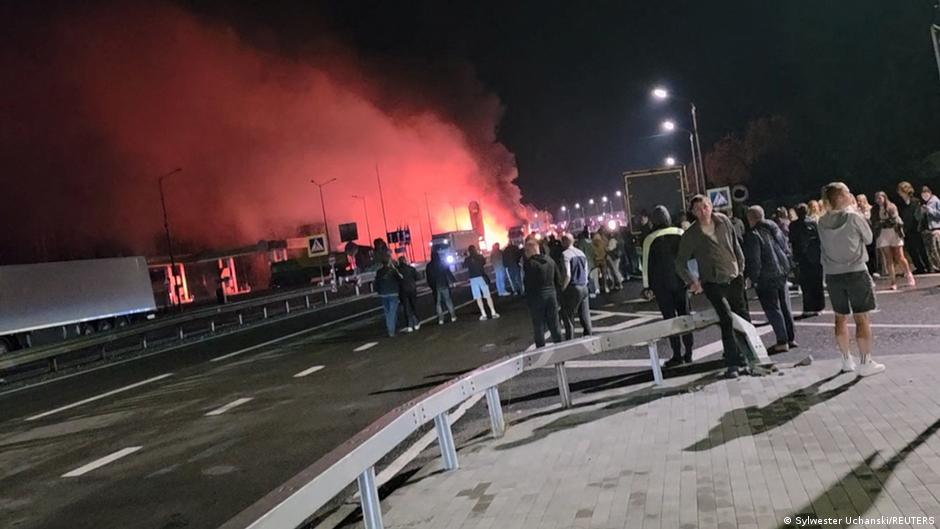
A petrol station approximately 800 meters (874 yards) from the Polish-Ukrainian border was hit by a drone early on Sunday morningImage: Sylwester Uchanski/REUTERSAdvertisementRussia's war against Ukraine is moving ever closer to the border with Poland.
After a drone attack by Russia destroyed a gas station and the locomotive of a passenger train near the Dorohusk-Yahodyn border crossing between Poland and Ukraine early Sunday, Warsaw has demonstrated its determination in the face of the immediate threat.
"Border crossings in Poland — as has previously been the case in Moldova and Romania — are being targeted in an attempt to discourage people and deter countries from supporting Ukraine," Deputy Prime Minister and Defense Minister Wladyslaw Kosiniak-Kamysz told the private broadcaster TVN on Monday.
"Support for Ukraine is part of Poland's reason of state," Kosiniak-Kamysz said. He added that Poland's own security situation would be worsened should Ukraine lose the war.
Early on Monday, Prime Minister Donald Tusk met with the ministers responsible for Poland's security. Senior military commanders also attended the meeting. "We discussed further measures to strengthen the security of our borders," Tusk subsequently wrote on the social media platform X.
Polish Foreign Minister Radoslaw Sikorski provided more details.
"Poland will provide a nonprovocative but serious response to Russia's escalation, such as the attack on the train in Ukraine near the Polish border, one that will strengthen security," Poland's top diplomat told TVN Monday evening.
On Sunday, Tusk spoke of an "escalation of activities" by Russia. The prime minister also announced that he would discuss the incident with Poland's allies in Europe.
"There is no doubt that we, if necessary, must be prepared, together with them, to deliver a coordinated response," Tusk said after a special session of the Government Centre for Security.
Russian drones attacked a passenger train on the Kyiv-Warsaw line just short of the Polish border on Sunday morning. The train's locomotive was destroyed in the attack. All passengers and crew were evacuated in time.
Two special trains carrying high-profile participants returning from a security conference in Kyiv were nearby at almost the same time as the attack.
Among those on board were former Swedish Prime Minister Carl Bildt, former British Prime Minister Boris Johnson, former Finnish Prime Minister Sanna Marin, former Polish President Aleksander Kwasniewski and Günter Sautter, foreign and security policy adviser to German Chancellor Friedrich Merz.
Polish political scientist Katarzyna Piskorska, who has organized the Warsaw Security Forum in the Polish capital for years, was also on the train.
"Our train was stopped beforehand, and the passengers were evacuated," she told TVN. "The situation was very tense, but everyone remained calm. We were given an evacuation plan and knew exactly what to do."
"The Russians wanted to intimidate us, but they achieved the opposite: The participants affected by this incident are determined to step up their support for the country that was attacked," she said.
Piskorska said the mood in Ukraine was "worse than at any time since the start of the war." She pointed to a new generation of drones equipped with jet engines that can reach their targets much faster.
Despite numerous acts of sabotage assumed to have be carried out by Russian agents and incidents involving Russian missiles and drones, Poland's government has remained firm in its commitment to supporting Ukraine.
Foreign Minister Sikorski has even called for support for Ukraine to be doubled, arguing that doing so is in Poland's own security interest.
But the government in Warsaw also has to consider the shift in Polish public opinion.
In a survey conducted in mid-July, 52% of respondents said they were in favor of continued military aid for Kyiv; 45% opposed it. These figures stood at 77.5% and 18.3%, respectively, after Russia's invasion of Ukraine in 2022.
"Russia has won the propaganda war in Poland," Piskorska said. "It is absurd that we are taking the side of the aggressor and claiming that this is not our war," she said, appealing to fellow Poles to "finally wake up."
Defense Minister Kosiniak-Kamysz has also expressed concern about what he described as a "radical shift in sentiment."
"In the past, there was consensus on this issue. Today, we are seeing great skepticism toward Ukraine," Kosiniak-Kamysz said. "There are forces in Poland that are spreading Russian propaganda," he added.
The Polish media, too, are sounding the alarm.
"Putin is sending out a signal that he is prepared to kill our citizens," Bartosz Wielinski wrote in the Tuesday edition of the Polish daily Gazeta Wyborcza. The Kremlin, he wrote, had sent a message that Poland is "the next country in line."
"These are no longer arson attacks or cyberattacks. These are acts on the threshold of war," he wrote.
Polish daily Rzeczpospolita said that "Putin is knocking on NATO's door."
"The attack on the Warsaw–Kyiv railway line was not just another Russian provocation. It was an attempt to intimidate Poland and the West. The response from Poland's politicians will show whether they are capable of assuming responsibility for the country's security," wrote editor-in-chief Michal Szuldrzynski.
Incidents involving Russian drones are now almost a daily occurrence in Poland. On Monday, a drone washed up on a beach near Jaroslawiec on the Baltic coast. A preliminary investigation indicates that the aircraft was unarmed and appeared to be intended for reconnaissance rather than combat.
"We do not know where Russia believes the limits of the escalation spiral lie," Kosiniak-Kamysz said. "But we do know that the Russians are prepared to go even further."
This article was originally published in German.