PM, president agree to solve all issues through dialogue after Bilawal's remarks whip up storm - The Express Tribune
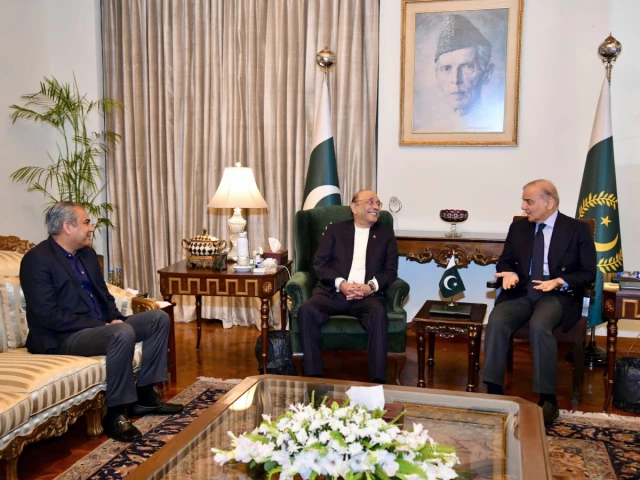
Prime Minister Shehbaz Sharif and President Asif Ali Zardari on Thursday agreed to resolve all outstanding issues through dialogue after the storm created by the critical remarks of Pakistan Peoples Party (PPP) Chairman Bilawal Bhutto-Zardari that led to intense criticism from federal government representatives.
The president’s media wing said the duo met at Aiwan-e-Sadr in Islamabad today to discuss the country's political situation and regional developments, with a particular focus on the Middle East.
“During the meeting, it was agreed that all matters would be resolved through dialogue and mutual consultation,” the statement highlighted.
The leaders also discussed the previous constitutional amendments, noting that all coalition parties had introduced these through mutual consultation.
وزیراعظم شہباز شریف اور صدر مملکت آصف علی زرداری کی ملاقات۔ ملاقات میں موجودہ صورتحال پر گفتگو ہوئی ملاقات کے دوران مشرقِ وسطیٰ کی صورتحال پر بھی بات چیت ہوئی۔ ملاقات میں موجودہ سیاسی صورتحال کا بھی تفصیلی جائزہ لیا گیا تمام معاملات کا حل بات چیت کے ذریعے نکالا جائے گا۔… pic.twitter.com/n9p0UCaFGS
Interior Minister Mohsin Naqvi also participated in the meeting; he has remained at the centre of Bilawal's tirade against the government. The minister is an avid supporter of new administrative units in the country and asserts that the system has collapsed.
Minister of State for Interior Talal Chaudhry welcomed the meeting between President Asif Ali Zardari and Prime Minister Shehbaz Sharif, describing it as the right way to resolve political differences through dialogue and consultations.
Speaking on a private television programme, Aaj Shahzeb Khanzada Kay Sath, Chaudhry said mature political parties addressed disagreements through negotiations, adding that political and democratic matters should be settled through consensus.
"Better late than never. This is a mature and democratic approach. Negotiations and dialogue are the right way to move things forward," he said.
He described Bilawal as a young and emotional leader, contrasting him with his father, President Zardari, who, he said, had always favoured resolving issues through dialogue.
Asked about the government's response to Bilawal's recent remarks, Chaudhry said the government was also answerable to its supporters and had to respond, but had refrained from making remarks as emotional as those made by the PPP chairman.
Responding to a question about Bilawal's criticism of government representatives, Chaudhry said the PPP chairman had often spoken about dialogue, tolerance and the right to express opinions. He questioned why Bilawal could not exercise restraint when the interior minister, defence minister, planning minister and representatives of other parties expressed their views.
"The first principle is that if you ask others to show tolerance, you must first demonstrate it yourself by being willing to listen to other people's opinions," he said.
Chaudhry rejected suggestions of any conspiracy or non-political manoeuvring behind the debate, saying political and democratic matters would be resolved through democratic means.
He said no political party, particularly a major party such as the PPP, could be excluded from the process, adding that major decisions should neither be taken nor would be taken without consensus.
The minister said the discussion concerned the creation of administrative units aimed at improving governance, administrative performance and the living standards of ordinary people.
He ruled out any legislation on the matter without taking coalition partners into confidence, particularly the PPP. All legislation had been passed after thorough consultations with allied parties, he said, adding that the government would continue the practice.
Chaudhry also argued that discussions on improving governance should extend across the country rather than focus on a single province.
"It cannot be that one province has the best administration and governance in the country, yet it is proposed to divide it into two, three or four parts, while no such discussion takes place in areas where governance is not as good," he said.
He said the issue should be debated and a way forward found through democratic means.
The debate on carving new provinces for broader governance reforms gained momentum on July 31, when Naqvi called for additional administrative units or provinces to overhaul what he described as the country's outdated governance system. Addressing the Pakistan Economic Summit 2026 in Islamabad, he argued that the existing governance model had effectively “collapsed” after decades of failing to deliver.
His remarks drew a mixed response, with several political leaders also calling for a debate on the issue in parliament instead of public fora.
The proposal drew the interest of the Muttahida Qaumi Movement-Pakistan (MQM-P), which has repeatedly advocated carving out new provinces from Sindh. Even before Naqvi's July 31 remarks, Mustafa Kamal had floated the idea of dividing Sindh.
On September 4, the Sindh Assembly passed a resolution rejecting attempts to divide the province or create new administrative units. Chief Minister Syed Murad Ali Shah declared that there will be no compromise on Sindh's geographical unity.
More recently, Bilawal’s speech at the Karachi Press Club stirred up a storm after he said a bloodbath was imminent if Sindh was administratively divided. He also hinted that the government was mulling a 28th amendment for the purpose, while asserting that the 27th amendment was coerced onto the PPP lawmakers.
The PPP scion said he acknowledged a system collapse and was up for a reset ‘only’ through political interventions.
"They were fully involved in the 26th Amendment. For the 27th Amendment, they ensured that every single vote was accounted for, and now they are calling it brute force,” Sanaullah said.
Meanwhile, Defence Minister Khawaja Asif also hit back at Bilawal, questioning his moral standing to lecture others while pointing to the PPP's 18-year rule in Sindh.
In response, Bilawal reasserted his views, giving out multiple statements in various televised interviews. He asked the government officials to "calm down" and hear out his opinions as one of the largest political stakeholders in the country. He once again turned down a referendum, saying it was never "historically" used for democratic reasons. The PPP stalwart also snubbed calls for the division of Sindh.
Today, the MQM-P once again joined the chorus of new provinces, stating that their resolve to make new provinces was final.
The president and the prime minister have held a series of meetings on the issues that are in the limelight in the political space.
On November 14, President Zardari met Prime Minister Shehbaz at his Model Town residence after Interior Minister Naqvi proposed a referendum on the issue. According to a statement issued by the PM's office, the two leaders had agreed on cooperation between coalition partners, continuity of consultations and progress on public welfare initiatives.
Comments are moderated and generally will be posted if they are on-topic and not abusive.
This material may not be published, broadcast, rewritten, redistributed or derived from. Unless otherwise stated, all content is copyrighted © 2026 The Express Tribune.