PM Mark Carney pledged to ‘Buy Canadian.’ Since then, $7.8 billion in contracts went to American corporations - Toronto Star
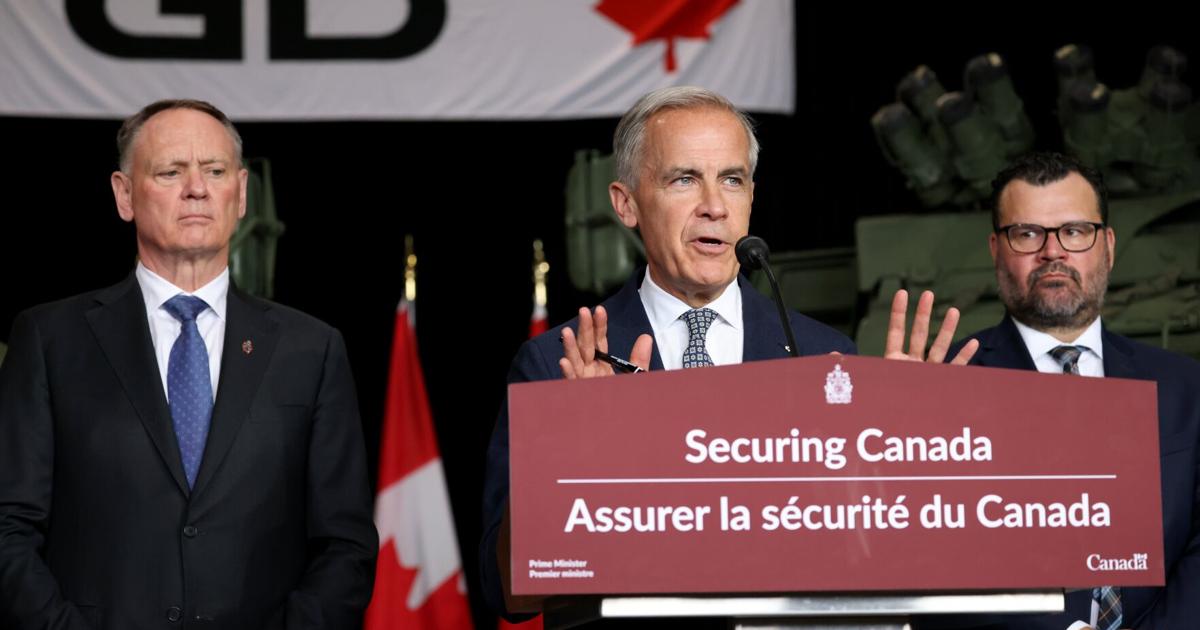
A government spokesperson says Ottawa 'continues to take action' to strengthen Canadian supply chains and support Canadian workers, businesses.
Prime Minister Mark Carney visited General Dynamics in London, Ont., in July. The U.S.-based company is one of the largest beneficiaries of the billions worth of contracts that flowed south since he took office.
Since assuming office a year and a half ago, Prime Minister Mark Carney has repeatedly promised that his government would “build Canadian and buy Canadian.”
But American-controlled multinational corporations have dominated the most lucrative federal contracts under Carney’s leadership, a Toronto Star analysis of government data shows. The share of government contract dollars going to U.S. companies also increased.
Since Carney was sworn in as Prime Minister in March 2025 and up to the end of July 2026 — the latest available data — Ottawa awarded $25 billion in contracts to buy everything from cloud services to military vehicles and office furniture.
The vast majority of it, $22.4 billion, went to Canadian companies, according to federal contract data. United States businesses come at a distant second place, with nearly $1.2 billion.
But that’s not the full picture; procurement data does not distinguish between a homegrown shop and the locally-incorporated subsidiary of an American corporation. This is how well-known U.S. brands such as defence contractor Lockheed Martin or tech giant Amazon, which has received about $49 million in contracts under Carney, sometimes show up in procurement data as Canadian companies.
The Star cross-referenced procurement data with another federal data set, the Inter-corporate Ownership (ICO) review’s index, which includes information on more than 50,000 companies and their “country of control” — where the people controlling the firm live. That metric is used to measure “the extent and impact of foreign control within the Canadian economy,” according to the ICO review, which reports on its findings to Parliament.
The Star also reviewed reports filed with the U.S. Securities and Exchange Commission, company websites and other public records to confirm American ties among some of Ottawa’s largest contractors. Where there was no ICO match for smaller contractors, the Star used procurement data to establish an organization’s country.
The results show that while Carney has promised to uphold Canadian sovereignty and make the country’s economy less dependent on the U.S., his government has been reliant on its businesses. They also illustrate the limits of Ottawa’s Buy Canadian Policy, which went into effect in December to give “priority to Canadian businesses and Canadian-made content for large federal purchases.”
In its first 16 months in power, the Carney government gave an estimated $7.8 billion in federal contracts to American-controlled corporations. Contracts with Canadian companies over the same period amounted to $14.9 billion.
Public Services and Procurement Canada did not answer the Star’s questions on the proportion of contract dollars going to U.S.-controlled companies. Spokesperson Jean-François Létourneau said that the government “continues to take action to increase domestic participation, strengthen Canadian supply chains, and support Canadian workers, businesses, and communities.” He said that since December, 34 contracts worth $1.5 billion have been awarded under the Buy Canadian Policy.
The Prime Minister’s office declined to comment.
The share of federal contract dollars heading south went from one-fifth in the 16 months before Carney took office to nearly a third under his watch.