
Pinglu Canal: Engineering a new waterway to the sea
By continuing to browse our site you agree to our use of cookies, revised Privacy Policy and Terms of Use. You can change your cookie settings through your browser.
China's Pinglu Canal officially opens to navigation on Wednesday, giving southwest China a shortcut to the coast and overseas markets. The 134.2-kilometer waterway connects the Xijiang River shipping network with the Beibu Gulf in south China's Guangxi Zhuang Autonomous Region.
Designed for vessels of up to 5,000 tonnes, the canal marks the completion of a major river-to-sea transport project, bringing together navigation engineering, ecological protection and regional logistics.
The canal was built at a cost of 72.7 billion yuan (about $10.75 billion).
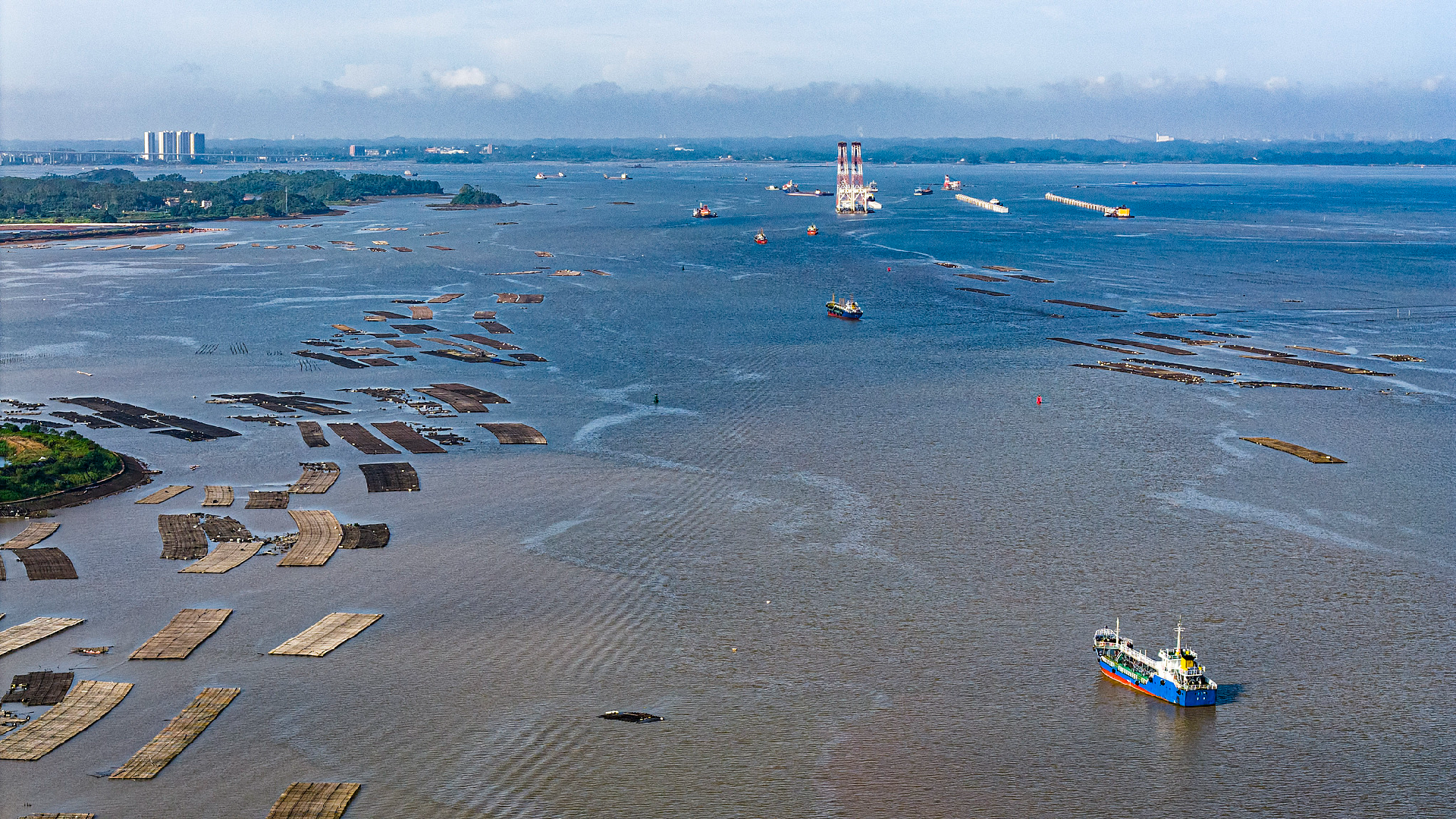
The estuary of Pinglu Canal in Qinzhou, Guangxi Zhuang Autonomous Region, south China, August 25, 2026. /VCG
The canal connects the Xijiang River system with the Beibu Gulf through a network of waterways and ship locks.
Three double-line ship locks at Madao, Qishi and Qingnian are key parts of the navigation system. The project has undergone vessel trials covering ship-lock passage, overtaking, turning, tidal berthing and night navigation.
On Tuesday, authorities announced navigation classifications for the canal. The inland section is provisionally classified as a Class B navigation area, while the Qinzhou Bay river-sea junction is classified as equivalent to a Class A navigation area.
The classifications define the navigation requirements for vessels operating along the route.
Mangroves in Fangchenggang, Guangxi. /VCG
Ecological protection has been a major part of the canal's construction.
The project has cleaned 14,490 mu (966 hectares) of mangrove forest. The mangrove forest area at the estuary covers 3,649 hectares.
The project has also relocated 9,572 mature mangrove trees and replanted 275,000 mangrove saplings elsewhere, with a survival rate of over 90%.
At the Qingnian hub, a fish passage helps restore migration routes affected by an earlier water-control structure. A 240-meter wildlife overpass, covered with soil and vegetation, provides a route for terrestrial animals across the canal.
Together, these measures show how ecological protection has been incorporated into the construction of the canal.
A view of Qinzhou Port in Guangxi. /VCG
The canal will shorten the inland waterway route between southwest China and the sea by about 560 km compared with the route via Guangzhou Port.
Annual logistics cost savings are estimated at around 5.2 billion yuan.
By connecting inland waterways with the Beibu Gulf, the canal is expected to make it easier for domestic goods to reach overseas markets and for imported goods to move inland.
Its longer-term effects on trade and industrial distribution will depend on how effectively the waterway connects with ports, logistics facilities and existing transport networks.
The Pedro Miguel Locks and Centennial Bridge over the Panama Canal, Panama. /VCG
The Panama and Suez canals illustrate how major waterways can shape maritime trade routes.
The Panama Canal connects the Atlantic and Pacific oceans. According to the Panama Canal Authority's 2024 annual report, the canal's direct contribution to Panama's GDP was estimated at 2.9% in fiscal year 2024.
The Suez Canal is a major route linking Europe and Asia. In 2024, UNCTAD reported that average daily transits through the canal had fallen 57% below their previous peak amid disruptions.
These examples illustrate how waterways can affect shipping routes, transport costs and the geography of trade.
The Pinglu Canal serves a different role, linking inland China with the Beibu Gulf. Its effects on regional logistics and trade will depend on how effectively it connects river transport, ports and regional trade networks.

