
Paradise gained: Hockey lionesses are golden pride of India after defying China - The Indian Express
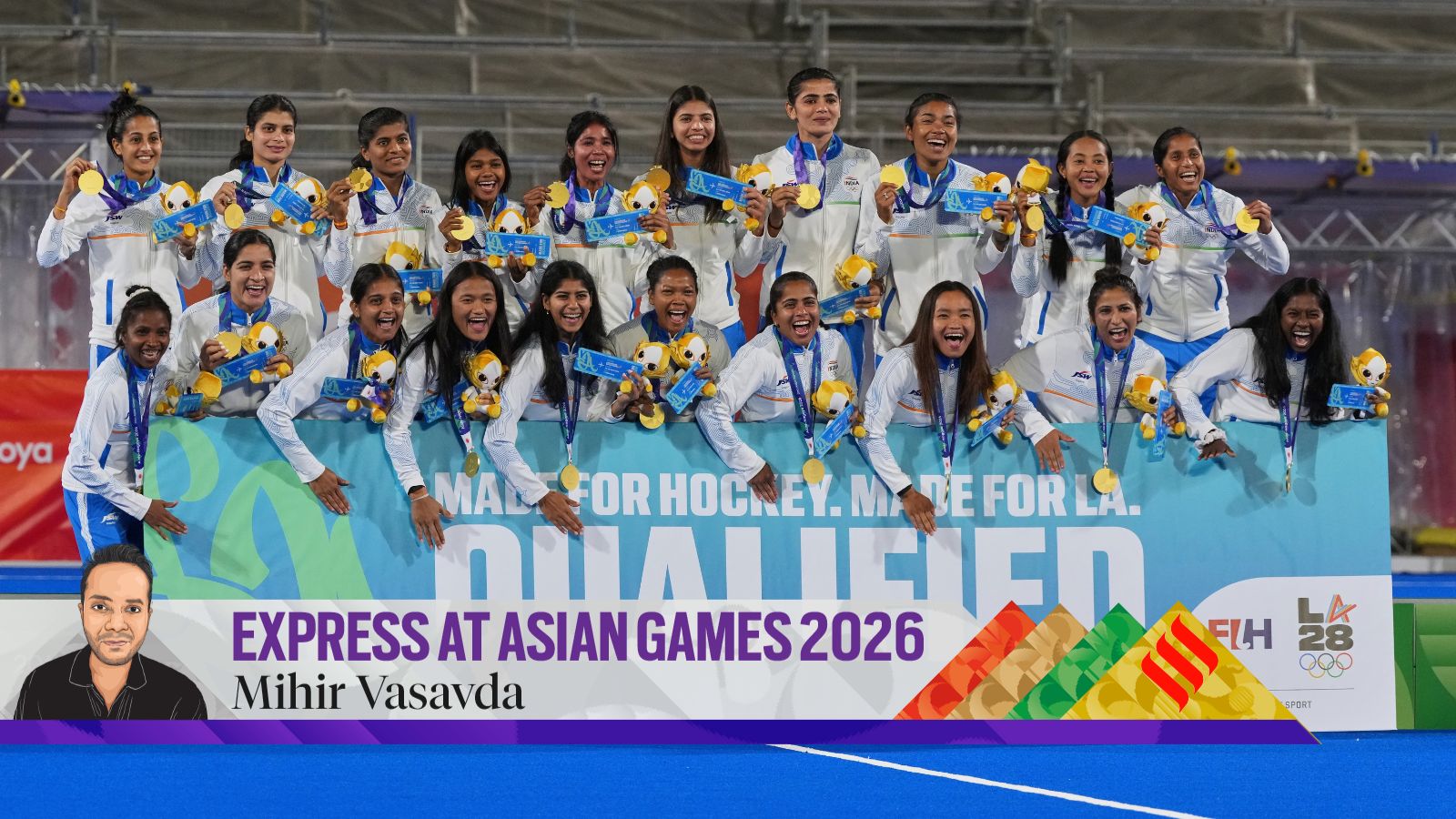
Somewhere in the last few years, this women’s hockey team had lost more than matches.
It had lost its rhythm, confidence, the ability to run together, pass crisply, score together. The dressing room had fractured. An Olympics was missed. Coaches came and went. An entire starting 11 could have been made of injured players. There were moments when it was difficult to see where the next win, let alone the next Olympic dream, would come from.
On Friday night in Nagoya, they found their way back. India beat China 1-0 to win the Asian Games women’s hockey gold, ending a 44-year wait for the title and securing a direct berth at the 2028 Los Angeles Olympics. “Amazing,” gushed Sjoerd Marijne, the chief coach. “I can’t believe it.”
The scoreline, though, tells only the simplest part of the story.
Because this was a team that had spent the last year learning how to be a team again. Then, with a gold medal and an Olympic place on the line, they had to show exactly how far they had come. A 45-minute delay as their bus got stranded wasn’t ideal. But the 60 minutes of the match might’ve seemed even more stretched out
Earlier, the players had asked for Marijne. The Dutchman assembled his A team, and slowly began putting the pieces back together. It was not a magic wand, though the transformation makes it look like one. “What has changed in this period is the team environment, we have worked on our unity. After the new coach came, we had a renewed belief,” goalkeeper Savita Punia, who reconsidered her future after a conversation with Marijne, said.
Marijne likes to call his players ‘sherniyan’. Against China — the same China that had won the Asiad gold four times since the turn of the century, and won a silver at Paris Olympics — they played like the lionesses he believed they could be.
Lalremsiami gave them the perfect start in the 10th minute, turning onto Sakshi Rana’s pass and sending a fierce reverse hit into the net. China had begun the final with intent, but India had struck when their opportunity came. What followed was 50 minutes of the kind of defending that can only come from a team that trusts the player standing beside you.
China kept probing. Savita Punia and Bichu Devi Kharibam — the two goalkeepers who alternated quarters — kept organising. Navneet Kaur, Sushila Chanu, Ishika and Shilpi Dabas kept stepping into the path of attacks, their clearances repeatedly killing Chinese moves before they could turn into something more dangerous.
When China won a penalty stroke in the second quarter, Savita read Zhang Ying’s effort and threw herself to her left bottom corner to keep India ahead. It was a moment that showed how much the 36-year-old has evolved. There was a time, until not too long ago, that Savita would not dive low to her left. This summer, she trained with Dutch legend Pirmin Blaak and added this facet to her game. When another Chinese attack threatened in the fourth, she was there again.
India’s slender lead came under increasing pressure with every passing minute. They had begun the evening trying to win the gold. Now, they were trying to protect it, knowing that one lapse could wipe away everything. They bent low to make tackles and block passes, chased runners deep into their own half and kept finding the legs for one more sprint, one more clearance. Each player seemed to understand where the next danger would come from and, more importantly, where the next cover had to be.
It was the sort of collective resistance India had shown against Australia in that Tokyo quarterfinal five years ago, when they made the leap from believing they could compete to proving they could make one of the world’s best teams uncomfortable. This felt bigger. Tokyo had been a breakthrough. Nagoya was a reckoning with everything that had happened since.
The team that had once struggled to run, pass and score was now running itself into the ground to preserve a one-goal lead against the hosts. The players who had once been divided were now moving almost instinctively for one another. The dressing room that had fractured was now holding together under the fiercest pressure of the tournament.
China kept coming, but India kept finding another body, another stick, another clearance. The clock became an ally. The pressure became unbearable, and still they held. When the final hooter came, the players who had spent the closing minutes bent almost double finally straightened up and fell into each other’s arms. For months, they had been trying to rediscover what had made them a team in the first place. On a chilly Gifu night, they found it again.
The players threw Marijne into the air, laughing as he disappeared and reappeared above the huddle of orange shirts. A cold wind swept across the stadium. Clapton’s riffs of You Look Wonderful Tonight drifted through the speakers. On the podium, Savita and Bichu stood shoulder to shoulder and took turns putting their medals around each other’s necks. Around them, the team kept smiling for the cameras.
Over the course of a 18-year-long career, Mihir Vasavda has covered 2010 FIFA World Cup; the London 2012, Tokyo 2020 and Paris 2024 Olympic Games; Asian Games in 2014 and 2022; Commonwealth Games in 2010 and 2018; Hockey World Cups in 2018 and 2023 and the 2023 ODI Cricket World Cup. ... Read More
