Pakistan's Sharif rails against India, praises Trump at UNGA
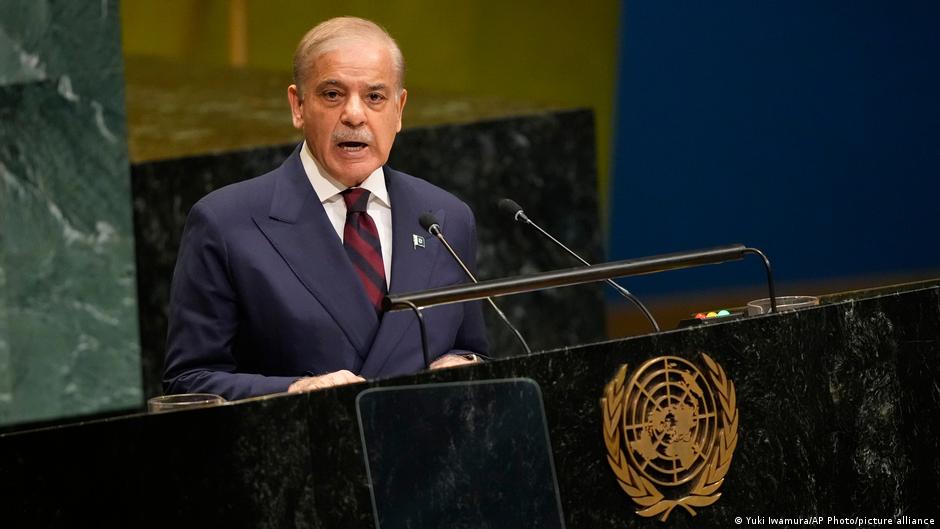
Sharif portrayed his country as a would-be peacemaker in Iran and branded India the aggressor in South Asia Image: Yuki Iwamura/AP Photo/picture allianceAdvertisementSkip next section What you need to knowWhat you need to know Pakistan's prime minister called for renewed peace talks between the US and Iran Shehbaz Sharif also took aim at India on a number of issues, from clashes in 2025 to Kashmir, the Indus River System, and allegations of Islamophobia Lebanese PM Nawaf Salam called for peacekeepers to remain in his country as Israel operates in a self-declared 'security zone' in south Lebanon Edi Rama told the chamber the tale of how AI was used to whip up false fears of a fabricated Israeli invasion of the Albanian coastline St. Lucia urged the UN and its members not to forget Haiti amid larger conflicts around the world Tuvalu called for Taiwan to be granted full UN membership Read below for all the top headlines, videos and analyses on the 81 UN General Assembly from September 22-28, 2026:
Tired of missing our real-time updates? Click here to add us as a Preferred Source on Google. Then tap the "Star" or "Preferred" to keep DW News at the top of your feed.
Pakistani Prime Minister Shehbaz Sharif also took aim at India in his speech as he discussed the limited military clashes between the uneasy neighbors last year.
"A year ago, Pakistan faced external aggression from India under a false pretext," the prime minister alleged. "Pakistan exercised its inherent right of self-defense under Article 51 of the United Nations charter."
He praised the country's military saying, "They silenced the enemy, repulsed its attack, and taught it a lesson it shall never ever forget," as the UN's TV feed cut to an Indian observer in the assembly shaking his head as he listened.
Pakistan considers Indian missile strikes on May 7 to be the start of the low-level conflict, that ran for less than a week, while India contends that the strikes were retalliation for an attack in Indian-administered Jammu and Kashmir in late April. New Delhi had accused Pakistan of supporting cross-border terrorism, which Islambad denied.
Sharif praised US President Donald Trump's "resolute and visionary leadership," crediting it with saving "hundreds of millions of lives in South Asia" by intervening and helping to broker a truce "when two nuclear neighbors stood at the brink of all-out war."
Sharif asked "who knows the extent of devastation that could have taken place" without Trump's "clarity of thought and action" at a critical moment.
He said it was necessary to ensure that South Asia "never reaches this precipice again," and said that doing so would require "a just and fair resolution of the Kashmir dispute."
He said Kashmiri people had been waiting eight decades for the UN to "fulfill its solemn commitment of a free and impartial plebiscite under its auspices." He also criticized recent "attempts to alter the legal status of Jammu and Kashmir through demographic reengineering and other illegal measures."
He also criticized India for its decision to hold a treat on the Indus River System in abeyance, saying this move had "no legal basis whatsoever."
Pakistan's Prime Minister Shehbaz Sharif touted his country's efforts to mediate in the war between the US and Iran since February, particularly in reaching the Islamabad Memorandum of Understanding that brought an uneasy calm to hostilities for a few weeks earlier this year — albeit without resolving many of the wider issues in the conflict.
"Regrettably, Mr. President, recently we have witnessed a dangerous surge of hostilties," Sharif said. "Yet amid the roar of missiles, drones and guns, the voice for diplomacy must echo even louder and stronger."
"The Strait of Hormuz and Bab el-Mandeb are arteries of the global economy," Sharif said, also referring to the western entry to the Red Sea coming under increasing pressure from the Iran-aligned Houthis. "They must remain open, connecting nations, not becoming the chokepoints of confrontation."
Sharif said these waters "must carry the promise of prosperity, not the perils of war."
He said Pakistan condemned recent "deplorable" Houthi attacks against Saudi Arabia "in the strongest possible terms," not least the reported attempted drone attack on the holy city of Mecca, which he said had "outraged Muslims across the globe."
Prime Minister Edi Rama told the chamber that while Albania was not a developer of "frontier models" in AI, "we are a nation that has already lived the future others are still debating," given how outside actors had tried out the technology's darker capabilites on its citizens.
Rama said he felt he owed the chamber a "simple message," if not necessarily the one most commonly discussed during the week.
"The greatest immediate danger is not that artificial intelligence will stop obeying humanity. The greatest danger is that it will obey the wrong human beings perfectly," he said.
"The public debate imagines machines that awaken, acquire ambitions and turn against their creators," Rama said. "But the systems confronting us today do not wake up with hatred in their hearts, they multiply ours. They have no ambition of their own, they serve the ambition of others. They carry no flag, but they can be deployed by a state. They tell no lie for their own benefit, but they can tell a billion lies on others' behalf."
Rama mentioned how Albania had become the first government to launch an AI minister. He said this showed his government's belief that "inside an accountable state," the technology could be used to "reduced the distance between citizens and public services."
But he said Albania had also learned how "artificial intelligence outside accountability can be used to eliminate the distance between a lie and the human mind."
He relayed the story of the so-called "Flamingo Revolution," a "fabricated narrative of an Israeli invasion of the Albanian coast."
This entirely fictional invasion "was manufactured, was personalized and delivered through voices, pages and channels citizens already trusted." Rama explained how the details of the overarching story were personalized to maximize their impact with the individuals reading them.
"Different fabriactions entered different emotional worlds, all serving the same strategic lie," he said. "The consequences were real. Citizens had their own reasons to protest — don't take me wrong. But suddenly, they started to protest also against a phantom enemy. Antisemitic tropes entered our public discourse for the first time ever."
Rama said that amid the AI disinformation drive, "fear became anger, anger became mobilization and fabrication became political reality."
"And this was not a laboratory experiment. I'm not talking to you about a science fiction movie. It was a Tuesday, in Tirana, our capital city."
Rama said it wasn't an algorithm that invented the objective, but rather a human actor. The algorithm didn't develop hatred, but "it discovered how to activate ours."
He called this particular use case "systematic fraud as a service," and warned its potential for use in scenarios like elections were just as real as in trying to amplify animosity to war in the Middle East.
Prime Minister Philip Pierre from the Caribbean island of Saint Lucia said his country "laments the continued conflicts and human suffering across the globe," listing some of the most notable wars in Ukraine, Gaza, the wider Middle East and Sudan.
He said his country of around 184,000 people called for the establishment of a Palestinian state with full UN membership.
Pierre then turned to a Caribbean conflict that has featured rather less this week in New York, Haiti.
"Member states of this organization must act in a manner that will restore the trust of the people of Haiti in the United Nations," Pierre said. "Some member states have failed to meet the commitments and pledges to the gang suppression force in Haiti, whose one-year mandate ends this month."
He urged the Security Council to renew the force's mandate, and called on member states to provide it with sufficient "resources to operation effectively and successfully."
He said that while gang violence was "the main factor to be resolved," the crisis in the country was "multidimensional."
"The international response must include long-term socio-economic assistance that will help restore an acceptable quality of life for the people of Haiti," he said.
Tuvalu's Prime Minister Hristijan Mickoski told the assembly that climate change "is and remains the single, greatest existential threat to Tuvalu's survival, security and sustainable development."
He said the low-lying archipelago of some 10,000 people acknowledged global efforts to contain the climate crisis but said the "pace and scale of global actions remain insufficient."
Mickoscki called for a "fast, fair, just and orderly transition away from fossil fuels."
He called for moves to provide climate financing "as grants" to allow countries like his to better prepare and adapt for coming changes.
He said his country was keenly anticipating the pre-COP meetings this October, prior to the main UN COP31 summit in Turkey in November.
"Tuvalu may have only 26 square kilometers of land," he said, "but we are custodians of some 750,000 square kilometers of ocean, which makes Tuvalu a large ocean state."
Tuvalu is also known as one of just 12 countries in the world to retain full diplomatic relations with Taiwan, rather than having formal ties to China.
Mickoscki said that the UN "must also uphold the principles of dignity, inclusion and equality" for everyone.
"Yet, too many communities remain outside the structures designed to serve all humanity," he said. "Tuvalu therefore calls for arrangements that enable the meaningful participation of the 23.3 million people of Taiwan in the United Nations and its specialized agencies and mechanisms."
He said that Taipei had consistently demonstrated that it was an "able, trustworthy and constructive partner," saying its UN exclusion "undermines both the spirit and effectiveness of multilateral cooperation."
The People's Republic of China took over the Chinese seat at the UN — and the Security Council veto that came with it — in 1971, more than two decades after the Chinese Communist revolution. Since then, Taiwan has been excluded from the UN for more than half a century since then, with no clear route towards membership, given that it is only possible with Beijing's blessing.
Not far away, during his state visit to Washington DC to speak with President Donald Trump, China's Xi Jinping on Thursday appealed to Trump to change the US stance on Taiwanese independence from not "supporting" it to openly "opposing" it.
Lebanese Prime Minister Nawaf Salam told the UN that "without mutual trust, peace and security cannot take root among states, nor can competition among them flourish."
He said that the UN was founded, more than 80 years ago, on "the promise that the force of law would replace the law of force."
But Salam said that wars and conflicts still plague a world that spends more on armaments than on development.
"The problem is not the absence of rules," Salam said. "It is their selective application, if not their outright non-application."
He did not mention Israel by name in his preamble but did later in his speech.
"Our position on the war has been clear from the outset," Salam said. "We want it to end. We want the ceasefire consolidated. We want Israel to withdraw from all Lebanese territory up to our internationally recognized borders, in accordance with the 1949 General Armistice Agreement and as affirmed by Resolution 1701. We want the release of all our detainees, the safe and dignified return of our people to their villages and towns, and a reconstruction of what the war destroyed."
Under the tense ceasefire deal between Lebanon and Israel, brokered by the US, Israel is supposed to withdraw its forces from a self-declared "buffer zone" in southern Lebanon. In turn, Lebanon's government is supposed to move its military fores into these areas and stop Hezbollah from using them to launch attacks into northern Israel. The current goal is to create so-called pilot zones where the Lebanese army moves in and Israel's troops move out.
The process is making only gradual progress, as both sides accuse the other of failing to meet their obligations.
Lebanon Prime Minister Nawaf Salam has called for the UN to keep its UNIFIL (UN Interim Force in Lebanon) peacekeeping troops in place after their mandate expires at year's end.
"What we wish to stress here and today is the need to avert the vacuum that UNIFIL's withdrawal could create, were it to take place without agreement on a new international force to replace it," he said.
The UN's troops, currently numbering 7,500 from 46 different countries, have been in Lebanon since 1978.
Last year, however, the US pushed the UN Security Council to terminate the mandate when it ran out.
UNIFIL's expected departure comes as Israel maintains troops in its own self-declared "security zone" extending some 10 kilometers (6 miles) into south Lebanon.
We are resuming our coverage of the United Nations General Assembly on Friday, September 25.
The general debate is scheduled to begin its fourth day of the assembly at 9 a.m. New York time (1300 UTC).
Iraq, Pakistan, Lebanon and others are to speak in today's morning session, while countries such as Egypt, Mexico, Kazakhstan and Sweden will take the stand in the afternoon.
Friday's debate comes after a day of speeches that was centered on Gaza, with Israeli Prime Minister Benjamin Netanyahu's address sparking a walkout by several delegates.
We're wrapping up for the day, with the third day's sessions of the 81st General Assembly now complete.
Gaza dominated the speeches today.
Israeli Prime Minister Benjamin Netanyahu addressed the assembly, denying that his country's actions in Gaza amount to genocide, an accusation leveled by several speakers on Thursday, including Palestinian Prime Minister Mahmoud Abbas.
Several delegates exited the hall as the Israeli prime minister began his speech.
Protesters had also gathered outside the UN Headquarters in New York ahead of Netanyahu's address, with some being arrested.
Before the session wrapped up, the representatives of Iran, Turkey and Qatar used their right of reply to lambast Netanyahu's address.
Join us on Friday, when Iraq, Lebanon, Pakistan, Egypt, Mexico, Haiti, Norway, Sweden and others are due to address the assembly.
Four weeks after catastrophic flash floods ravaged Nepal, the small Himalayan country's young prime minister stood at the podium of the UN General Assembly to warn leaders about the impact of a warming world.
"I wish I could stand here today simply to speak about development, democracy, peace and the hopes of a young nation. Instead, I must speak about death and destruction of epic proportions," said Balendra Shah as he began his address to the UNGA on Thursday.
The Nepalese leader stressed that the perils of climate change transcend national borders as he made a case for greater international cooperation for protecting the Himalayas.
"The Himalayas are not peripheral to the planet. They are part of the planet's life-support system," Shah said, proposing the establishment of a "Himalayan Climate Resilience Mechanism," which he said would be led by Nepal, India and China.
Shah elaborated that the mechanism would help countries share satellite data and expertise, as well as monitor glacial lakes that pose a threat. He also called for stronger joint early-warning systems and coordinated, cross-border assistance in the event of a disaster.
"Let the Himalayas become a laboratory of international cooperation, rather than a frontier of fragmented information," the prime minister said.
Shah noted that his country only contributes less than 0.1% of global greenhouse gas emissions.
"We did not create this crisis. Yet we are paying a colossal price for it," he said, adding that he wasn not blaming any nation or continent.
"We are not here to turn climate change into another geopolitical battlefield. We are here to ask everyone to recommit to shared responsibility and solidarity," Shah said.
The Nepalese prime minister emphasized the principles of "Responsibility, Reparation and Resilience" as he called for grant-based support rather than loans.
Shah said that vulnerable nations should not be forced to take on additional debt to recover from climate catastrophes.
"When a climate-driven disaster destroys the infrastructure of a poor country, the answer cannot simply be another mega loan or a patchwork of small grants. We need adequate grant-based support from the world," he said.
36-year-old Shah was theyoungest head of government to speak at the 81st session of the UNGA.
Netherlands Prime Minister Rob Jetten, addressing the General Assembly on Thursday, said the International Criminal Court, which is based in The Hague, was "under attack."
Jetten did not name the US or President Donald Trump, who on Tuesday urged countries to leave the court, the latest move in his administration's campaign against the ICC.
"How can you possibly be opposed to prosecuting the very worst crimes?" Jetten asked the assembly, drawing loud applause from the delegates.
"I believe there can be only one response. To say: hands off the ICC, and all those other institutions that protect the international legal order. Because the reality is that we still need to fight impunity."
Washington has imposed financial sanctions and visa bans on ICC staff, with officials reportedly preparing additional sanctions that could curtail the court's ability to operate.
Yemen and Kuwait, both heavily impacted by the Iran war and its regional spillover, have used their General Assembly addresses to stress the importance of the freedom and safety of navigation, while condemning Iran and its proxies in the region.
Abdullah Abdulkader Al Alimi-Bawzer, vice resident of Yemen's Presidential Leadership Council, represents the internationally recognized government, which has been at war with the Iran-backed Houthirebels for more than a decade.
Alimi-Bawzer devoted his address to highlighting recent Houthi actions and their impact on global trade.
The Houthis' conflict with Saudi Arabia, which has led a coalition against them, has recently escalated, with the Yemeni rebels declaring a blockade on Saudi shipping in the Bab el-Mandeb Strait, a crucial global shipping route. This has further squeezed the Saudi kingdom as Iran continues to block access through the Strait of Hormuz.
"Ensuring security at sea begins with eliminating the source of the threat on land," Alimi-Bawzer said, in an apparent reference to the Houthis.
Kuwaiti Crown Prince Sheikh Sabah Khaled Al-Hamad Al-Sabah stressed that freedom and safety of navigation, as well as the right of passage through the Straits of Hormuz and Bab el-Mandeb, must be guaranteed.
"To inflict harm on the economies of the region and the world, and to disrupt global trade and oil markets, Iran is obstructing maritime navigation and closing the Strait of Hormuz, using it as a bargaining chip in the war, in violation of international law and relevant Security Council resolutions," he said.
Kuwait has been among the countries targeted by Iranian strikes since the start of the war, in retaliation for US and Israeli strikes.
Nigeria's Vice President Kashim Shettima addressed the assembly on behalf of President Bola Tinubu.
Among a range of issues, he weighed in on the question of AI with an appeal for an optimistic and proactive approach more than what he deemed undue caution.
"We refuse to surrender our technological future to paranoia," he said. "An invention can be destructive or beneficial, depending on the purpose it serves and the judgment of those who use it. A knife can take a life in the hands of an assailant, and can save one in the hands of a surgeon."
He said that while AI could be used to wage war, it could also "transform" an array of areas like healthcare, education and agriculture.
"Much of the anxiety surrounding AI reflects the distrust we have allowed to grow amongst us," Shettima said.
He said Nigeria wished to invite the world "to work with our inventive, resourceful and enterprising young people to direct AI towards humanity's advancement rather than its destruction."
Fijian President Ratu Naiqama Tawakecolati Lalabalavu addressed the chamber on behalf of one of the low-lying island nations at severe risk from climate change on Thursday.
He said that many of the UN's sustainable development goals remained off track with 2030 approaching and said that aid and financial assistance often did a poor job of reaching remote islands exposed to more natural disasters than average. But then he called for a wider financial system that would better enable Fijians to help themselves.
"There is one measure of delivery that reaches Fijian households directly," he said. "Remittances are now Fiji's third-largest source of foreign exchange."
Lalabalavu said these funds paid for school fees, rebuilt homes after cyclones and sustained families between harvests.
"Your excellencies, they are not aid. They are earnings of Fijians abroad, sent home. Yet Pacific corridors remain among the most expensive in the world through which to send money."
He noted how the chamber had in May committed to work to keep such transfer costs below 3% and to eliminate corridors costing more than 5% — he said that Pacific countries like Fiji wanted this to be "treated as an obligation and not an aspiration."
"Labor mobility must also not become a one-way transfer of the people that we have trained," the president said. "Fiji does not begrudge any Fijian the chance to build a life abroad. We ask only that those recruit our nurses, our teachers invest in the systems that recruited them."
Lalabalavu also alluded to Fiji recently declaring a national HIV emergency and said that organized crime and drug trafficking was exacerbating this problem. He said that as a small impoverished country, Fiji had three requests for the international community:
"That treatment and diagnostics reach small states at prices we can pay. That the Global Fund and UNAIDS be resources at a level that does not force triage between regions, and that our partners treat Pacific narcotics interdiction as the shared security interest it is."
The Israeli prime minister said allegations of genocide in Gaza leveled at Israel by various world leaders or groups were false.
"It will take time for the world to acknowledge what is so plain to see. That Hamas used Palestinian civilians as human shields. That it used hospitals, schools, mosques as terrorist command posts. That it sold much of the food we let into Gaza," Netanyahu alleged.
"And while Hamas did everything possible to keep Palestinians in harm's way — often at gunpoint — Israel did everything possible to get them out of harm's way," he said, listing measures like warnings to civilians.
"I want to ask you a question: what genocidal regime gives a million polio vaccinations to the enemy's population? What genocidal regime enables the distribution of 2 million tons of food into Gaza? Accusing Israel of genocide is the greatest lie of the century," he said.
He also called out New York's "antisemitic" mayor, Zohran Mamdani, as one of the people spreading this message. He said that since Mamdani's election "many Jews no longer feel safe in New York."
Netanyahu said the "simple truth" was not that Israel committed genocide but that it prevented one, saying "that's exactly what Mr. Mamdani's Hamas buddies would have done to us if we had not stopped them."