Pakistan shoots down eight drones launched from Afghanistan: security sources
Direct Source Verification:
This story is aggregated from The Express Tribune (tribune.com.pk). Full reporting rights and copyright belong to the primary publisher.
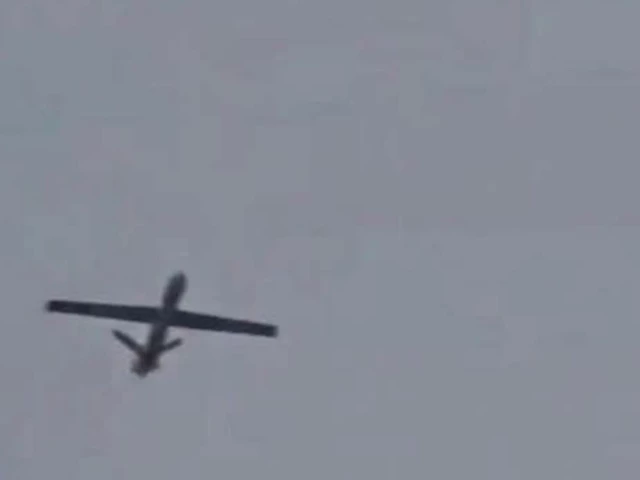
Sources say 4 drones brought down in areas close to Torkham border, another 4 shot down near the border with Kohat
Pakistan’s air defence system shot down eight drones after they entered the country’s airspace from Afghanistan on Wednesday morning, security sources said.
"Four of the drones were brought down in areas adjoining the Torkham border, while another four were shot down in mountainous areas near the border with Kohat," the sources said.
The sources said the Pakistan Army and Pakistan Air Force had thwarted the attempt by the Afghan Taliban regime to target public places, adding that the country’s “active and alert air defence system” had detected and brought down all eight drones.
The sources described the incursion as “further evidence” of what they said was the Afghan Taliban regime’s direct support and patronage of terrorists.
“The Pakistan Armed Forces remain fully prepared at all times to defend Pakistan and its people,” the sources said.
Read: Four Afghan drones shot down over Balochistan
On Monday, Pakistan carried out “calibrated” air strikes against terrorist hideouts near the Afghan border and conducted intelligence-based ground operations that killed a total of 37 terrorists following a series of deadly attacks in Khyber-Pakhtunkhwa (K-P).
The information ministry, in a statement, had said that on September 20, security forces conducted an intelligence-based ground operation against a group of terrorists in Kohat and Hangu districts. "As a result of precise and skilful engagement, nine khwarij belonging to the Indian proxy Fitna al-Khawarij were sent to hell, while several were injured."
The statement said three targets were destroyed in precision strikes, including a training centre for suicide bombers. It said 28 terrorists, along with several suicide bombers, were killed, while large quantities of weapons and ammunition stored at the centres and hideouts were also destroyed.
The airstrikes were carried out after 23 people, including 15 police personnel, were martyred in the blast at a mosque in Kohat’s Police Lines during Friday prayers. Eight terrorists were also killed during a subsequent search and clearance operation. Later, Ittihadul Mujahideen Pakistan (IMP), led by Afghanistan-based Hafiz Gul Bahadur, claimed responsibility for the deadly bombing and rampage involving multiple attackers.
Previous drone attacks
Pakistan had reported previous incidents involving drones crossing from Afghanistan into its airspace.
On July 1, the military’s media wing, Inter-Services Public Relations (ISPR), said security forces had shot down four “rudimentary drones” launched from Afghanistan into Balochistan on June 30. The military accused the Afghan Taliban regime of supporting terrorist groups operating from territory under its control and warned that further cross-border provocations would draw a strong response.
Earlier, on June 19, the Information Ministry rejected claims from Afghan Taliban-linked channels that Afghan forces had carried out drone strikes on alleged Islamic State-Khorasan Province (ISKP) camps in Khyber-Pakhtunkhwa and Balochistan. The ministry said one “rudimentary drone” had crossed into Pakistani airspace near Shinko in Khyber and was detected and neutralised by Pakistan’s air defence system.
Pakistan warns Afghanistan
In separate warning following the terrorist attack in Kohat, Pakistan said it had the “will and capability” to eliminate terror threats “wherever they are” and urged the international community to press the Afghan Taliban regime to take decisive action against terrorism.
Attributing the attack to “the vilest of Khwarij with roots in Afghanistan” the Information Ministry noted that the attack was a reminder that “terrorism has no religion and no justification”. It added that Islamabad had repeatedly raised “grave concerns” over the alleged use of Afghan territory by the banned TTP and other terrorist groups to plan and launch attacks inside the country.
“The presence of terrorist sanctuaries, alongside their recruitment and support infrastructure in Afghanistan, poses a direct threat to Pakistan’s security,” the ministry had said. It added that these concerns had repeatedly been conveyed to the Afghan Taliban regime and its interlocutors. “They must dismantle these networks rather than deflect responsibility,” Pakistan said.
United Nations Security Council report formally implicated the banned Balochistan Liberation Army (BLA) and terrorist entities operating from Afghanistan, highlighting tactical collaboration and shared operational logistics between the groups.
Read more: Pakistan carries out 'calibrated' air strikes against terrorist hideouts
Member-state reporting confirmed that BLA militants were trained alongside TTP members at facilities in Afghanistan, according to the report, which also described growing operational links among various militant groups operating across the border.
This was not the first time a UN report pointed to the threat posed by militant groups operating from Afghanistan. In 2023, a UN report also revealed that the TTP had established a new base in K-P in mid-2023, shedding light on close ties between the TTP and the Afghan Taliban, as well as between the TTP and anti-Pakistani groups and Al Qaeda.
Pak-Afghan tensions
K-P had witnessed a significant rise in militant violence last year, with more than 500 attacks reported, marking a 50% increase compared to the previous year.
The fighting between Pakistan and Afghanistan that started in October has killed scores of people on both sides, with Afghans taking the brunt. Islamabad accuses the Afghan Taliban of harbouring militants who launch attacks in Pakistan, although Kabul denies this, calling the militancy its neighbour's domestic problem.
Operation Ghazab Lil Haq was launched around the end of February following renewed clashes along the Pakistan-Afghanistan border, after Afghan Taliban forces fired on multiple locations, prompting swift military retaliation by Pakistan.
The clashes intensified after Afghanistan launched a border offensive in response to Pakistani air strikes targeting terrorist positions. The two sides had agreed to a week-long ceasefire on the eve of Eidul Fitr on March 18, following requests from Türkiye, Saudi Arabia and Qatar.
Also Read: Info ministry rejects Afghan Taliban-linked claims of cross-border drone strikes
Pakistan in April put forth three core demands to the Afghan Taliban during peace talks in Urumqi, China, including Kabul formally declaring the Tehreek-e-Taliban Pakistan a terrorist organisation, dismantling its infrastructure, and providing verifiable proof of the action. These demands form the basis of Pakistan's negotiating position, which sources say has hardened amid persistent security concerns.
In the most recent development, Pakistan carried out “precision strikes” along the Pakistan-Afghanistan border targeting terrorist hideouts, killing 26 Fitna al-Khawarij terrorists in response to recent terrorist attacks in the country.
Information Minister Attaullah Tarar said the operations were conducted in the aftermath of recent attacks, including the assault on a Federal Constabulary post in Khyber-Pakhtunkhwa on June 9, a vehicle-borne suicide attack on a military post in North Waziristan on June 2, and an attack on a police station in Bannu on May 9.
Original Source
https://tribune.com.pk/story/2630976/pakistan-shoots-down-eight-drones-launched-from-afghanistan-security-sources