
‘Not playing in the red ocean’: SP Group aims to triple China district cooling capacity in 5 years - The Straits Times
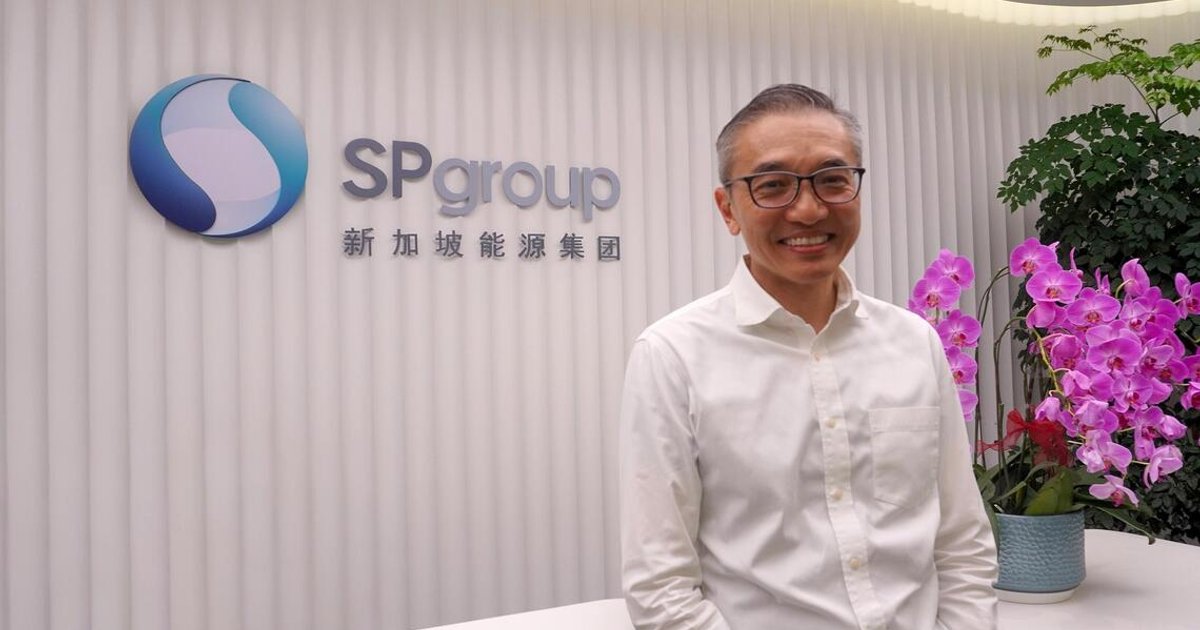
Michael Lim, deputy managing director for SP Group’s Sustainable Solutions China, says the company invests in sustainable energy solutions, including solar energy and battery storage.
SHANGHAI/GUANGZHOU – SP Group seeks to stand out from local competitors by offering integrated sustainability solutions, instead of competing on price.
“If customers are looking for the best price, it is a ‘red ocean’. We are not there playing in the ‘red ocean’,” said Michael Lim, deputy managing director for SP Group’s Sustainable Solutions China, referring to a business term for competitive and price-driven markets.
Instead, the company is targeting the “blue ocean” of less crowded, value-driven markets, by being a one-stop provider of sustainable energy solutions, Lim said on a media trip organised by Enterprise Singapore.
SP Group operates electricity and gas networks in Singapore and Australia, alongside sustainable energy businesses spanning district cooling and heating, renewable energy, electric-vehicle charging infrastructure, and digital services in Singapore, China, Thailand and Vietnam.
Outside of Singapore, its biggest market for district cooling is China, where it intends to triple its current district cooling capacity of around 120,000 refrigeration tonnes (RT) by 2031.
“We look at the quality and the life-cycle cost savings (of our services), and we are confident that our savings are quite significant,” said Lim, without disclosing price comparisons with competitors.
SP Group entered the mainland Chinese market in 2015, and now operates projects in 20 provinces and municipalities, with a focus on the Yangtze River Delta, the Chengdu-Chongqing region, and the Greater Bay Area.
District cooling and heating, which involves the centralised production of water that is piped to buildings for air-conditioning and temperature control, is its flagship business and “bread and butter” in China, said Lim.
Among the group’s business segments, district cooling is the third-largest revenue generator, following the sale of electricity and the use of system chargers and transportation of gas, based on the company’s annual report for the year ended March 31, 2026.
The company’s first and largest overseas district cooling and heating project is at Raffles City Chongqing, which has a cooling capacity of 14,000RT. More recently, its district cooling and heating network at the China-Singapore Guangzhou Knowledge City began operations in July 2026.
When fully operational, the network is expected to reduce cooling and heating-related life-cycle energy consumption by up to 40% and cut annual carbon emissions by about 2,000 tonnes, said Lim. The project now has an installed capacity of 7,300RT, with the aim to scale up to 9,000RT.
The network’s cooling capacity can be scaled further to support more buildings in the area, similar to SP Group’s Marina Bay district cooling network, which is expected to serve 50 connected developments by 2030.
SP Group’s district cooling and heating network at the China-Singapore Guangzhou Knowledge City began operations in July 2026.
While pure-play district cooling players had a bigger advantage in the past, client demands are shifting, said Lim. When SP Group first entered the Chinese market in 2015, it chose to invest in all forms of sustainable energy solutions, including industrial rooftop photovoltaic systems integrated with battery-energy storage, rather than being a pure-play district cooling operator.
For example, at the China-Singapore Guangzhou Knowledge City, SP Group integrates district cooling and heating, solar energy, energy storage and digital monitoring to reduce energy costs for commercial buildings.
SP Group provides district cooling and heating, and smart and clean energy solutions at the China-Singapore Guangzhou Knowledge City.
“Today, I think we are actually reaping those advantages that we set in the beginning,” Lim said.
He noted that while SP Group retains its competitive advantage as an integrated player, the value of life-cycle cost savings is not widely understood in the Chinese market yet. “I think it takes time to... recognise the value from a life-cycle perspective... The key word is stewardship – you need to educate your customers and bring them along.”
But this is evolving as China pursues its climate goals of peaking carbon dioxide emissions before 2030, and achieving carbon neutrality before 2060. Against this backdrop, “more and more clients are looking at sustainability as a market trend”, said Lim. THE BUSINESS TIMES


