Ninikanwa Okey-Uche: I take pride in helping women grow’ - The Guardian Nigeria News
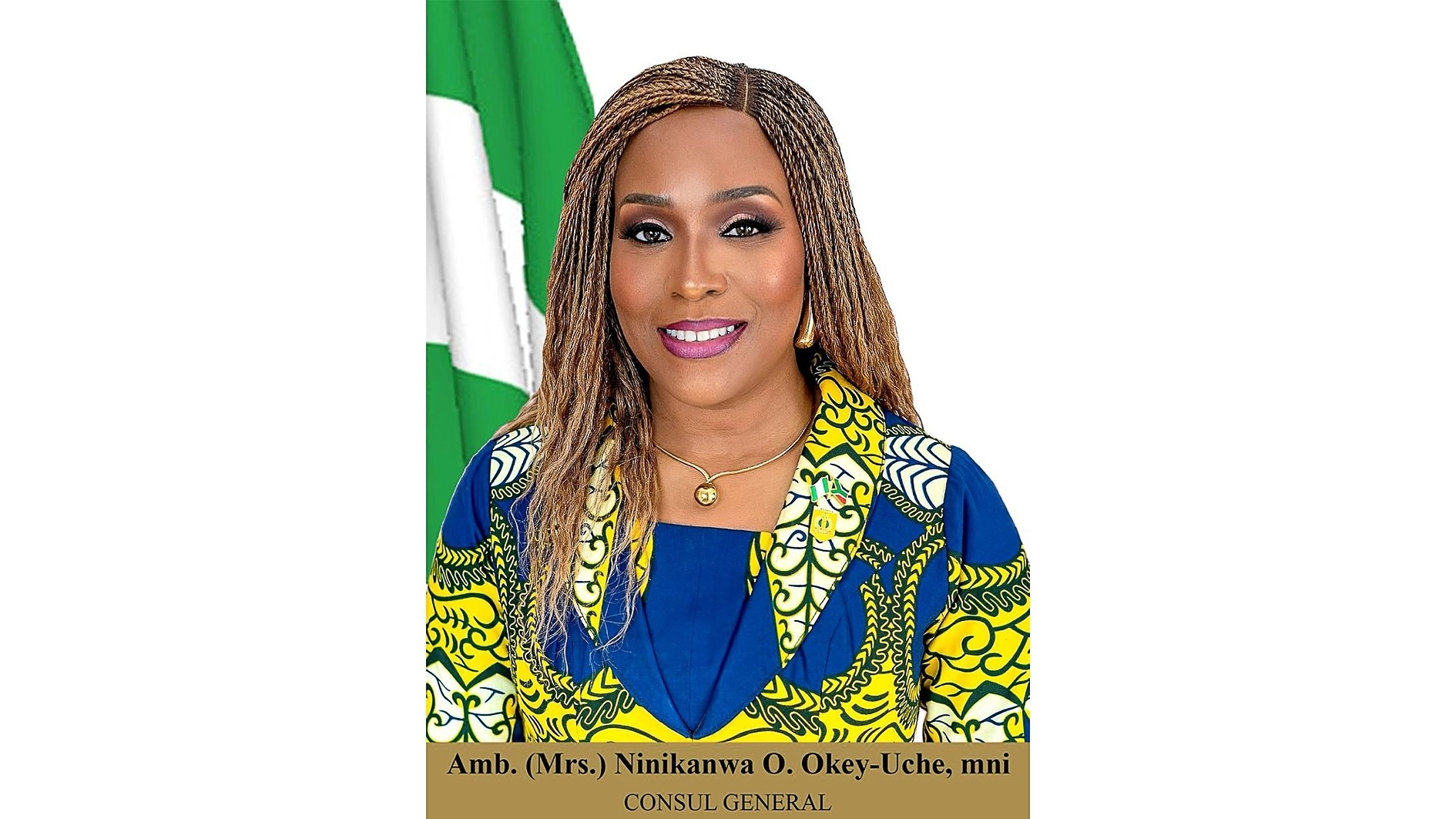
Ambassador (Mrs.) Ninikanwa Okey-Uche, mni, is the Consul-General of Nigeria in Johannesburg, South Africa. With over three decades of experience in international relations and public service, she has served in diplomatic postings across Brussels, The Hague, New York, and Beijing...
Ambassador (Mrs.) Ninikanwa Okey-Uche, mni, is the Consul-General of Nigeria in Johannesburg, South Africa. With over three decades of experience in international relations and public service, she has served in diplomatic postings across Brussels, The Hague, New York, and Beijing. Okey-Uche holds a Bachelor of Arts in Foreign Languages from the University of Benin, a Master’s degree with distinction in International Politics from CERIS in Brussels, and is currently pursuing her PhD. In this interview at MTN Headquarters in Johannesburg, South Africa, she reflects on her 31-year diplomatic career, raising seven children while serving at home and abroad, supporting Nigerian women in the Foreign Service, and the challenges Nigerians face in South Africa.
You have been in the Foreign Service for over 3 decades. Take us through your career journey. How did you get here?
Yes, I’ve been on the job for 31 years this September. I joined the service in 1995, and that’s all I’ve ever done: from Brussels, The Hague, New York, Beijing, and now Johannesburg. I joined with a degree, and that’s Grade Level 8 in the Ministry of Foreign Affairs, and over the years, I’ve risen to Grade Level 17 – our Foreign Service Special Grade; then I got my Ambassadorial rank, then I was appointed as a Consul General. Through my career, having been exposed to the ACP-EU, the OPCW and the UN, today, I’m grateful to God to qualify as a multilateralist. So, I got here by God’s grace. He helped me each step of the way. Meanwhile, 31 years of service means only 4 more years until I have to retire. You know, for us its age 60 or 35 years of service – whichever comes first.
You have had quite an extensive career; tell us a little about growing up. What are some of the things that shaped the future you are living now?
I did my primary and secondary school in England. After my O Levels, we all had to see career guidance counsellors, and they would ask, “So what do you think you want to be?” I remember saying, “Oh, I don’t know. I don’t have any idea.” And, you know, so when you don’t have an idea, they look at your O Level grades. My A’s were French, Spanish, English Literature, and English Language. So, I remember the career guidance counsellor saying, “Have you ever thought of an international career? Maybe your country’s foreign service or something international?”
And I was like, “Not really, but sounds interesting.” That was it. I never aimed for the Nigerian Foreign Service. Because I studied French, I had hoped for Schlumberger or Elf, one of those predominantly French oil companies, but I ended up as a Youth Corper in Aso Rock Villa, and from there I ended up in the Ministry of Foreign Affairs. Initially, I wasn’t happy, but one of the people who made me take the job was my late and great Uncle – Ajie Ukpabi Asika, who was the wisest man in the whole world to me at the time. So, I ran to him, “See, see, civil service job o…” He talked me through it and told me to take it. My parents also gave the same advise; I accepted the job, and I’ve never looked back.
You have also raised a family while navigating a demanding diplomatic career. How many children do you have?
I have 7 biological children. My oldest is 28. My youngest is 14. So, I’ve been moving around the world with them. There was even a time when I was pushing a double pushchair, and I also had my last baby in a baby carrier on my chest! My husband and I have 4 girls and 3 boys. The girls are 28, twins who are 15, and a girl who’s 14, while my boys are 27, 25, and 22 – So they’re men.
For many women, balancing work and raising children can be difficult. What has that experience been like for you?
It hasn’t been easy with a family of seven children. Yes, it’s a lot, and the only explanation for how we have coped is simply ‘God’s grace’. Still, I always tell people’’Do not try it at home!’’ You really need an amazing, understanding, and supportive husband like mine! I must also confess that I do worry about younger women in our Foreign Service. The stats show that if you join single, you run the risk of remaining single, and if you join married, you run the risk of ending up divorced! However, it can be done, and I’m living proof.
What would you tell another woman who wants to build a successful career while raising a family?
Don’t believe anyone who says you can’t do both! First of all, identify your interests, strengths, and passions early. A lot of people graduate and really don’t know what they want to do. They spend years almost groping in the dark until they find their sweet spot. Also, it’s important to go for a ‘career’, not just a ‘job’. A career takes a lot of patience, endurance, and focus to score the intended goals. I used to feel a little sad I wasn’t a big shot lawyer or banker because they seemed to be swimming in money. That has never been the case for me, but I have no regrets today. Serving your country all over the world, in the capacities I have been privileged to, is a precious currency of its own. So, I always tell people: identify not just what you love, but where your strengths lie, and think more ‘career’ than ‘job’, because these days, young people get a good job; the moment they get a higher offer, they’re gone. This way, they have no track record they’re building. They don’t wait to grow and organically reach any peak in one place. No matter how brilliant you are, the next job they go to, they’re a newbie. The icing on the cake remains a supportive husband who will be the wind beneath your wings, and not the weight that won’t let you grow and flourish.
Were there points when your career and raising your children clashed, or when you felt like giving up?
Not really; there were just difficult times, but as they say – ‘When the going gets tough, the tough get going’ and ‘What doesn’t kill you makes you stronger’. For my first few postings, I would go with 2 nannies, and my husband would visit often. However, when I was in America, it was a very trying period as my nannies couldn’t go with us, so concentration at work was very difficult. Then COVID caught us there. The saving grace was that by that time most of my kids were already big. Still, it wasn’t easy, so I just begged God for extra strength every single day.
There are not too many women in the space you occupy. How easy was it for you to become a Consul General, and what are you doing to help other women climb that ladder?
First of all, we do have quite a few female Ambassadors, High Commissioners, and Consul Generals. I didn’t have to do anything special to get here, just staying the course and remaining focused. I’m a career diplomat, not a political appointee. My whole life has been on this same path. By the time you get to Grade Level 16, you’re already an ambassador, and then I got to 17 (our Special Grade). However, being appointed as a CG is a privilege, not a right. Some of my cohort retired before reaching this peak; some even passed away. I certainly wouldn’t say I’m better than anyone else, but somebody somewhere thought I could do the job, and I’m trying hard to make sure they never regret it. I just stayed the course. You work three years, take promotion exams, pass, move up. I literally just stayed the course. I got my Ambassadorial rank, and soon after, I was appointed Consul General and instructed to head to Johannesburg. I was totally shocked, but also pleasantly surprised and grateful to God. We don’t lobby for such things. They have the nominal roll list. They know who is where and when, and they decide and inform. There aren’t enough slots for all to be substantive Heads of Missions. So, I am humbled each day when I wake and head to work. As for what I’m doing to make a way for other women, although I don’t give women preferential treatment just because they are women, I do understand that they often have to work twice as hard to get half the acclaim men get, so I protect, project, and promote those who are willing to put in the work. And guess what? Even if the woman isn’t too good, I’m still intentional about helping them up their game by pointing out the areas they need to improve, pushing them to be the best version of themselves, and just taking pride in seeing their growth. It was in this same way that female mentors moulded me on my journey up.
Let’s talk about South Africa and the perception of safety among Nigerians. There is a lot of anxiety about what is happening here. How would you describe the situation?
Black African migrants, who are less than 4.5 percent of the entire South African population, are being wrongfully and unacceptably scapegoated. Meanwhile, such a small percentage can never be responsible for the alarming unemployment and crime rates, broken policing, healthcare, and education, etc. The marchers keep marching and causing grievous harm to lives, businesses, and properties. If you want to march here, you have to get permission from the police. They actually say what streets you’re able to march along, etc. So, they only march in particular areas of townships. However, we can’t understand why they keep being permitted to march after repeatedly violating the terms outlined when they secure their marching permits. Their leaders also continue to walk free, so we just don’t understand it. However, if I wasn’t Consul General, I would probably read it in the papers and on social media, just like you. There are different worlds here. One is beautiful, paradise in fact, while the other is dark and ugly, where life has no value. However, my business is what happens to our people here, so I don’t sleep much. We’re working round the clock. It’s unfortunate. We’re always struggling. There’s a big fashion show I was trying to put together displaying both Nigerian and South African talents, but the Nigerians were too scared to come. All they hear and see is what social media has to offer.
How many verified cases involving Nigerians have been recorded by the consulate?
I have a list of over 90 extrajudicial killings of Nigerians, some dating even before I came. Sometimes we know the names of the police officers responsible, but nothing has happened. Meanwhile, the fact that we are aware of over 90 means that there are many, many more, because over the years, our people lost faith in their diplomatic missions for different reasons. For instance, I want to be in Cape Town tomorrow when I hear there’s a problem, or East London, or Durban, but we can’t get there, so our people out in those far-away provinces remain disadvantaged. So, we try to be close to the community leaders and get them to help with their reach to bridge the gap. It’s also important to make the distinction that even if a death did not occur on the day of a March, this does not mean it was not fueled by the whole xenophobia/afrophobia dark cloud currently floating over South Africa, thanks to a loud and destructive few that have no respect or regard for the tenets of pan-Africanism, or the spirit of ’ubuntu’ they speak of here.
So, for you, is there hope that the situation will improve?
As they say – Where there is life, there is hope.’ The belief is that after their elections in November, things will calm down, as it is a terrible situation fueled by political forces. However, the main issue is: how do we stop it from happening again? A lot of damage has been done. All the people who have abandoned their properties, their livelihoods, and even their families have been torn apart. It’s been a lot. People truly have been sleeping outside and suffering. It’s been a humanitarian crisis. However, our government and private sector have done a lot, and efforts are still ongoing to repatriate all who are endangered, stranded, and destitute, and desperate to go home, in the face of all the xenophobic attacks and threats of attacks, compounded by repeated deadlines for all foreigners to leave the country.
How has the situation affected Nigerian women in particular?
It has affected women quite profoundly because, biologically, we are more emotionally vulnerable. We feel deeper, and we cry more. Women are having to deal with not just frustrated, pained, and victimised husbands, fathers, brothers, sons, or boyfriends; they’re also having to deal with the children. I’ve seen women sleeping outside with their children, begging for tickets to go home. I’ve also seen grown men weeping as well. However, although it’s tough on the men, they generally leave the children’s matters to the women to handle. So, the women have to handle the men’s matters, as well as the children’s matters. All the same, it would be unfair to say that women are more affected than men. It’s not a gender thing. Everyone who is exposed to the attacks, threats of attacks, and deadlines to leave is being deeply traumatised.
Finally, after 31 years as a diplomat, what has been the most rewarding part of your journey?
Honestly, it’s been the toughest times for our people, the crisis times such as this xenophobia/ afrophobia situation in South Africa and when COVID struck the world. Being able to touch lives positively and actually make a difference, regardless of whether we’re well funded or not are the most difficult, but most rewarding times. It’s like being a church worker. You’re put in a position where you can directly impact lives. For me, it’s an awesome privilege to represent my country abroad. It has also blessed me with the opportunity to make my family, my Service, my country, and my Creator proud.