Nine women found dead in Ekurhuleni: Security expert maps possible transport links - IOL
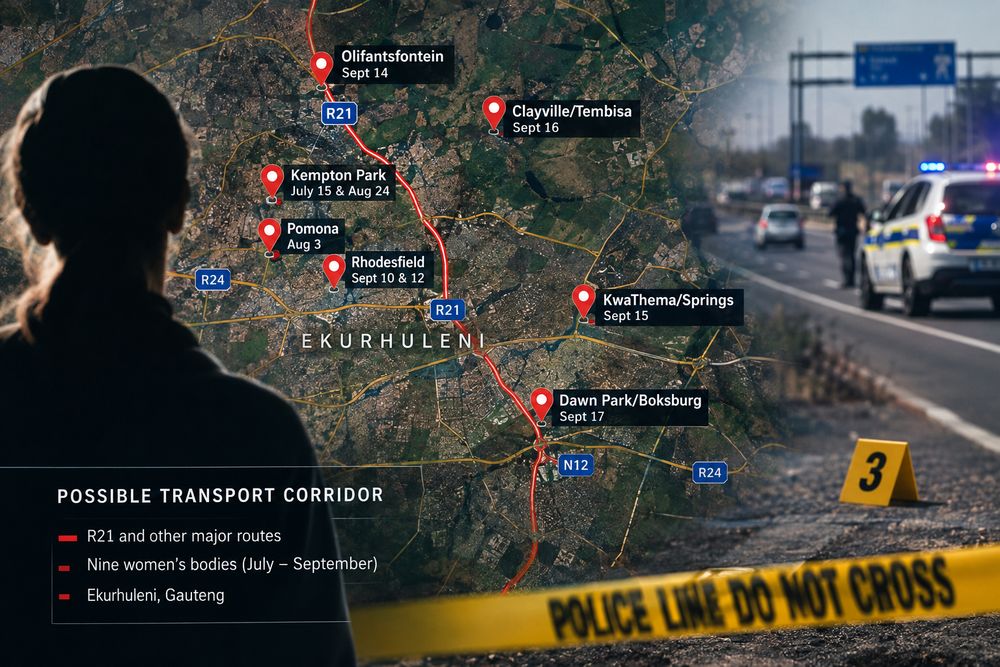
Possible transport corridor emerges in Ekurhuleni women’s killings.
A security expert has identified a possible transport corridor pattern in the locations where nine women’s bodies have been discovered across Ekurhuleni between July and September.
The geographical analysis, compiled by security expert Jan Joubert Jooste on September 17, examines the publicly reported locations of the bodies and considers whether their distribution could provide investigators with clues about the movements of a possible offender or offenders.
Jooste, whose security work extends beyond South Africa and includes assignments in hostile countries and for major corporate institutions, cautioned that the geographical analysis does not establish that the deaths are connected or that they were committed by a single person.
“SAPS has not confirmed that all nine deaths were committed by one offender,” the report states.
According to Jooste’s analysis, the earliest concentration of discoveries was around Kempton Park and the R21 before the geographical footprint expanded into other parts of Ekurhuleni.
The reported locations include Kempton Park, Pomona, Rhodesfield, Olifantsfontein, KwaThema/Springs, Clayville/Tembisa and Dawn Park in Boksburg.
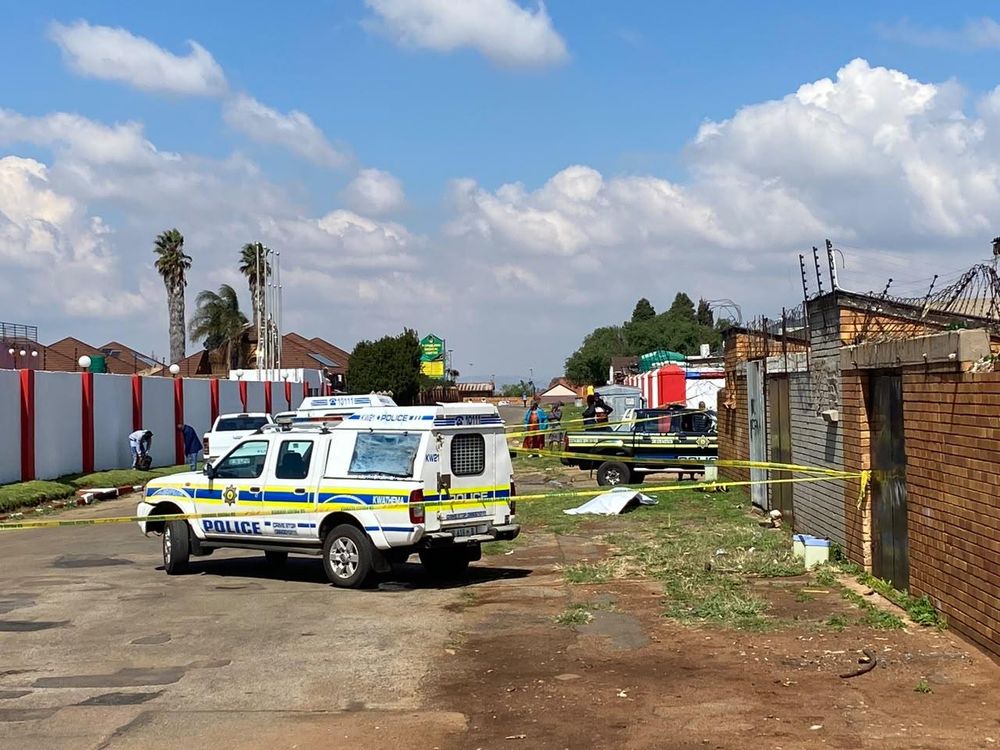
The ninth body was discovered in Dawn Park on September 17. Police indicated that the body appeared to have been dumped there and that the case would form part of the broader investigation into the deaths of the women.
Jooste said the geographical expansion could be significant if investigators eventually establish that some or all of the cases are connected.
"Rather than focusing only on where a possible offender lives, investigators could examine whether the person had regular familiarity with the wider East Rand Road and transportation network," he said.
However, the report stresses that the location where a body is found does not necessarily indicate where the victim was killed or where an offender lives.
“A disposal location alone cannot establish an offender's residence,” the report states.
Jooste said the condition of some of the bodies could also become relevant in determining whether the locations where they were found were the primary crime scenes.
Police said one woman found near Rhodesfield on September 10 was already in an advanced or decomposed state when discovered. Another decomposed body was reported in KwaThema on September 15.
Jooste said decomposition alone does not establish that a body was transported after death.
He said environmental conditions such as temperature, humidity, exposure and clothing, as well as the amount of time since death, can affect the rate of decomposition.
Jooste’s analysis suggests investigators could compare forensic estimates of the post-mortem interval with the period during which a victim could reasonably have been at the recovery site.
"If forensic evidence shows that a victim had been dead for substantially longer than she could have been at the location where her body was found, investigators could consider whether the primary crime scene was elsewhere. This distinction could change the geographical significance of the recovery sites," he said.
In addition, he said investigators would then need to examine the possible location where a victim was last seen or acquired, the primary assault or homicide scene, any temporary holding location, the vehicle loading point, the transport route and the eventual disposal site.
Gauteng police have discovered 9 bodies of women in the Kempton Park killings which have rocked the entire East Rand community. This map charts each location where the bodies have been found, while also illustrating the names and faces of all the deceased.
Image: Itumeleng English/ANAStudio. Sihle Mlambo/IOL
Jooste sets out four possible explanations for the geographical pattern if the cases are ultimately linked.
One possibility is that Kempton Park was an activity anchor, with repeated discoveries reflecting familiarity with the area. However, this would not establish that an offender lived there.
Another is wider East Rand mobility, where a person regularly travelled through several Ekurhuleni corridors for work, family, social activities or other routine reasons.
A third possibility is that the pattern represents disposal geography rather than offender geography.
If victims were killed elsewhere and transported to the locations where their bodies were found, the recovery sites could reveal more about accessible disposal routes than an offender’s residence.
The fourth possibility is that there are multiple offenders or separate perpetrators.
He notes that similarities in victim profiles and geographical proximity do not, by themselves, establish that one offender is responsible.
Jooste recommends that investigators establish the exact GPS coordinates of confirmed recovery sites and separately determine each victim’s last-known location, probable encounter or assault location and disposal site.
The estimated times of death should also be compared with discovery times, as the order in which bodies were found does not necessarily reflect the order in which the women were killed.
CCTV and automatic number plate recognition data along the R21, R24, N12 and connecting roads could be examined for common vehicles and repeated movements.
Lawfully obtained cellphone tower records could also be compared against relevant time windows.
The analysis further identifies transport nodes, fuel stations, businesses and CCTV blind spots as areas that could potentially provide useful information.
Forensic comparisons could be critical in establishing whether apparently separate scenes are connected.
These could include DNA, fibres, restraints, tool or weapon signatures, tyre impressions and other characteristics found at the scenes.
Jooste also recommends comparing the women’s victimology and routines rather than relying solely on factors such as age, sex and the locations where their bodies were discovered.
Jooste’s preliminary finding is that the publicly available information shows a possible transportation geography, beginning with a concentration around Kempton Park and the R21 before spreading across the wider East Rand.
However, the analysis does not conclude that an offender lives in Kempton Park or identify any individual as a suspect.
Instead, if the cases are eventually linked, Jooste suggests that investigators could examine whether a recurring movement corridor or activity area connects the women’s timelines with the body-recovery sites.
That hypothesis could then be tested against CCTV, ANPR, telecommunications records, forensic comparisons and verified victim timelines.
The analysis is based on open-source information and is not an official SAPS investigative document or forensic profile.

/file/attachments/orphans/ATBBluffers_540909.jpg)