Neo-Nazi NSU attacks exposed 15 years ago
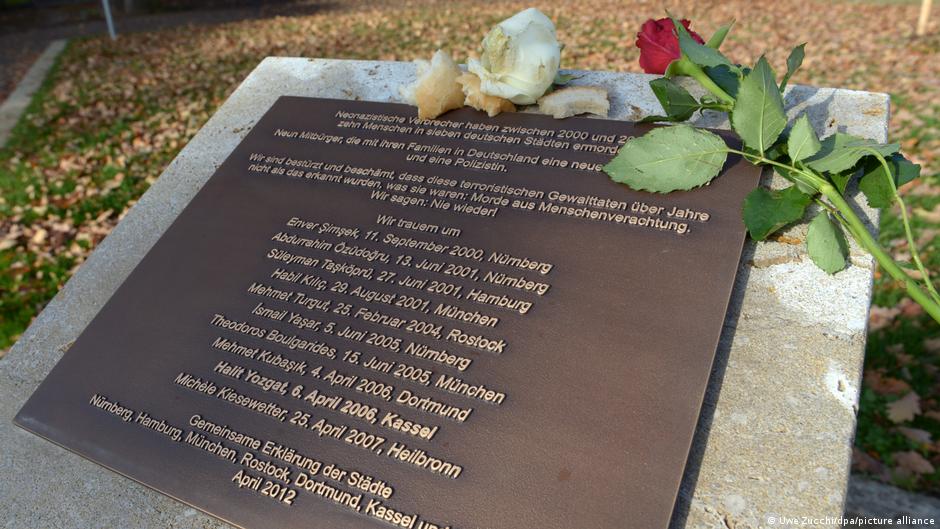
The memorial plaque for 10 NSU murder victims in KasselImage: Uwe Zucchi/dpa/picture allianceAdvertisementHalit Yozgat was the NSU's ninth murder victim. He was killed at point-blank range on April 6, 2006, in Kassel, in the German state of Hesse. Before him, eight other men with immigrant backgrounds had also been shot point-blank since September 2000. The tenth and final victim that did not fit this pattern: she was a woman. Police officer Michèle Kiesewetter was killed on April 25, 2007, in Heilbronn, in the German state of Baden-Württemberg.
Four and a half years after Kiesewetter's death, the identities of those behind the mysterious series of murders finally came to light. On November 4, 2011, Beate Zschäpe, who was later sentenced to a long prison sentence, revealed the existence of the National Socialist Underground (NSU). The group also included Uwe Böhnhardt and Uwe Mundlos, who were found dead in a burned-out RV on the same day.
The two men are believed to have taken their own lives following a failed bank robbery in the eastern German city of Eisenach, under circumstances that have never been fully clarified. In a macabre confession video that Zschäpe sent to the media, they boasted that they had shot and killed nine men on racist grounds.
One of the many unanswered questions is why Michèle Kiesewetter was also killed. No definitive answers were provided either in the first NSU trial before a Munich court, which lasted from 2013 to 2018, or in numerous parliamentary investigative committees.
Fifteen years after the neo-Nazi terrorist group was exposed, the families of the murder victims are increasingly losing hope that any new information will come to light. One such opportunity was the trial of Susann Eminger — who was sentenced in July 2026 by a court in Dresden, in the state of Saxony, to two years' probation for supporting the terrorist group.
Eminger helped her friend Beate Zschäpe assume a different identity during doctor's visits and when dealing with the police by letting Zschäpe use her health insurance card and ID card. However, the court was unable to prove that she was aware of the series of murders committed by the NSU.
Nonetheless, relatives of the murder victims and the survivors of a bombing carried out by the NSU in Cologne, in the German state of North Rhine-Westphalia, think the verdict beggars belief: "Ten people were executed in cold blood, and countless others were injured in bombings," said Michalina Boulgarides, whose father, Theodoros, was shot dead in Munich on June 15, 2005.
"When will the victims get justice?" asked Boulgarides, in response to the suspended sentence handed down to Susann Eminger in the second — and likely final — NSU trial. Her husband, André, had received a two-and-a-half-year prison sentence in 2018 in the first criminal trial against the terrorist group, but he was required to serve only two-thirds of it. That, too, has outraged the victims' families.
The sentence for neo-Nazi Ralf Wohlleben, who had been sentenced to ten years in prison for aiding and abetting murder in the first NSU trial, also ended in May 2026. This means that Beate Zschäpe remains the only person convicted in connection to the NSU who is still incarcerated; she is likely to remain behind bars until 2035. All other investigations by the Federal Prosecutor's Office against suspected NSU supporters have been dropped.
While legal proceedings appear to be largely concluded, the broader societal debate surrounding the unprecedented series of murders and attacks carried out by right-wing terrorists continues. Two key projects, however, are making slow progress: the national memorial center planned for Nuremberg (Bavaria) and the memorial on Keupstraße in Cologne.
Nuremberg is an obvious choice for a national documentation center for the victims of racism and right-wing extremism. It was here where the NSU murdered its first victim, Enver Şimşek, a florist, followed by two others. Another man was badly injured here in what is believed to be the first NSU bombing.
What's more, Nuremberg also played a major role during the Nazi era, where Adolf Hitler held propaganda-laden Nazi Party rallies featuring mass marches and speeches.
The German Bundestag has been considering the idea of an NSU Documentation Center since 2024. However, plans for a swift implementation fell by the wayside because the governing coalition at the time, led by Chancellor Olaf Scholz (SPD), collapsed prematurely. The project is now set to be completed by 2030.
A response from the federal government to a parliamentary inquiry from the environmentalist Green Party provides initial details: Just under €9 million ($10 million) has been earmarked to create the central memorial site under the leadership of the Federal Agency for Civic Education (BpB).
Things are further along in the city of Chemnitz, in the eastern German state of Saxony. A documentation center on the NSU complex has been in operation in the city since 2025, the year in which it was European Capital of Culture. The title of the exhibition, "Open Trial," speaks to its broad, ambitious approach as a space for education, research and events.
Gamze Kubaşık gave a speech at the opening. Her father, Mehmet, was shot and killed by the NSU in Dortmund on April 4, 2006. In fact, Chemnitz was where the terrorists Zschäpe, Mundlos and Böhnhardt had been in hiding for years. "This is also where they planned my father's murder," said Gamze Kubaşık, highlighting the significance of the location. "The support they received from the local neo-Nazi scene enabled them to carry out their schemes and reinforced their ideology."
The executive directors of the Chemnitz-based organization, Nora Krzywinski and Esther Gerstenberg, believe a national memorial and documentation center dedicated to the NSU complex is necessary. "However, it cannot replace the work being done at the actual sites of terror and to address the social conditions that gave rise to it," they emphasized in their response to a written inquiry from DW.
The guiding concept for the exhibition, explained Krzywinski and Gerstenberg, is to highlight the perspectives of those affected and to link remembrance with an examination of the persistence of racism and the responsibility of the state and society. "That is why we do not view our work as a substitute for a national memorial site but rather as part of an integrated system that connects sustained local, regional and national efforts to remember and come to terms with the past in a lasting way."
While efforts to address the multifaceted NSU complex in Chemnitz have already taken concrete form, the residents of Keupstrasse in Cologne are still waiting for the promised memorial to the 22 people injured in the June 9, 2004, bomb attack. According to media reports, however, construction cannot begin until 2030 at the earliest, because old buildings around the planned site must first be demolished and new ones erected.
This means that it will take more than a quarter-century until a memorial honoring the victims of the NSU bombing on Keupstrasse can be erected where it took place. Meanwhile, 15 years after the NSU exposed itself, the German Bundestag has agreed to hold a debate. It is titled: "Commemorating the victims, living up to our responsibilities and taking today's threats seriously."
The text was originally written in German.