Nasa's crashing telescope resumes science ops. Will it now fall faster?
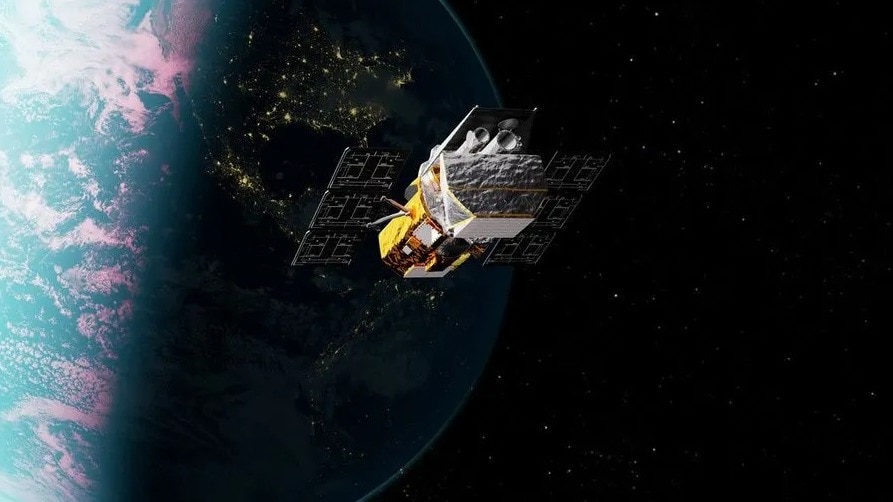
Nasa's Neil Gehrels Swift Observatory is back to studying some of the universe's most violent events.
But there is a problem it needs to come to terms with, which is that the ageing space telescope is still slowly falling towards Earth, and Nasa expects its scientific life to end within weeks.
On September 25, Nasa said Swift had switched on its third science instrument, the Burst Alert Telescope (BAT), and had also restored its ability to automatically turn towards sudden flashes in the sky. An illustartion of the cosmic explosions Swift observatory studies. (Photo: Nasa)
The observatory was then about 325 km above Earth.
Once it drops below roughly 300 km, operating it becomes increasingly difficult, with science observations now expected to end in early to mid-October.A TELESCOPE TO STUDY COSMIC EXPLOSIONS
Swift has been orbiting Earth since November 20, 2004, studying gamma-ray bursts, which are extraordinarily powerful flashes of high-energy light.
The telescope has also been additionally studying black holes, stars and other cosmic events.
It does these tasks using three instruments that work in tandem. An illustartion shows the different instruments the Swift observatory uses. (Photo: Nasa)
The Burst Alert Telescope (BAT) detects gamma rays and quickly alerts scientists when a powerful cosmic explosion occurs. The X-Ray Telescope (XRT) then studies the X-rays coming from the event, while the Ultraviolet/Optical Telescope (UVOT) observes its ultraviolet and visible-light aftermath.
In simple terms, BAT finds the explosion, XRT examines its X-ray afterglow and UVOT studies what follows in ultraviolet and visible light.SWIFT IS FALLING FROM SPACE
But the problem is that Swift itself is running out of altitude. An illustartion of Swift telescope studying a cosmic explosion. (Photo: Nasa)
Earth's thin upper atmosphere creates drag even hundreds of kilometres above the planet, gradually pulling the spacecraft lower.
Furthermore, increased solar activity has accelerated that orbital decline.
Consequently, Nasa began preparing for Swift's eventual fall in December 2025.
On February 11, 2026, it suspended most science operations to reduce drag and preserve time for a planned rescue that would involve raising the observatory into a higher orbit.
As a result, BAT was switched off in April to save power and allow Swift to adopt an orientation designed to reduce atmospheric drag.With all of its telescopes back to work, our Swift observatory is ready to catch cosmic outbursts!If its Burst Alert Telescope spots a gamma-ray flare, Swift will automatically point its other two telescopes at the site. More on Swift’s current status: https://t.co/XzzIiDO03I pic.twitter.com/c4cDio8PxL— NASA Universe (@NASAUniverse) September 25, 2026A RESCUE MISSION THAT FAILED
The rescue attempt began on July 3, when Katalyst Space's robotic Link spacecraft launched from the Marshall Islands.
Link was supposed to rendezvous with Swift, capture it and raise its orbit, but it eventually developed attitude-control problems.
By July 28, Nasa said two of its three reaction wheels were unavailable and there were also problems with its cold-gas thruster system.
On August 19, Nasa and Katalyst announced that Link would no longer capture or boost Swift. The mission was instead scaled back to demonstrate rendezvous and proximity-operation technologies. A solar panel on Katalyst Space’s Link robotic servicing spacecraft is seen in orbit. (Photo: Katalyst Space)
That left Swift on its original downward path, but gave it one last chance to work.
Its X-ray and ultraviolet/optical telescopes restarted on August 26. BAT was confirmed to be detecting gamma rays on September 18, and automated pointing resumed on September 21.
Swift is therefore scientifically alive again.
But its return comes with a deadline, and a hefty ask. Each day it captures explosions around the universe, the observatory is bound to fall faster.
As it currently stands, Earth's atmosphere continues to pull Swift down, and one of Nasa's longest-running cosmic observers is approaching the end of its mission.- Ends