Nagastra drones to Pinaka rockets: How Nagpur is powering India's defence push
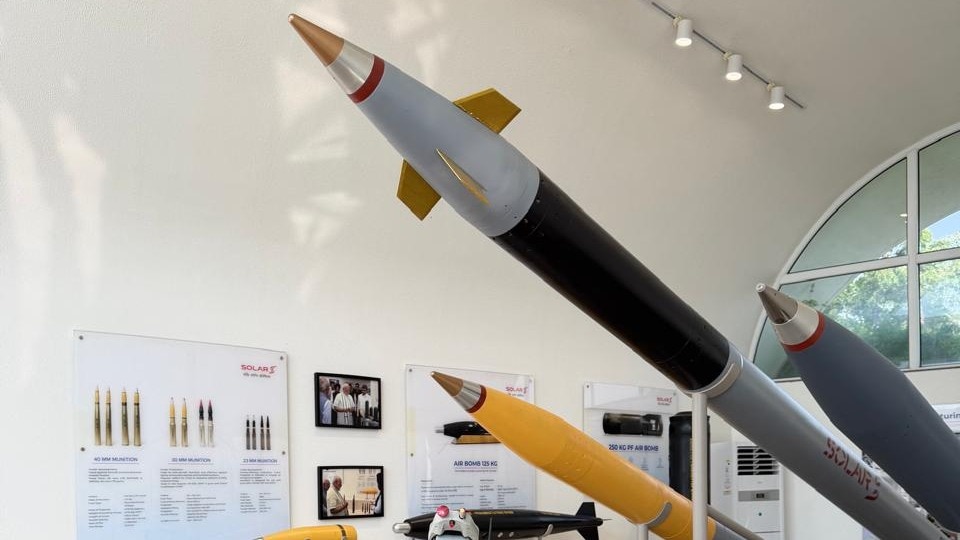
A year after Operation Sindoor, Nagpur is emerging as a major hub of indigenous defence manufacturing, with Solar Defence and Aerospace Limited delivering the first batch of 450 Nagastra-1 loitering munitions to the Army and exporting 1,000 Guided Pinaka rockets to Armenia this year.
As modern warfare increasingly relies on precision strikes, unmanned systems and long-range firepower, India is stepping up efforts to strengthen its indigenous defence manufacturing capabilities. At the forefront of this push is Nagpur-based Solar Defence and Aerospace Limited, which is manufacturing two key weapons systems for the Indian armed forces: the Nagastra series of loitering munitions and the Pinaka multi-barrel rocket launcher ammunition.
In October this year, the company handed over the first batch of 450 indigenous Nagastra-1 anti-tank loitering munition systems to the Indian Army. The delivery marks a significant milestone in the development of India's homegrown suicide drones, which were also deployed during Operation Sindoor to target terrorist installations in Pakistan.
The development comes a year after Prime Minister Narendra Modi inaugurated Solar Defence and Aerospace Limited's munition manufacturing facility in Nagpur in 2025.
The company is also manufacturing Pinaka rockets, another major indigenous weapon system developed by the Defence Research and Development Organisation (DRDO). In January 2026, Defence Minister Rajnath Singh flagged off the first batch of 1,000 Guided Pinaka rockets from the Nagpur facility for the Armenian ground forces, marking a significant milestone in India's defence exports.
An exclusive report by Aaj Tak's Manjeet Negi takes a closer look at the making of these weapons systems and how Nagpur is becoming an important centre for India's expanding defence manufacturing capabilities.NAGASTRA-1: SUICIDE DRONE USED DURING OP SINDOOR
The Nagastra-1 is an anti-tank loitering munition designed to locate and destroy enemy targets, particularly tanks and armoured vehicles. Unlike conventional drones used only for surveillance, it can hover over an area, monitor enemy movement and launch a precision strike when the target is identified.
The system was used by the Indian Army during Operation Sindoor to strike terrorist targets in Pakistan, bringing India's indigenous loitering munition capabilities into focus.
Its latest delivery to the Army follows successful technical trials at Rajasthan's Mahajan Field Firing Range in August 2026. With the first batch of 450 units handed over in October, the system is now entering the next stage of deployment.
One of Nagastra-1's key advantages is its ability to operate in two modes, depending on the mission.
In its recoverable and reusable mode, the drone has an operational range of up to 25 km. In the fire-and-forget mode, in which it carries out a one-way kamikaze strike, it can travel up to 50 km to hit its target.
It can remain airborne for up to 60 minutes, giving it the ability to conduct surveillance and track enemy positions before executing an attack. Its anti-tank capability makes it particularly useful against enemy armoured formations.NAGASTRA-2: WARHEAD DESIGNED TO PENETRATE TANK ARMOUR
Building on the capabilities of Nagastra-1, the company is also developing Nagastra-2, an advanced loitering munition designed to take on heavily armoured targets.
A key feature of Nagastra-2 is its 4-kg tandem shaped-charge warhead. According to Solar Defence and Aerospace Limited chairman Satyanarayan Nuwal, the warhead can penetrate up to 650 mm of rolled homogeneous armour (RHA), the standard reference used to measure the protective capability of tank armour.
The system is equipped with high-resolution cameras that can operate in both daylight and at night, allowing it to identify and track targets in different visibility conditions.
Nagastra-2 is also designed to address one of the biggest challenges facing unmanned aerial systems in modern warfare: electronic interference.
Enemy forces increasingly use GPS jamming and communication disruption to interfere with drones and other unmanned systems. To counter this threat, Nagastra-2 incorporates Electronic Counter-Countermeasure (ECCM) technology.
The company claims the system can maintain its targeting capability even amid jamming and spoofing attempts, allowing it to continue towards its designated target.
The company had earlier received an order for 450 Nagastra-1R systems from the Army in 2025. The system underwent trials at locations ranging from Ladakh to Babina, as part of efforts to establish its operational capabilities.
The development of Nagastra-2 is expected to further strengthen India's indigenous loitering munition capabilities, particularly against enemy tanks and armoured vehicles.PINAKA: HOW INDIA'S INDIGENOUS ROCKET SYSTEM HAS EVOLVED
Alongside the Nagastra series, Nagpur is also playing an important role in the manufacturing of Pinaka rockets, one of India's key indigenous artillery systems.
Developed by DRDO, Pinaka is a multi-barrel rocket launcher system capable of firing multiple rockets in quick succession to strike enemy positions, bunkers and other military installations.
While Pinaka ammunition was traditionally manufactured through the public-sector defence production ecosystem, private-sector participation has now expanded its manufacturing capacity.
Solar Defence and Aerospace Limited has entered the segment with orders worth around Rs 6,000 crore and has successfully undertaken the manufacturing and testing of the high-tech rocket system. From Nagastra suicide drones to Pinaka rockets: How Nagpur is powering India's defence arsenal
The company has been manufacturing different variants as the system has undergone successive upgrades to improve its range and accuracy.
Initially, Pinaka had a range of around 37.5 km. Subsequent upgrades extended its reach to 45 km and 75 km, with DRDO and the Nagpur-based company working on more advanced versions.
The Army inducted the Pinaka Mk-I Enhanced following successful trials in April 2022. This variant can strike targets at distances exceeding 75 km.
The latest Guided Pinaka variant has an operational range of up to 120 km, significantly expanding the system's reach. Its advanced guidance, navigation and control systems are designed to improve accuracy, giving it the ability to engage targets with greater precision than conventional unguided rockets.
Recent trials at Pokhran have further demonstrated the capabilities of the upgraded system.GUIDED PINAKA: 1,000 ROCKETS EXPORTED TO ARMENIA
Pinaka's evolution from a domestic artillery system into an export product marks another important development in India's defence manufacturing ambitions.
In January 2026, Defence Minister Rajnath Singh flagged off the first batch of 1,000 Guided Pinaka rockets from Solar Defence and Aerospace Limited's Nagpur facility for the Armenian ground forces.
The export is a significant milestone for India's indigenous defence industry, demonstrating the growing international acceptance of weapon systems developed and manufactured in the country.
The Armenian order also highlights the expanding role of private-sector manufacturers in India's defence exports, with Solar Defence and Aerospace Limited now producing ammunition for an overseas military customer.
The company says several other countries have expressed interest in acquiring the Pinaka system following the Armenian order.
According to the firm, its relatively lower cost, precision-strike capabilities and growing confidence in India's defence manufacturing ecosystem have contributed to the system's international appeal.
The growing importance of Pinaka in India's defence preparedness is also reflected in the scale of government procurement.
The Ministry of Defence has signed contracts worth more than Rs 10,200 crore with Solar Industries and Munitions India Limited for Pinaka launchers and ammunition.
The contracts are expected to strengthen the domestic manufacturing ecosystem and support the armed forces' requirements for the rocket artillery system.- Ends
Born in Pauri district of Uttarakhand, Manjeet Negi did his early schooling from his village school near Rishikesh and then moved to the town for secondary education. Later, he did his graduation from Hemavati Nandan Bahuguna University. In the year 2000, he did his journalism diploma from Kurukshetra University and started his career with Doordarshan News and started reporting on defence forces from the 2001 Bhuj earthquake. In his career as a defence correspondent, Negi has had the opportunity to report exclusives from world's highest battlefield Siachen Glacier in the north to the Andamans in the South and from the Rann of Kutch in the west to the Arunachal Pradesh border with China in the East.
A regular news-breaker on matters of national security and military affairs, Negi considers the coverage of he Kedarnath tragedy of 2013 as the highest point of his career. During the grave disaster at Kedarnath in June 2013, Manjeet Negi was the first and only TV reporter who walked for 55 Kms on the hilly track to reach the Kedarnath shrine. Spending his first night in the complex amidst several hundred dead bodies around him, Negi says he saw Lord Kedar in his dream. After the Kedarnath disaster, the writer got another opportunity to cover another disaster in the Nepal earthquake in 2015 for the Aaj Tak channel. During the reporting of that disaster for about 10 days, the writer got an opportunity to witness and report the large scale relief and rescue operations undertaken by the Indian Army and the Indian Air Force.
Besides reporting, he is also a skilled mountaineer. With Nehru Institute of Mountaineering and Garhwal Regiment, he has undertaken mountaineering expedition to Satopanth via Gomukh. Accompanying the Mount Manaslu mountaineering expedition of a Garhwal Regiment unit, he also reported about the expedition. He has also scaled the Dronagiri mountain near Joshimath in Uttarakhand. Manjeet Negi has also been honoured with a special award by the Union Home Minister, Shri Rajnath Singh for his reporting of Kedarnath disaster. He was awarded the best reporter award for his coverage of Nepal earthquake by India Today Group. At present, the writer has been working as Editor with Aajtak Channel of India Today Group.