Mooncake: A small festive pastry with a long and rich history - CGTN
By continuing to browse our site you agree to our use of cookies, revised Privacy Policy and Terms of Use. You can change your cookie settings through your browser.
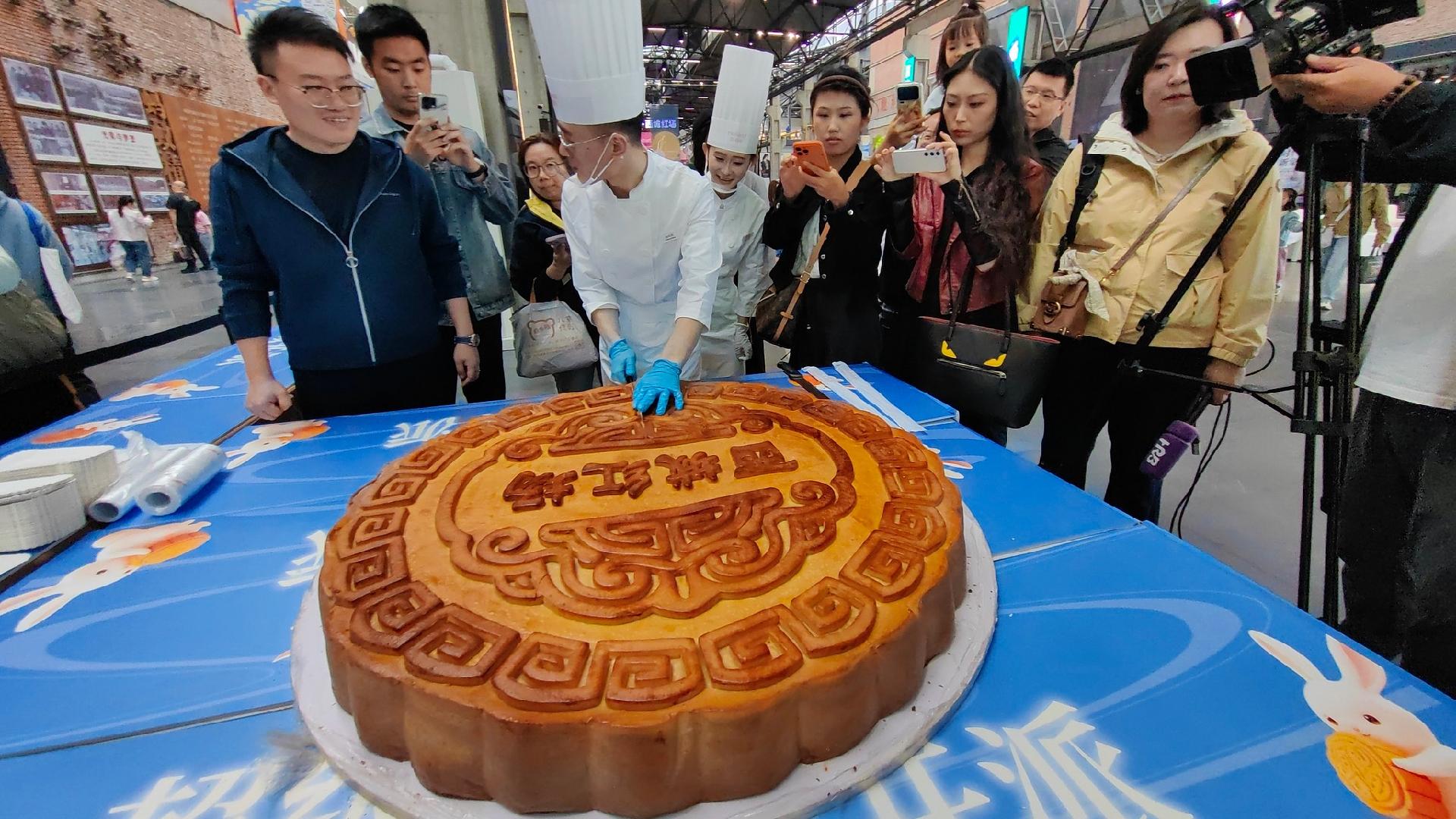
Mooncakes are a symbol, a ritual and a connection to a tradition that stretches back more than 3,000 years. /CFP
Every year, as the full moon rises on the 15th day of the eighth month of the Chinese lunar calendar, families across China and much of Asia gather to mark one of the most important dates in the cultural calendar. The Mid-Autumn Festival, also known as the Moon Festival or Mooncake Festival, is the second biggest holiday in China after Chinese New Year.
At the centre of the festivities sits a small, dense, intricately decorated pastry that carries centuries of meaning in every bite.
In 2026, the festival falls on 25 September. For the millions of people who celebrate it, mooncakes are a symbol, a ritual and a connection to a tradition that stretches back more than 3,000 years.
The origins of the Mid-Autumn Festival lie in ancient Chinese moon worship, rooted in agricultural life and the changing of the seasons. The festival is believed to have evolved from the autumnal equinox moon ceremonies of antiquity, when people gave thanks for the harvest and prayed for the light to return.
The Chinese lunar calendar, shaped by the phases of the moon, governed the farming calendar. The full moon of the eighth month was considered among the most auspicious of the year.
As for mooncakes themselves, their origins are the subject of debate among historians.
The circular form of the mooncake mirrors the full moon and carries with it the values of family reunion, happiness and completeness. /CFP
One of the most compelling theories connects them to resistance and revolution. According to legend, during the Yuan Dynasty, Han people seeking to overthrow the ruling Mongol Empire used mooncakes to pass secret messages between rebels, hiding slips of paper inside the pastries to coordinate their uprising.
It was only during the Ming Dynasty (1368–1644) that mooncakes became a popular bakery product in their own right, and the legend of Chang'e - the moon goddess - began to be imprinted on their surfaces as a form of food art.
By the Qing Dynasty, eating mooncakes during the festival had become a firmly established tradition.
No account of mooncakes is complete without the story of Chang'e, the Moon goddess whose image adorns mooncakes to this day.
According to Chinese mythology, the hero Hou Yi was rewarded with an elixir of immortality after shooting down nine of the ten suns that had scorched the Earth in a state of permanent drought. His apprentice Feng Meng attempted to steal the potion, but Hou Yi's wife Chang'e drank it herself to prevent him. She ascended to the moon and remained there eternally, accompanied by a jade rabbit.
To honour her sacrifice, villagers placed food offerings in their courtyards and made wishes under the moonlight. From then on, the 15th day of the eighth month became the Mid-Autumn Festival, and Chang'e was worshipped as the moon goddess, her story immortalized in the circular pastries made in the moon's image.
The circular form of the mooncake mirrors the full moon and carries with it the values of family reunion, happiness and completeness. In Chinese culture, roundness itself is a symbol of bliss and good fortune.
In Mandarin, the concept of unity and harmony is expressed as Yuanman, a word that also captures the roundness of both the full moon and the mooncake. These pastries are typically around five to ten centimetres across and are dense and rich, meant to be shared rather than eaten whole. A single mooncake is commonly cut into four slices and enjoyed with a cup of Chinese tea.
One of the most striking things about mooncakes is how varied they are. /CFP
They are given as gifts between family members, friends, colleagues and business partners as an expression of goodwill and gratitude.
Buying mooncakes is an indispensable part of the annual celebration, with people preparing boxes of the delicacy for family, friends and colleagues. When time allows, the festival also brings people together for dinner, allowing them to share these treats.
One of the most striking things about mooncakes is how varied they are. Across China's regions, distinct styles have developed, each with their own crust, filling and character.
Cantonese-style mooncakes, originating in Guangdong Province in southeastern China, are the most widely recognized internationally. They have a tender, golden-brown crust and can be filled with lotus seed paste, melon seed paste, roast pork, ham, chicken, duck, mushrooms or salted egg yolks. They are sweet in flavour and the style most commonly found in Chinese bakeries around the world.
Beijing-style mooncakes from northern China are known for their thicker, more crumbly crust and sweet fillings such as red bean paste or hawthorn, with meticulous surface decoration. The traditional ratio of pastry to filling in this style is four to six.
Suzhou-style mooncakes, associated with the Yangtze Delta region around Shanghai, are among the oldest variety, with a history of over a thousand years. They are distinguished by their flaky, layered pastry and can be either sweet or savory, sometimes filled with pork or ham.
Chaoshan-style mooncakes from southeastern Guangdong tend to be larger than most, with fillings of mung bean paste or black bean and potato paste.
Authorities have set limits on retail pricing and required sellers to maintain sales records. /CFP
Yunnan-style mooncakes offer two celebrated varieties: ham mooncakes filled with diced ham and honey, balancing sweet and salty, and flower mooncakes filled with fresh roses or other edible flowers - a reflection of Yunnan's botanical abundance.
And then there are ice-skin mooncakes, first popularized in Hong Kong. Their white, unbaked skin - stored in a refrigerator rather than an oven - gives them their name, and they have become a modern favorite, often filled with contemporary flavors like custard, chocolate or ice cream.
The mooncake industry in China has grown into a fiercely competitive market worth an estimated ¥16.9 billion ($2.52 billion).
As the pastries have evolved into luxury gift items, the packaging has grown increasingly elaborate and thus expensive. Some boxes have been bundled with nuts, liquor and high-end hotel packages, prompting Chinese authorities to launch a crackdown on "sky high" mooncake prices and excessive packaging in recent years.
Authorities have set limits on retail pricing and required sellers to maintain sales records.
Officials warned that overpriced mooncakes "deviate from the origin of traditional culture" and could serve as vehicles for corruption.
The Mid-Autumn Festival and its mooncakes are no longer confined to China.
The festival is celebrated across East and Southeast Asia - known as Tsukimi in Japan, Chuseok in South Korea and Tet Trung Thu in Vietnam. It is also marked in Chinese diaspora communities from Singapore and Malaysia to the United States and the United Kingdom.
Each culture brings its own inflection to the celebration, but the core meaning - gratitude, reunion, the brightness of the full moon - remains consistent across them all.