Medicine Nobel goes to scientists who can ‘control brain using light’: What their work is - The Indian Express
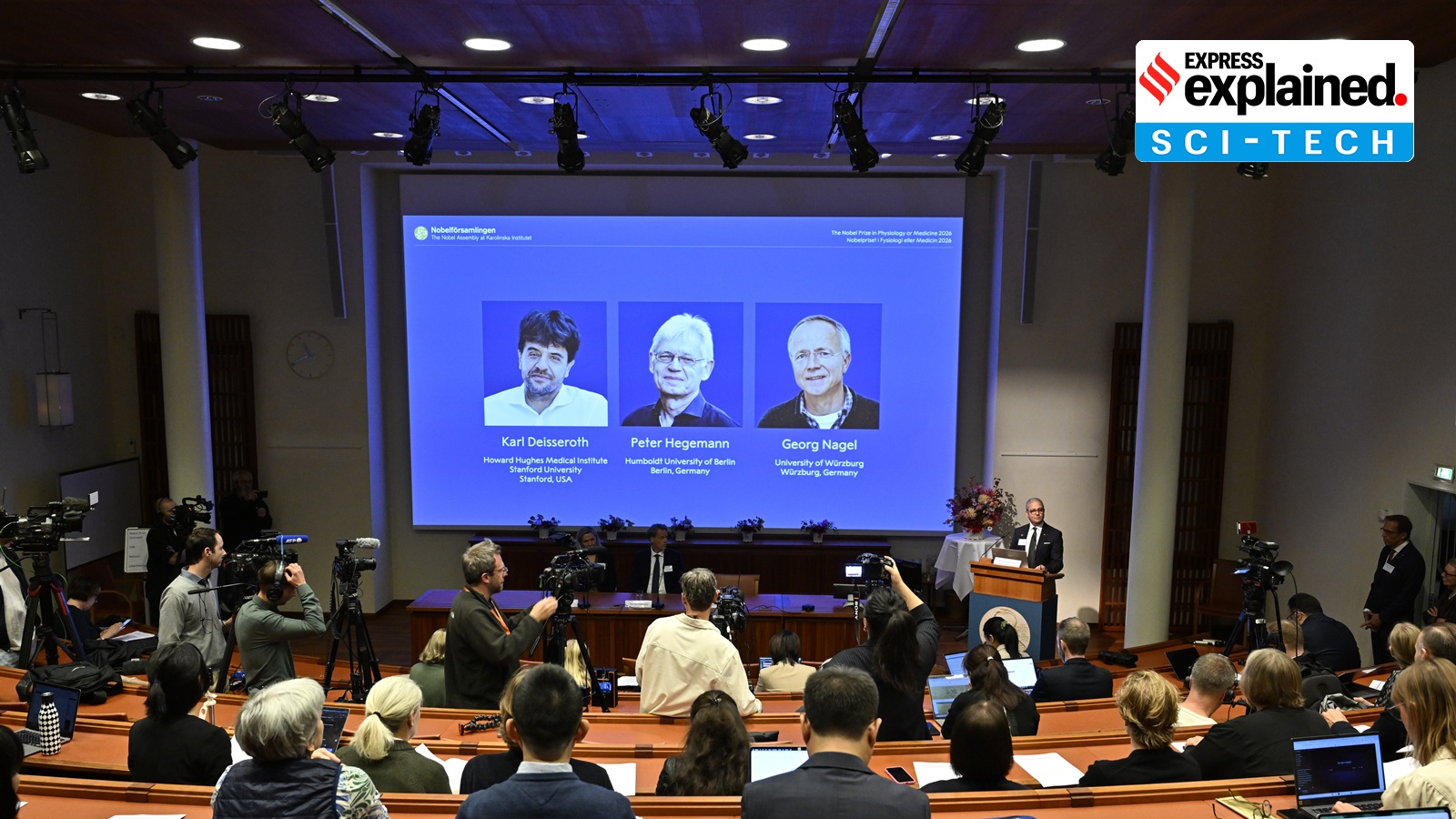
Nobel Prize 2026 Medicine: Scientists who developed a way to use light to control specific nerve cells in the brain, allowing researchers to study — and influence — how they shape memories, feelings and behaviour, have won the 2026 Nobel Prize in Physiology or Medicine.
The prize was awarded to Peter Hegemann, Georg Nagel and Karl Deisseroth for “discoveries concerning light-gated ion channels and optogenetics”, the Nobel Prize committee said.
What exactly have the scientists done, and what is the real-world impact of their work? We explain.
Light-gated ion channels are proteins that act like tiny doors in a cell’s membrane, but with one special feature: light controls whether the door is open or closed. When a particular wavelength of light hits the protein, it changes shape and opens. Charged particles called ions can then flow through the channel.
For example, when light hits the human eye, it sets of a reaction that leads to ions moving through the channel as an electric current, travelling through optic nerves to eventually reach the brain.
Optogenetics is a technique that lets scientists control specific cells using light. According to the Nobel Prize’s official press release, optogenetics has “transformed neuroscience from observing and “reading” brain activity to actively “writing” into it, establishing a causal link between distributed, genetically specified circuit motifs and behavior, emotion, and cognition.”
Among the actions the Nobel winners managed to perform using light was a mouse moving its whiskers, and creating the memory of feeling fear in mice who were perfectly safe.
The brain is a remarkable organ, and scientists have long wondered how it can control physical functions, govern feelings and memory, and create art.
In the 20th century, researchers identified which brain regions govern which bodily functions. However, they could not show that a specific type of nerve cell directly caused a particular feeling or behaviour, so the resulting picture was like a blurry photograph.
Francis Crick (Nobel 1962) imagined a solution. Nerve signals are extremely fast, so he reasoned that light would be the ideal way to control them. If nerve cells could be made to react to light, neural activity could be controlled. Crick admitted the idea was far-fetched, but perhaps not impossible.
In the early 1990s, Peter Hegemann, at the Max Planck Institute for Biochemistry in Martinsried, was intrigued by the unicellular alga Chlamydomonas, which could sense light through an ‘eyespot’, a tiny orange dot on its cell’s surface. If the alga was kept on one end of a bowl, and light shone on the other end, it would swim to that side within milliseconds. Hegemann wondered how the eyespot was so much faster than the human eye.
His theory was that unlike the human eye, where photoreceptors first register light and then many proteins have to be moved before an electric signal can pass through the ion gate, in Chlamydomonas, the same protein was doing the reception and the passing on.
Others were sceptical, since no known ion channel reacted to light on its own. Isolating the protein proved difficult because it became unstable outside the eyespot. Around the turn of the millennium, however, Japanese researchers mapped the alga’s DNA. Hegemann’s group found two genes resembling known light-capturing proteins.
Hegemann contacted Georg Nagel at the Max Planck Institute for Biophysics in Frankfurt. Nagel injected each gene separately into frog egg cells, which then produced the proteins and placed them in their outer membranes. He found that Hegemann’s hypothesis was correct: both proteins were ion channels that opened in response to light.
They were named channelrhodopsin-1 and channelrhodopsin-2, and the second paved the way to optogenetics. It opened within 0.2 milliseconds of a light pulse, letting positively charged ions flow and producing an electrical signal.
The two then introduced the gene for channelrhodopsin-2 into human embryonic kidney cells and hamster kidney cells. The cells became light-sensitive and produced electrical signals when illuminated. In 2003, Hegemann and Nagel published their results and proposed the protein as a tool for generating electrical impulses in cells using light.
Karl Deisseroth, while studying medicine in the 1990s, trained at a psychiatric clinic. Here, the functions of the brain, and the sufferings of those whose brain worked differently, held his attention.
His group then searched for a protein that could trigger impulses in nerve cells. After hearing of channelrhodopsin-2, he asked Nagel for the DNA. Introduced into rat nerve cells in petri dishes, it was produced without apparent problems. Blue light provoked a nerve signal that could pass to other nerve cells. The group published this in 2005.
The method was named optogenetics in 2006, and researchers soon found more light-activated proteins that turn nerve cells on and off. In 2007, Deisseroth’s group introduced the channelrhodopsin-2 gene into a specific nerve cell type in the mouse motor cortex. A thin optic fibre fed through a small hole in the skull let them control the movement of the mice’s whiskers.
The same year, light shone on a recently discovered cell type suspected of controlling wakefulness woke sleeping mice, confirming the hypothesis. In 2012, with Susumu Tonegawa, Deisseroth activated an engram, the pattern of neural pathways formed when a memory is created. Reactivating the cells that formed a fear memory made mice show fear when not in danger. It was the first demonstration of exactly which nerve cells are necessary for a specific memory.
An adult human brain has around 90 billion nerve cells, each with thousands of connections, and cells with entirely different functions can be intermingled. Optogenetics lets researchers separate them. They have identified circuits governing pain, social behaviour, thirst, food consumption, reward, attention, circadian rhythm and fever.
The method also works beyond the brain. Deisseroth showed that forcing the heart to work harder can reinforce anxiety, and other researchers found gut cells that explain why some prefer sugar to sweeteners.
Optogenetics has deepened understanding of depression, anxiety, schizophrenia, Alzheimer’s and Parkinson’s disease. In ongoing clinical trials for retinitis pigmentosa, a channelrhodopsin-like protein placed in a blind person’s retina restored some vision. With light-emitting glasses, the person could discern and grasp objects on a table. Researchers also hope optogenetics could make cochlear implants more precise.
As the Nobel Prize website’s official press release says, “Across cognition, emotion, and movement, these discoveries and applications illustrate a profound shift. Behaviors previously understood as unified phenomena can now be experimentally deconstructed into discrete computational streams. By enabling temporally precise, pathway-specific interventions in intact brains, optogenetics has transformed neuroscience by revealing the causal logic of brain function.”
But does this not sound potentially dangerous?
While most scientific advancements have the risk of potential misuse, optogenetics doesn’t exactly mean shining a light and controlling someone’s brain.
Rohit Singh, Assistant Professor in the Departments of Biostatistics & Bioinformatics and Cell Biology at Duke University, USA, told The Indian Express, “There are three major technical safeguards. First and most important, optogenetics typically relies on genetically modifying neurons to produce light-sensitive microbial proteins that human cells do not naturally produce. Doing so would require a genetic intervention. Second, when it comes to visible light, the scalp and skull block much of the incoming light, while the light that penetrates is scattered, making precise targeting difficult. Third, changing the activity of specific neurons does not by itself give us the ability to control a person’s thoughts or actions.”
KARL DEISSEROTH: Born in 1971. He is the Professor of Bioengineering and of Psychiatry and Behavioral Sciences, at the Howard Hughes Medical Institute and Stanford University, USA.
PETER HEGEMANN: Born 1954. Professor of Neuroscience, Humboldt University of Berlin, Germany.
GEORG NAGEL: Born 1953. Professor of Molecular Plant Physiology, University of Würzburg, Germany.
Yashee is a Senior Assistant Editor at The Indian Express, and she heads the Explained Desk. With over 12 years of experience in mainstream journalism, she specializes in translating intricate geopolitical shifts, legal frameworks, and historical narratives into accessible insight. Having started her career with Hindustan Times and later contributing to India Today (DailyO), Yashee brings a veteran’s perspective to contemporary analysis. She holds a Bachelor’s degree in English Literature from the historic Presidency College, Kolkata, and a postgraduate diploma from the Asian College of Journalism (ACJ), Chennai. Her work provides readers with the deep context needed to navigate a complex world. ... Read More