Mecca defense pact intended for 'collective deterrence' with no 'regional aspirations': Pakistan army - Anadolu Ajansı
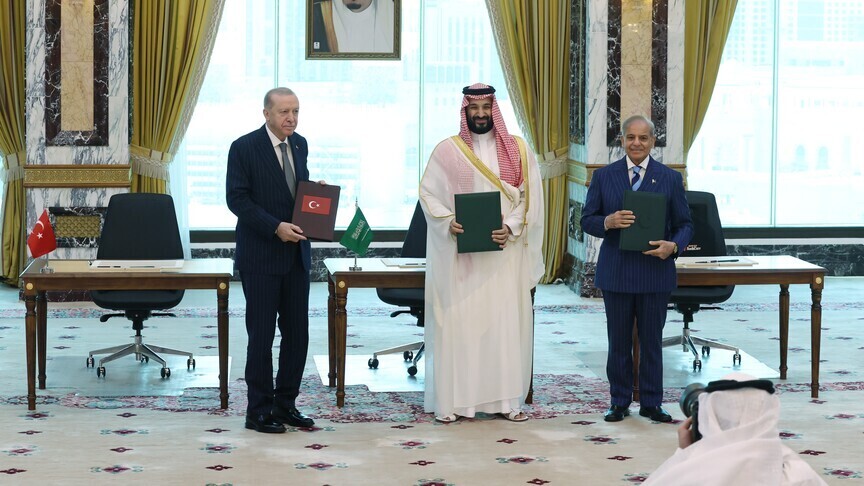
Pakistan's army on Wednesday said the trilateral Mecca defense pact between Türkiye, Saudi Arabia and Pakistan is intended for "collective deterrence," and has no “regional aspirations."
“It formalizes Pakistan’s decades-old relationship with the Kingdom of Saudi Arabia and the brotherly country of Türkiye in the domains for collective deterrence and defense of the three countries,” army spokesman Lt. Gen. Ahmed Sharif Chaudhry said in an interview with Saudi broadcaster Al Arabiya.
Asked whether the pact inked in Mecca last month is primarily a defensive cooperation or the beginning of a broader strategic alliance, Chaudhry asserted that the pact was "defensive, as its name implied."
The pact provides that an attack on one member state would be treated as an attack on all.
The alliance's inaugural meeting was held in Istanbul on Aug. 31, where it was decided that Pakistan would initially head the alliance’s secretariat for three years.
“It is defensive.There’s nothing aggressive. There are no regional aspirations. It is collective deterrence,” he said, adding that the agreement was also “complementary”.
“So this mutual defence agreement is complementary in nature. It is not competing with any other relationship of these countries,” he said, adding that the three allies have independent relationships with other nations, blocs and alliances.
In response to a question about how Pakistan would respond if one of the countries in the alliance came under attack, he said that the operationalization of defensive commitments were never made public in any discourse.
“You see, you have multiple other agreements which are defensive in nature, which are committal in nature. But no country comes out and starts sharing its operational details."
“It is for the three countries to decide, and it is for them to know and for them to actualize it,” Chaudhry maintained.
On whether the alliance was “complementing or competing” with Pakistan’s decades-long relationship with China, he said: “We need to understand that the Pak-Saudi and the Pak-Türkiye relationship has not come out of the blue. The Chinese understand it. The world at large understands it, that how historic these relationships are. We have formalized that."
To a question on whether the defense agreement would become part of the wider, Muslim-world security architecture, Chaudhry said that there was nothing in the pact that stated that it was a Muslim alliance, adding that it was an alliance for regional stability.
“It is not a club that is being made for only Muslim countries,” he said, adding that decisions on its expansion would be taken by the leadership of the three countries.
The alliance, he further said, can always encompass new, willing partners who also believe in regional peace, stability and security, and who have the shared vision of non-aggression, non-interference and collective deterrence.