
Martin Regg Cohn: Time changes are a question of geography, not ideology, for Doug Ford - Toronto Star
The debate over year-round daylight saving time is not just perennial, it’s political, Martin Regg Cohn writes.
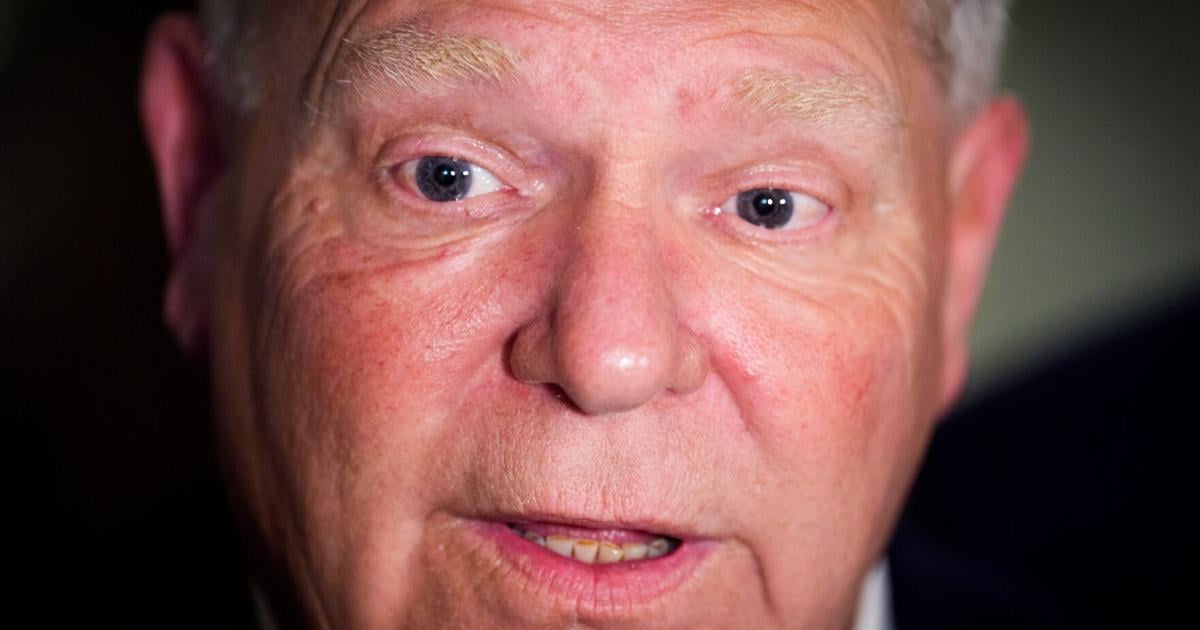
Premier Doug Ford speaks to reporters at Queen’s Park on Oct. 27, 2026.
Martin Regg Cohn is a Toronto-based columnist focusing on Ontario politics and international affairs for the Star. Follow him on Twitter: @reggcohn.
The time-worn ritual of moving our clocks back has come and gone, but it will be back.
For the debate over year-round daylight saving time is not just perennial. It’s political.
The Western provinces have made their move — refusing to move their clocks this week as winter looms. Quebec’s new separatist government says it too will stop future clock changes.
What next for Ontario? That depends — on our neighbours.
Premier Doug Ford is trying to have it both ways.
On the one (clock) hand, Ford supports the same policy of extending daylight saving time year-round, as just adopted by three Western provinces (a fourth, Saskatchewan, is sticking with year-round standard time).
On the other hand, Ontario’s official position is to bide its time, waiting to see what Quebec and New York do first. A 2020 law passed by Ford’s Tories was perhaps ahead of its time, declaring the province should ultimately adopt daylight saving time year-round, while hedging their bets by saying we’d only shift gears when our neighbours were ready.
Perhaps that’s because Ford understands the importance of political timing when it comes to time changes. As he explained to reporters this week, Ontario should stay in the same zone as its key economic partners in New York and Quebec, where stocks are traded and work is done.
It’s a question of geography, not ideology. If we live and work next door to New York, why give up the comparative advantage of staying in sync with the major markets? And if federal public servants have to adjust their watches twice a day when commuting between Gatineau and Ottawa, why risk losing track of time?
“We have to be in line with Quebec and … New York for the financial sector — it just makes life easier,” Ford told reporters. “If Quebec and New York and the Eastern corridor in the U.S. want to do it, I’m all in.”
To be precise, Ford’s PC government will implement daylight saving time when the time is right. Even if it’s wrong in principle.
After all, what’s animating the politicians is political popularity. Everyone likes those long summer days that stretch into evening, so why not squeeze out an extra hour of light in the dark days of winter?
Government surveys across the country show that when asked, people hate changing their clocks and prefer daylight saving time year-round. I understand that time changes drag us down, and that later sunsets are uplifting.
Scientists agree that changing our clocks every spring and fall is disruptive. But they also warn against the populist clamour to make daylight saving time a permanent, year-round framework.
Daylight saving time simply shifts early morning light to the late afternoon, albeit arbitrarily. The science says it’s bad for our biology to wake up and go to work in the dark (not to mention perilous for schoolchildren in traffic), because our circadian rhythms count on daylight to kick-start our bodies.
During COVID, we told the anti-vax crowd to “follow the science.” Now, people just want to “follow the sun.”
What populist politician would dare tell people they’re wrong to say, “Let there be light?”
Let’s just say that when it comes to time zone changes, times are changing. And so, rather than relitigate the science here, let’s stick to the political science at play here.
Ford, who understands a thing or two about politics and populism, speculated that the Western premiers were in a rush to embrace daylight saving time for their own reasons: It’s not just about popularity but synchronicity, because now they are an hour closer to Ontario time.
“Manitoba and Western Canada, the reason they did it? They want to get closer to our time frame,” Ford explained. (Winnipeg is now aligned with Toronto, while Calgary is only an hour behind instead of two.)
Seems his fellow premiers aspire to be populists, just like him. It takes one to know one.
What’s noteworthy about Ford’s approach is that he’s right on process, if not necessarily substance — for we should surely align with our neighbours lest we unnecessarily complicate our lives.
What’s instructive about the brash declarations from newly-elected Parti Québécois Premier Paul St-Pierre Plamondon is that his separatist government will go its own way in its own time. His own Quebec residents in the Gatineau region are worried about being out of sync with Ottawa, yet he seems oblivious.
Ford, for his part, is watching the time.
“I’m very, very open to discussions with the premier of Quebec,” he said. “We’re going to be discussing this, and hopefully we’ll come up with a consensus. Because you can’t go on up in Ottawa and go across the river and you’re an hour behind.”
Like a broken clock that displays the correct time twice a day, our wrong-headed premier is at least trying to get it right on those twice-yearly time zone changes.
By contrast, Quebec’s new PQ government, intent on breaking up the country, is busy trying to bend time to its own will — confident that time is on the side of sovereignty.
Error! Sorry, there was an error processing your request.
There was a problem with the recaptcha. Please try again.
You may unsubscribe at any time. By signing up, you agree to our terms of use and privacy policy. This site is protected by reCAPTCHA and the Google privacy policy and terms of service apply.
Opinion articles are based on the author’s interpretations and judgments of facts, data and events. More details
Martin Regg Cohn is a Toronto-based columnist focusing on Ontario politics and international affairs for the Star. Follow him on Twitter: @reggcohn.


