
Map Shows States Where Gas Prices Could Surge - Newsweek
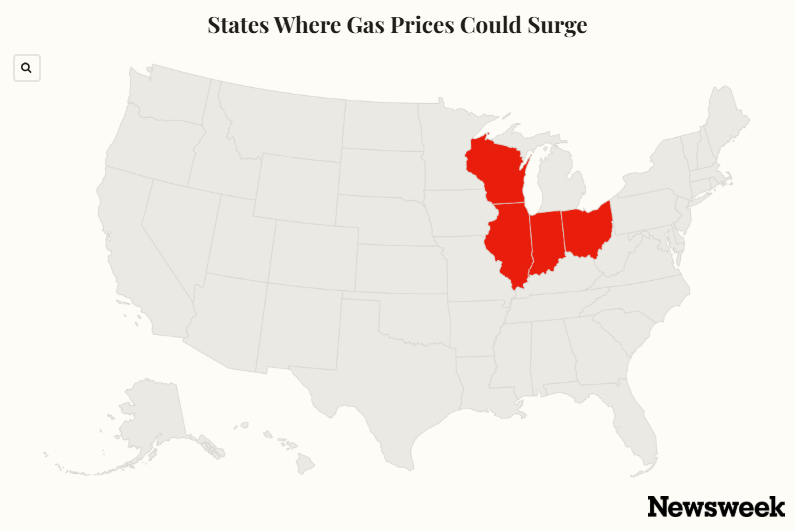
Some parts of the country could see sharper increases in gas prices after the ExxonMobil refinery in Joliet, Illinois, suffered a total power outage earlier this week.
The facility, which usually processes about 275,000 barrels of crude oil per day, was forced to shut down on Monday. Generally, Joliet accounts for roughly 6 percent of Midwest refining capacity, making it one of the region's most important fuel suppliers.
Patrick De Haan, head of petroleum analysis for GasBuddy, issued a warning for residents in Illinois, Indiana, Ohio and Wisconsin on Tuesday.
“In response to yesterday afternoon’s surge in wholesale gasoline and diesel prices related to the Joliet refinery losing power, we are likely to see gas prices and diesel move higher *very* soon in: IL, IN, OH, WI. Michigan may miss it as it already saw a jump yesterday,” De Haan wrote on X.
Nationwide, average gasoline prices have been climbing. GasBuddy reported that the average U.S. gasoline price rose 17.2 cents over the previous week to $4.25 per gallon as of Monday.
Gas prices affect millions of Americans' daily budgets and can influence both travel plans and household spending.
Regional spikes can also be especially significant because fuel markets are highly dependent on local refinery operations and their fuel supply chains.
According to GasBuddy, gasoline prices have been rising across the country due to a surge in oil prices. The company said oil topped $100 per barrel and that gas prices increased in every state over the last week.
“Average gasoline and diesel prices rose in every state over the last week as geopolitical tensions escalated on multiple fronts, with friction between the U.S. and Iran, new hostilities in the Red Sea, and the shutdown of Saudi Arabia’s East-West pipeline all combining to jolt prices sharply higher,” De Haan said in a statement Monday.
“New weekend attacks also knocked two additional Russian refineries offline, further straining global refined product supplies and likely offsetting any seasonal relief. Diesel prices could climb even faster in the wake of the new refinery attacks.”
Recent market data also shows some of the largest monthly increases occurring in parts of the Pacific Northwest and Mountain West.
Oregon's average gasoline price increased 7.2 percent between early August and early September, while Washington recorded a 6.9 percent increase and Idaho saw a 6.1 percent rise, according to Choose Energy’s data center.
Those states already rank among the most expensive places to buy gasoline. As of early September, California had the nation's highest average gasoline price at $5.81 per gallon, followed by Washington at $5.48, Hawaii at $5.42 and Oregon at $5.00.
“Drivers would normally expect some relief at this point in the year as refineries transition to cheaper winter-blend gasoline, but 2026 is anything but a normal energy market, with the military conflict in Iran and its effect continuing to put pressure on oil prices,” Alex Beene, a financial literacy instructor for the University of Tennessee at Martin, told Newsweek.
Historically, the Great Lakes region has been especially vulnerable to sudden price movements due to refinery problems, experts say.
“Those in the Midwest will likely be impacted the most, especially in areas that rely heavily on supply from the Joliet refinery,” Kevin Thompson, the CEO of 9i Capital Group and the host of the 9innings podcast, told Newsweek.
Gasoline prices can vary widely by region. While drivers in Indiana, Texas, Mississippi and Oklahoma continue to pay some of the lowest prices in the country, those on the West Coast are already facing substantially higher costs.
“Usually, you would expect prices to come down due to the cheaper winter-grade gasoline coming into play,” Thompson said. “But, as we know, we have multiple issues overseas along with supply constraints that will likely keep prices much higher than anticipated.”
Source: Choose Energy/AAA state averages, September 2026.
Oil prices climbing above $100 per barrel have been a key factor pushing gas prices for consumers higher. But on top of this, refinery outages can reduce gas production amid already tight fuel inventories in certain regions and supply disruptions.
“You can have plenty of crude oil available, but consumers cannot put crude oil in their gas tanks,” Michael Ryan, a finance expert and the founder of MichaelRyanMoney.com, told Newsweek. When a major refinery suddenly goes offline, the supply of finished gas and diesel can tighten very quickly.”
Drivers are likely to see continued volatility at the pump in the coming weeks.
GasBuddy said the national average is on an upward trajectory If refinery operations normalize and crude oil prices ease, price increases could moderate.
But further supply disruptions could push costs higher in the Midwest and West Coast.
“I would expect volatility rather than assume one uninterrupted surge,” Ryan said. “Fall normally brings some relief as driving demand declines and cheaper winter blend gas arrives. But refinery maintenance and already tight global oil supplies mean there is much less room for something else to go wrong.”
Contact Newsweek editors on this story: Jason Lemon and Gray R. Thomas


