Map Shows Democrat, Republican Voter Registration Shifts 38 Days to Midterm - Newsweek
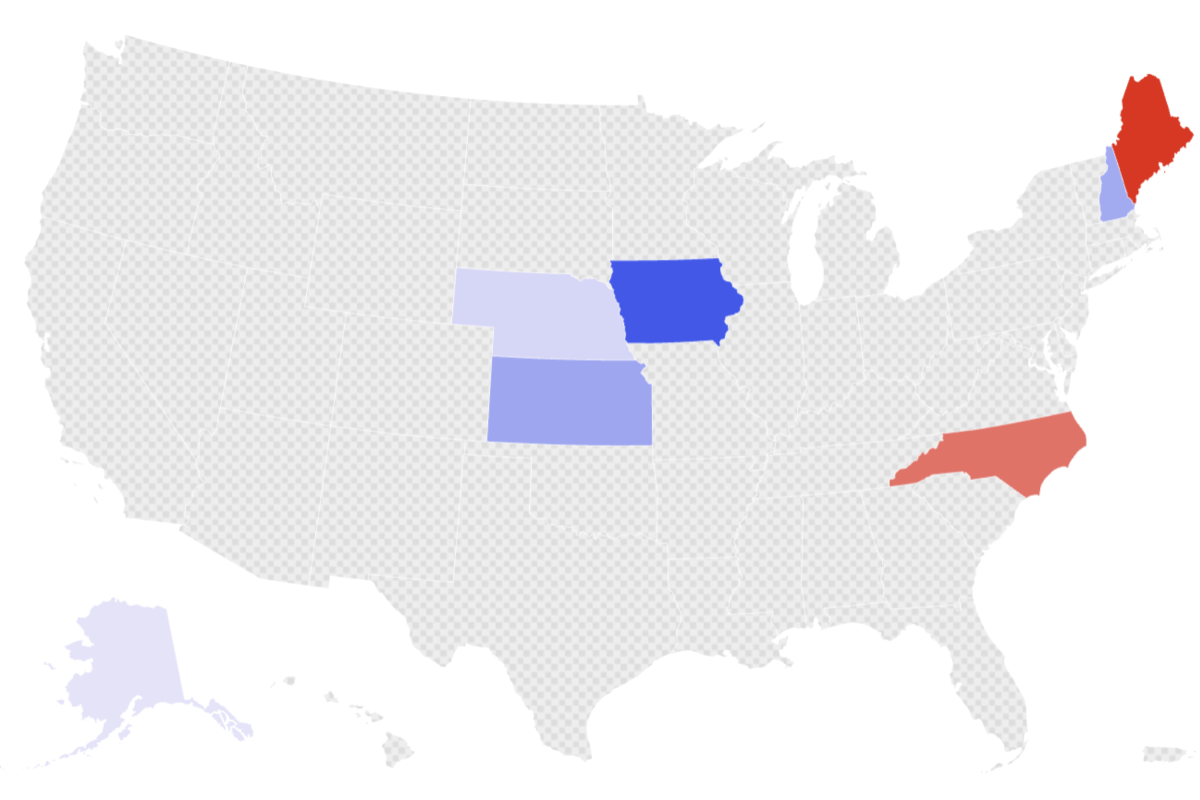
Democrats have cut into Republicans' voter registration advantage in several states with competitive Senate races ahead of the 2026 midterm elections, though Republicans retain advantages in some of the conservative states that appear increasingly competitive.
The race for Senate control appears increasingly competitive ahead of the November 3 elections, with Democrats leading some polls in more conservative states like Alaska, Iowa, Ohio and Texas, all of which backed President Donald Trump by double digits in 2024.
Democrats are increasingly hopeful that they can expand the electoral battleground to compete in these states that have historically been more difficult. This is largely due to Trump’s approval rating falling to new lows in polling this week amid frustrations with the economy, cost of living and soaring gas prices amid the Iran war.
Voter registration data can reveal changes in states’ partisan composition, but it’s not always predictive of how a state will vote, particularly during a wave year when one party is benefiting from a strong national environment.
These numbers can be influenced by factors including population shifts, migration patterns, the removal of inactive voters from voter rolls and people leaving a party when they are dissatisfied with its direction.
Notably, not all states have registration by party. Georgia, Michigan, Minnesota, Ohio and Texas all have fairly competitive races this year, but there is no partisan registration in those states.
Stephen Farnsworth, political science professor at the University of Mary Washington, told Newsweek that voters “often punish the president’s party in midterm elections.” Trump’s unusually low approval rating is making things worse for Republicans compared to the usual midterm pain for the party in the White House, he said.
“Angry voters are more engaged as shown in the latest registration figures. A lot of young people in particular worry about the availability of good jobs in the face of growing AI, which is another policy area where Trump is out of step with voters,” Farnsworth said.
There are several states where Democrats have narrowed the gap in voter registration that also have competitive Senate races this year, though Republicans do hold advantages in each of these states.
The gap has slightly narrowed in Alaska, where GOP Senator Dan Sullivan is facing a challenge from former Representative Mary Peltola.
In December 2025, Republicans had a 73,829 advantage on the voter rolls. That had narrowed to a 72,290-voter advantage in September 2026, according to the Alaska Division of Elections.
Polls show a tight race in the state, which backed Trump by about 13 points in the 2024 election. Alaska has been viewed as a reliably Republican stronghold, but a leftward shift in cities like Anchorage has loosened the GOP’s grip on the state.
The latest Alaska Survey Research poll showed a tight race, with Peltola leading Sullivan in the final round of ranked-choice, 50.6 percent to 49.4 percent. It surveyed 1,495 likely voters from August 20 to 23 and had a margin of error of plus or minus 3 percentage points.
Peltola had a larger lead in a poll from Data for Progress, which surveyed 578 likely voters July 28-August 4. It showed Peltola up 6 points, 53 percent to 47 percent. It had a margin of error of plus or minus 4 percentage points.
However, a poll from The New York Times and Siena University, conducted among 593 likely voters June 15-29, showed Sullivan up 2 points, 47 percent to 45 percent. It had a margin of error of plus or minus 4.9 percentage points.
The Cook Political Report classifies the race as a toss up.
Newsweek reached out to the Peltola and Sullivan campaigns for comment via email.
In Iowa, a former battleground that has become more conservative over the past decade, Democrats have also been able to chip away at Republicans’ advantage. In December 2025, there were 196,755 more Republicans than Democrats in Iowa. As of September 2026, that number was 182,715.
Iowa also backed Trump by about 13 points in 2024, as Republicans have made gains among the state’s rural, white population. Democrats have failed to make up those losses in suburban areas around cities like Des Moines.
But the Senate race between Republican Representative Ashley Hinson and Democratic state Representative Josh Turek appears competitive.
A new poll from Marist University gave Turek an 8-point advantage, 50 percent to 42 percent. It surveyed 1,050 registered voters from September 17 to 20, with a margin of error of plus or minus 4.4 percentage points.
However, Hinson led the latest survey from co/efficient by 4 points, 46 percent to 42 percent. It surveyed 831 likely voters from September 14 to 16, and had a margin of error of plus or minus 3.39 percentage points.
Turek also led Hinson in a recent YouGov poll. He had a single-point lead, 44 percent to 43 percent, among registered voters, but led by 4 points, 47 percent to 43 percent, among "strict” likely voters.
The poll surveyed 2,169 registered voters from September 3 to 8. Its margin of error was plus or minus 3.5 percent among registered and likely voters.
The Cook Political Report classifies the race as a toss up.
Newsweek reached out to the Hinson and Turek campaigns for comment via email.
The Kansas Senate race appears increasingly competitive, with the Cook Political Report this week shifting it from Likely Republican to Leans Republican.
Republicans have a sizable advantage of 394,642 voters in Kansas, down from 401,710 in November 2025, according to the Kansas secretary of state office.
The Sunflower State backed Trump by 16 points in 2024. But it does have a Democratic governor, and suburban areas around Kansas City have narrowed Republican margins in statewide contests.
Republican Senator Roger Marshall is up for reelection and is facing Democrat Adam Hamilton, a pastor.
A recent poll from Emerson College was a statistical tie, with Hamilton receiving 45 percent and Marshall 43 percent. It surveyed 750 likely voters from September 15 to 16, 2026, with a margin of error of plus or minus 3.6 percentage points.
A co/efficient poll also pointed to a close race, giving Marshall a 5-point lead, 49 percent to 44 percent. It surveyed 915 likely voters from September 8 to 10, 2026, with a margin of error of plus or minus 3.22 percentage points.
Newsweek reached out to the Hamilton and Marshall campaigns for comment via email.
Republican Senator Pete Ricketts is facing a challenge from independent candidate Dan Osborn in Nebraska. Osborn has said he would not caucus with either party in Washington, but he will need strong support from Democrats and independents, as well as some moderate Republicans, to win in November.
There are 292,049 more registered Republicans than Democrats in Nebraska, down from 294,750 in 2025, according to the Nebraska secretary of state office.
Nebraska voted for Trump by more than 20 points in 2024.
Forecasters give Ricketts an advantage, with the Cook Political Report rating the race as Likely Republican.
Polls show a close race. A SurveyUSA poll showed Osborn up 4 points, 46 percent to 42 percent. It surveyed 503 likely voters from September 8 to 13, with a credibility interval of plus or minus 6.4 percentage points.
An Impact Research poll, an Osborn internal, showed an even race, each receiving 47 percent of the vote. It surveyed 600 likely voters from August 9 to 13, with a margin of error of plus or minus 4 percentage points. It was first reported by The Omaha World Herald.
Newsweek reached out to the Osborn and Ricketts campaigns for comment via email.
Republicans also have an advantage in New Hampshire, though it backed former Vice President Kamala Harris by about 3 points in 2024. Independent voters are key to the Granite State, viewed as having a moderate electorate with a libertarian streak.
Republicans have a 43,022-voter registration advantage in the state, down from a 49,635 advantage in 2025, according to the New Hampshire secretary of state office.
The Senate race between Representative Chris Pappas and former Senator John Sununu is viewed as a toss-up by the Cook Political Report as polls suggest a closely divided electorate.
The latest survey from InsiderAdvantage showed Pappas up 8 points, 48 percent to 40 percent. It polled 1,200 likely voters from September 16 to 17, with a margin of error of plus or minus 2.83 percentage points.
A survey from GOP pollster Fabrizio, Lee & Associates showed the race in a statistical tie, with Sununu receiving 37 percent support and Pappas 36 percent. Other candidates received less than 4 percent support, while 23 percent were undecided about who they would vote for.
Another poll from the University of New Hampshire poll similarly showed Sununu with a lead, 45 percent to 43 percent. It surveyed 1,878 likely voters August 20-24 and had a margin of error of plus or minus 2.3 percentage points.
Newsweek reached out to the Pappas and Sununu campaigns for comment via email.
There are two competitive states where Republicans have gained ground in voter registration.
In Maine, where Senator Susan Collins is facing a competitive race against Democrat Troy Jackson, the former president of the Maine Senate, Republicans have gained a bit of ground, but Democrats still have an advantage on the voter rolls.
Democrats had a 31,732 advantage in the state as of March, a shift from 43,755 in 2025, according to the secretary of state office.
The Senate race is expected to be one of the most competitive of the midterms, with the Cook Political Report viewing it as a toss up.
Recent polls pointed to a close race.
A survey from The New York Times and Siena College showed Collins with a 3-point lead, 49 percent to 46 percent. It surveyed 619 likely voters from September 15 to 22, 2026.
Another poll from the University of Massachusetts Lowell published on Thursday gave Jackson a 5-point lead, 48 percent to 43 percent. It surveyed 650 likely voters from August 28 to September 14, with a margin of error of plus or minus 4.66 percentage points.
A Quantus Insights poll showed a statistical tie, with Collins at 47.1 percent and Jackson at 46.4 percent. It surveyed 644 likely voters from September 14 to September 15, 2026, and had a margin of error of plus or minus 4.3 percentage points.
Newsweek reached out to the Collins and Jackson campaigns for comment via email.
Democrats have also lost ground in North Carolina, where former Governor Roy Cooper, a Democrat, is viewed as a favorite over Republican Michael Whatley. The Cook Political Report classifies the race as Leans Democratic.
In 2025, Democrats had a mere 604 vote advantage. That has flipped to Republicans, who had a 7,403-vote advantage in the state as of September, according to the North Carolina State Board of Elections.
Jeff Allen, a spokesperson for Cooper’s campaign, told Newsweek that North Carolina “is a 50-50 state,” casting the election as a “margin-of-error race.”
“A Democrat has not won statewide federal office here in nearly two decades – and Whatley’s elite DC connections mean Republicans are going to spend whatever it takes to keep this seat,” Allen said.
Newsweek also reached out to the Whatley campaign for comment via email.
Polls have given Cooper a lead. A Quantus Insights poll showed him up 5 points, 48 percent to 43 percent. It surveyed 686 likely voters from September 21 to 22, with a margin of error of plus or minus 4.2 percentage points.
Cooper led by 11 points in a YouGov poll, which surveyed 3,895 registered voters from September 15 to 18 and had a margin of error of plus or minus 2.5 percentage points. Cooper’s support stood at 52 percent, while 41 percent of respondents said they would vote for Whatley among registered voters.
Farnsworth said that Democrats’ prospects “for taking over the Senate are better than 50-50.”
“Voters struggling with high prices want to see a president focused on that issue and trying to do something about it,” he said. “Instead they see a president who promised a more domestic focus is stuck in an unappealing stalemate with Iran, with limiting press access to public events, and on building a new White House ballroom and a massive arch near Arlington Cemetery.”
Prediction markets have recently shifted momentum toward Democrats for control of the Senate in November. As of Friday, Democrats had a 61 percent chance on Kalshi and a 63 percent chance on Polymarket of flipping the Senate.
That marks a shift from one month ago, when Republicans had a 53 percent chance on Kalshi, while their chances were tied on Polymarket.
Republicans had even stronger chances at the start of the year, holding a 68 percent chance on Kalshi and a 66 percent chance on Polymarket of holding onto the Senate.
Prediction markets let traders buy and sell contracts tied to political outcomes and current events, aggregating real-money wagers into probability estimates. Prices fluctuate as traders react to polling, fundraising, candidate developments and broader political trends. They measure trader sentiment at a given moment but do not always predict the future accurately.
Polls will be closely watched over the coming weeks as the race for Senate control remains close. Candidates are making their pitches to voters across their states on issues ranging from the economy and foreign policy.
Newsweek’s reporters and editors used Martyn, our AI assistant, to produce this story. Learn more about Martyn here.
Contact Newsweek editors for this story: Jenni Fink and Anthony Murray.