Major river-to-sea project: China's Pinglu Canal opens for navigation
By continuing to browse our site you agree to our use of cookies, revised Privacy Policy and Terms of Use. You can change your cookie settings through your browser.
The Pinglu Canal in south China's Guangxi Zhuang Autonomous Region officially opened to commercial navigation on Wednesday, marking the country's first major river-to-sea canal project planned and coordinated at the national level since 1949.
The 134.2-kilometer waterway connects the Xijiang River corridor with the Beibu Gulf, cutting the traditional shipping distance between southwestern China and the sea by more than 560 kilometers.
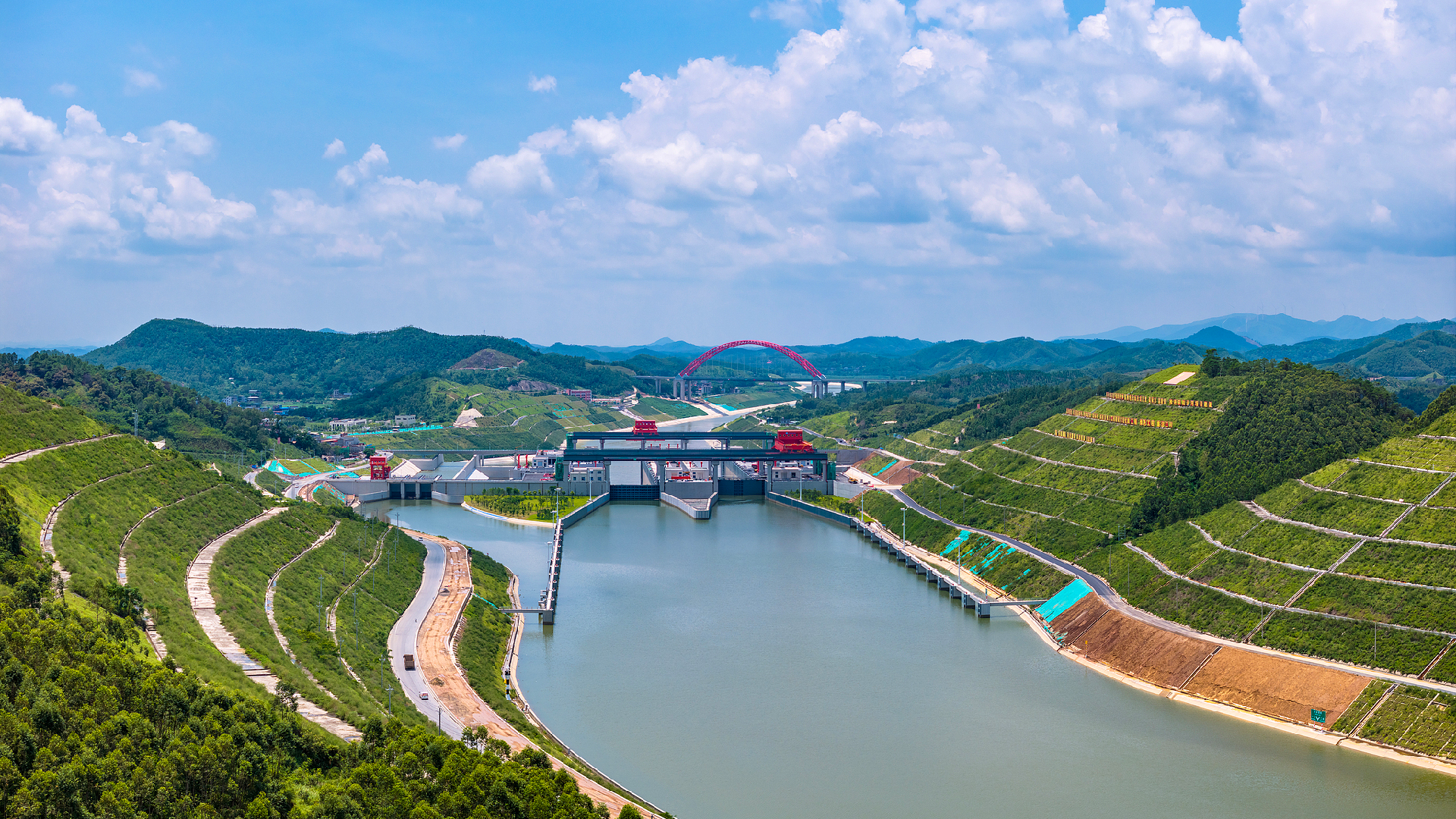
A view of Pinglu Canal in south China's Guangxi Zhuang Autonomous Region. /VCG
For decades, much of the cargo from China's southwest had to travel eastward before reaching the sea through Guangdong and other coastal areas. The Pinglu Canal provides a more direct route to the Beibu Gulf, allowing vessels of up to 5,000 tonnes to sail from the inland river network to the sea.
Local authorities estimate that the shortcut could reduce logistics costs by 18% to 30%, saving about 5.2 billion yuan ($720 million) each year.
The canal also forms a key part of the New International Land-Sea Trade Corridor, giving inland regions such as Chongqing, Chengdu, Guizhou and Yunnan a more direct maritime gateway to Southeast Asia.
The timing is significant. China and ASEAN have been each other's largest trading partners for six consecutive years. In the first half of 2026, their trade reached 4.34 trillion yuan, up 18.2% year on year.
The Beibu Gulf is already becoming an important gateway for that trade, with container throughput at Beibu Gulf Port reaching about 10 million TEUs in 2025, compared with around 2.28 million TEUs in 2017.
The canal could further expand the port's economic hinterland, allowing manufactured goods to move south toward ASEAN markets and agricultural products, minerals and other raw materials to move north into China's inland economy.
But connecting economies also means cutting through landscape. For Pinglu Canal, that has meant designing infrastructure not only for ships, but also for the species and ecosystems along its route.
Longmen Bridge near the estuary of Pinglu Canal in Qinzhou, Guangxi, August 25, 2026. /VCG
At the Qingnian navigation hub, engineers built a dedicated fish passage to help aquatic species overcome a water-level difference of nearly 10 meters.
The passage is more than 480 meters long and contains 120 pools. By gradually reducing water levels and flow velocity, the system allows fish to move upstream step by step. A separate passage has been designed for eels and other species capable of crawling or climbing.
Monitoring equipment has been operating since 2025. Project monitoring data show that more than 10 fish species have used the passage, with about 76,000 upstream movements and 115,000 downstream movements recorded.
On land, a similar principle is being applied.
At the Fenshuiling section, a wildlife-only bridge crosses the canal. Covered with soil and native vegetation, the overpass reconnects forest habitats separated by the waterway. It is designed to allow species including leopard cats, masked palm civets and red-bellied squirrels to cross what would otherwise be a physical barrier.
The measure follows recommendations from a 2025 study published in the journal Land, which assessed habitat fragmentation across 11 regional wildlife groups and called for dedicated ecological corridors to be incorporated into infrastructure planning.
The project's environmental approach also extends to the enormous amount of material generated during construction.
Engineers excavated roughly 315 million cubic meters of earth and rock. More than 98% of the material was reused for riverbank reinforcement, soil remediation and the creation of about 13,900 mu, or 927 hectares, of farmland.
The opening of the canal marks the beginning of another phase. As commercial traffic grows, maintaining water quality, preserving wildlife movement and protecting coastal ecosystems will require continuous monitoring and management.
Estuary of Pinglu Canal in the Maowei Sea waters of Qinzhou, Guangxi, August 25, 2026. /VCG
The Pinglu Canal is intended to create new connections — between inland China and the sea, between China and ASEAN, and between production centers and global markets. The challenge now is to ensure that these new connections do not permanently disconnect the ecosystems along its route.