Maine Poll Gives Susan Collins Lead Over Troy Jackson for First Time - Newsweek
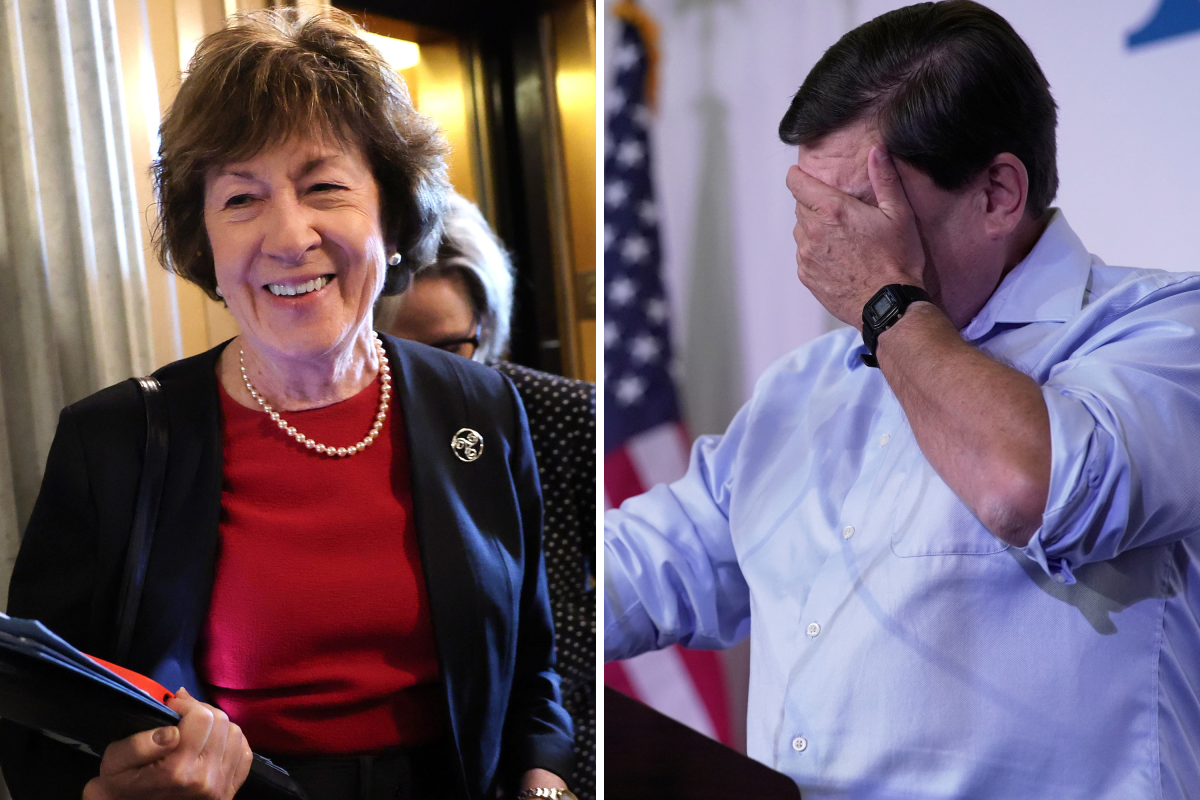
Republican Senator Susan Collins has opened her first lead over Democrat Troy Jackson in an independent poll of Maine's closely watched Senate race since Jackson became his party's nominee.
A New York Times/Portland Press Herald/Siena survey found Collins ahead by 3 percentage points, with 49 percent support to Jackson's 46 percent. Five percent of respondents were undecided.
The race nevertheless remains highly competitive, as Collins' advantage falls within the poll's margin of error of plus or minus 4.9 percentage points.
The survey questioned 619 likely voters from September 15 to 22. It follows a Quantus Insights poll conducted September 14 and 15 that placed Collins at 47.1 percent and Jackson at 46.4 percent, effectively a statistical tie within its 4.3-point margin of error.
Another poll from the University of Massachusetts Lowell published on Thursday gave Jackson a 5-point lead, 48 percent to 43 percent. Among independent voters, a critical voting bloc in the Pine Tree State, he led by 8 points, 40 percent to 32 percent, with 22 percent still undecided, the poll found.
Collins’ favorability was 7 points underwater, with 47 percent viewing her unfavorably, and 40 percent viewing her favorably, the poll found. Meanwhile, Jackson’s favorability was 3 points in the negative, 42 percent viewing him unfavorably and 39 percent holding favorable views toward him, the poll found.
It surveyed 650 likely voters from August 28 to September 14, with a margin of error of plus or minus 4.66 percentage points.
Other recent polls gave Jackson, a former president of the Maine Senate, narrow leads over the five-term U.S. senator.
The new findings suggest Collins is attracting crossover support despite difficult conditions for Republicans in Maine.
Fifty-five percent of respondents said they wanted Democrats to control the Senate, while 51 percent viewed Collins favorably, compared with 41 percent for Jackson.
Collins also received support from 8 percent of Democrats, while the candidates were tied at 47 percent among unenrolled and other voters.
The results offer a potential warning for Democrats because Maine is among the party's leading opportunities to gain a Republican-held seat.
The Cook Political Report and Sabato's Crystal Ball rate the race as a toss-up. Democrats need a net gain of four seats to secure an outright Senate majority.
The New York Times/Portland Press Herald/Siena poll was conducted largely before reports emerged of an abandoned FBI investigation connected to Collins and several other lawmakers.
Collins' office has denied any wrongdoing, while the FBI previously said its investigation found nothing implicating Collins or her campaign.
Newsweek contacted the Collins and Jackson campaigns for comment via email on Thursday morning.
Interviews conducted for the poll show the competing judgments behind the close result. Margaret "Peggy" Daigle, a 73-year-old Democrat, told the Portland Press Herald that she wants Democratic control of the Senate but is leaning toward Collins, saying the incumbent appears better able to build coalitions and pursue a "thoughtful strategy" in Washington.
Republican John Toomey shared a similar sentiment, calling the senator "the best bet for Maine" and telling the outlet, "I just trust Susan Collins more."
Another Democrat, John Treutel, said he supported Collins in 2020 but now plans to vote for Jackson, partly as a protest against the Republican administration and lawmakers he believes have failed to restrain it.
Tara Wheeler, also a Democrat, credited Collins with helping protect funding for her job but said she is leaning toward Jackson because "I think he's more in touch," while acknowledging the decision is "very close for me."
The new survey represents a notable movement in Collins' direction after several independent polls showed Jackson narrowly ahead.
A YouGov survey conducted September 2 to 8 found Jackson leading Collins by 4 points among likely voters, 48 percent to 44 percent.
YouGov interviewed 1,378 registered Maine voters, including 1,335 classified as likely voters.
The margin of error was plus or minus 4.9 percentage points for both groups.
Among the full registered-voter sample, Jackson led 46 percent to 44 percent.
A CNN/SSRS poll conducted August 31 to September 6 found Jackson ahead by 3 points, 48 percent to 45 percent.
SSRS interviewed 880 registered voters, with likely-voter results calculated by weighting respondents according to their predicted probability of voting.
The likely-voter findings had a margin of error of plus or minus 3.7 percentage points.
A Fox News poll conducted by Beacon Research and Shaw & Company Research from August 6 to 10 found Jackson leading by 2 points, 48 percent to 46 percent.
The survey interviewed 1,000 registered Maine voters and had a margin of error of plus or minus 3 percentage points.
All three differences fell within the respective polls' margins of error, meaning none established a statistically clear leader.
The Collins and Jackson matchup was effectively tied in the Quantus Insights poll conducted September 14 to 15, with Collins at 47.1 percent and Jackson at 46.4 percent among 644 likely Maine voters.
The Senate ballot had a reporting base of 621 after excluding 23 respondents who said they would not vote in the race, and the survey had a margin of error of about plus or minus 4.3 percentage points.
Quantus Insights' September survey illustrated the competing coalitions beneath the close statewide numbers.
Women backed Jackson over Collins by 51.6 percent to 41.6 percent, while men favored Collins by 53.1 percent to 40.7 percent.
Jackson also led among voters younger than 45, whereas Collins held clear advantages among those aged 45 and older, although subgroup results carry greater uncertainty than the statewide figures.
The timing of the survey limits what it can show about the newest controversy in the campaign.
Most interviews were conducted before ProPublica published a report about federal investigators' examination of claims involving Collins, former Navatek chief executive Martin Kao and political contributions associated with the defense contractor.
The FBI told ProPublica that an earlier investigation "ultimately found nothing implicating Senator Collins or Senator Collins' campaign."
No one from Collins' team was charged in Kao's case.
Collins' deputy chief of staff, Annie Clark, previously told Newsweek that the campaign had "cooperated fully" with investigators and described the allegations as "categorically false."
Jackson accused Collins of "corruption of the highest order" in a statement previously provided to Newsweek.
Maine political consultant Toby J. McGrath said the electoral importance of the report would depend on whether it could cut "through the noise" and whether voters believed that anything improper had occurred.
The race has already undergone an unusual change of nominees.
Jackson entered the Senate contest after Graham Platner, who had secured the Democratic nomination in June's primary, withdrew in July after a former partner accused him of sexual assault. Platner has denied the allegation.
Maine Democrats selected Jackson at a July 25 convention, leaving him with a compressed general-election campaign against a five-term incumbent.
Jackson's campaign presents him as a fifth-generation logger and former Maine Senate president running on a working-class economic platform.
Its published priorities include Medicare for All, lower prescription-drug costs, higher taxes on billionaires and corporations, a federal right to abortion, and the abolition of Immigration and Customs Enforcement.
Collins' campaign touts her track record and influence on Capitol Hill, describing her as "the first Maine Senator in nearly 100 years to be Chairman of the powerful Senate Appropriations Committee." Her path to reelection depends on maintaining support among Republicans while winning enough unenrolled voters and moderate Democrats to overcome Maine's broader Democratic lean.
Former Senator Joe Manchin of West Virginia, a centrist who left the Democratic Party to become an independent, announced in September that he would campaign for Collins, calling her "the soul of the Senate" and praising her willingness to work across party lines.
Collins entered the final phase of the campaign with a substantial financial advantage.
Federal Election Commission (FEC) data covering January 1, 2021, through June 30, 2026, showed Collins' authorized committee with $18.9 million in total receipts, $9.2 million in disbursements and about $11 million in cash on hand.
The receipts included $12.1 million in individual contributions and about $1.75 million from other political committees.
A separate Collins joint fundraising committee reported about $2.26 million in receipts and $2.12 million in cash as of June 30.
Jackson's federal committee was registered on July 7, according to the FEC.
The agency does not yet display fundraising, spending or cash-on-hand totals for the 2025-26 cycle for Jackson. The FEC says the figures may still be processing, no relevant activity may yet have been filed, or the applicable filing deadline may not have passed.
This does not mean the campaign raised or spent nothing, only that a processed financial summary was unavailable on the FEC page.
Jackson's campaign says it does not accept support from corporate political action committees or billionaire donors and describes its fundraising as powered by working people.
The difference in campaign age is important.
Collins has been able to raise money for the cycle over several years, while Jackson only became the Democratic nominee in July.
The candidates are also benefiting from spending and advertising by outside groups, which is legally distinct from money raised and controlled by their campaign committees.
Contact Newsweek editors on this story: Daniel Orton, Shakeema Edwards and Tony Phillips.
Update 09/24/26, 11:58 a.m. ET: This article has been updated with further information.
Newsweek's reporters and editors used Martyn, our AI assistant, to produce this story. Learn more about Martyn here.