Lula leads Flávio Bolsonaro 44%-39% in runoff, Genial/Quaest poll shows - Valor International
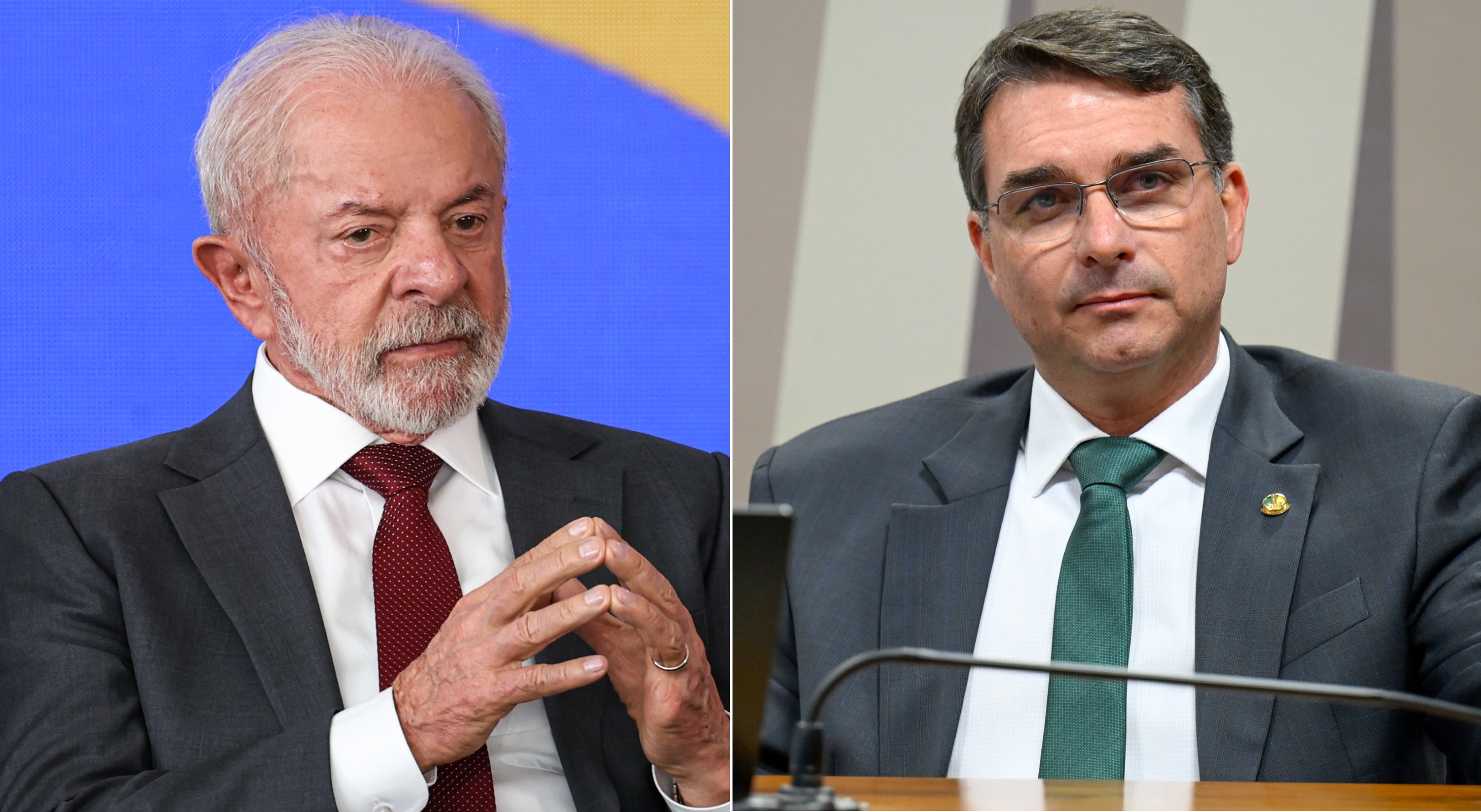
President and re-election candidate Luiz Inácio Lula da Silva (Workers’ Party, PT) holds 39% of the vote intentions against 30% registered by presidential candidate and Senator Flávio Bolsonaro (Liberal Party, PL) in the first round, according to a Genial/Quaest poll released this Wednesday (5). The gap between the two candidates has narrowed from 12 points to 9 compared to the July poll. In the second round, Lula has 44% and Flávio 39%. The lead of the PT candidate has also decreased, going from 8 points to 5.
The poll indicates Flávio’s recovery in both rounds, with the beginning of a right-wing electorate reorganization and the declining impact of programs delivered by the Lula administration this year. The survey’s margin of error is two percentage points, either way.
In the first round, Lula (at 39%) and Flávio (at 30%) continue to polarize the race. Other candidates total 13%—the same percentage recorded since May. Renan Santos (Missão) and Ronaldo Caiado (PSD) each have 4%, Romeu Zema (Novo) marked 2%. Cabo Daciolo (Mobiliza), Augusto Cury (Avante), and Samara Martins (UP) each have 1%, and the other names tested scored no points. However, Mobiliza, led by Cabo Daciolo, announced on Tuesday (4) that it would not have a candidate and would remain neutral in the race. Undecided voters account for 10%, while blank, null, or non-voters make up 8%.
In the second round, Lula would defeat Flávio by 44% to 39%, but the president’s lead has been dwindling according to the last three rounds of the poll. In this second-round scenario, 13% said they would vote blank, null, or not at all, and 4% are undecided.
In June, the president was six points ahead (Lula had 44% and Flávio 38%). In July, the difference recorded was eight points (the PT candidate had 45% and the PL senator 37%). Now it’s five points. Given the poll’s margin of error of two points, Lula stands between 42% and 46%, while Flávio is between 37% and 41%.
In April, Flávio was numerically ahead, with 42% against Lula’s 40%. The following month, both candidates were technically tied, with the PT candidate at 42% and the senator at 40%.
The president has seen a decline among independent voters, detached from both the Lula and Bolsonaro camps, and considered strategic in deciding this year’s contest. In July, the PT candidate had 40% in this segment and now stands at 33%. Flávio’s support rose from 27% to 30% among these voters in the second round.
The PL senator regained voting intentions among right-wing voters who are not Bolsonaro supporters, increasing from 74% to 81% in that electorate segment in the second round. Among Bolsonaro supporters, his numbers went up from 91% to 95%.
The survey tested other second-round scenarios. Against Caiado, Lula would win by 45% (same percentage as in July) to 37% (was 36%). Blank, null votes, and non-voters make up 14%, with 4% undecided.
If the right-wing candidate was Zema, Lula would win by 46% (was 45% in July) to 34% (was 35%). Blank, null votes, and non-voters total 16%, with 4% undecided.
Against Renan Santos, the president has 45% while the Missão candidate has 35%. Compared to the previous poll, Lula maintained 45% and Renan fluctuated two points up (was 33%). Blank, null votes, and non-voters account for 16%, with 4% undecided.
In the second round, Lula performs best among voters in the Northeast (64%), Bolsa Família beneficiaries (62%), Black people (61%), those with elementary education (55%), those who earn up to two minimum wages (54%), and Catholics (49%). Flávio performs better in the South (56%), among evangelicals (49%), white people (46%), those earning five minimum wages or more (44%), and those with higher education (45%). Among women, Lula has 47% and Flávio 35%.
The poll was conducted after the formalization of presidential candidacies during party conventions and following the disclosure of investigations into businessman Fábio Luís Lula da Silva, Lulinha, son of President Lula.
Since the previous round of the poll in mid-July, a contract of at least R$500,000 between Flávio and a company linked to Banco Master was also exposed, reinforcing evidence of the senator’s connection with former banker Daniel Vorcaro, owner of the defunct bank.
Since the previous survey, Lula’s campaign was also officially launched, featuring governors and national leftist political leaders. The president faces a 52% rejection rate among voters (was 50% in July). Flávio is rejected by 54% (was 57%). Caiado has a 34% rejection rate, Zema 32%, and Renan 20%. Among independent voters, Lula’s rejection stands at 62% and Flávio’s at 60%.
Felipe Nunes, CEO of Quaest, highlights Flávio’s recovery over both rounds, along with the decline in rejection and the increase in the percentage of voters firmly committed to the senator, from 62% to 68%. According to Nunes, this recovery can be explained by a right-wing reorganization, with anti-PT voters once again considering Flávio as an option. In the second round, Jair Bolsonaro’s son saw his voting intentions rise from 74% to 81% among non-Bolsonaro right-wing voters and from 91% to 95% among Bolsonaro supporters.
The “first piece of this reorganization,” says Nunes, was Flávio’s public reconciliation with former first lady Michelle Bolsonaro (PL). Flávio faced some political damage after Michelle released a video in June stating that she had been mistreated and disrespected by her stepson and was not participating in his campaign.
The two had not spoken since last year, according to the former first lady. A month later, on the eve of the PL national convention, which confirmed the senator’s candidacy for president, Flávio and Michelle released videos stating publicly that they had reconciled. The survey asked voters about their perception of the reconciliation, with 59% saying it was positive for the two to “make peace in public,” and 25% considering it negative.
For 46% of respondents, Michelle’s support increases the senator’s chances of winning the election, while 45% believe it does not. In July, however, 47% thought the former First Lady’s support did not increase Flávio’s chances of winning, while 38% believed it did. Among non-Bolsonaro right-wing voters, 70% say Michelle’s support increases the chances of winning the election (up from 53% in July).
In an analysis published on social network X, the CEO of Quaest also highlighted the negative reaction to the Supreme Court’s barring Flávio from visiting Jair Bolsonaro at home. Bolsonaro, who is imprisoned, is serving his sentence under house arrest. For 52%, the measure was wrong, while 41% consider it correct.
Nunes assessed that programs announced by the government this year, such as the new Desenrola, have lost “marginal strength.” As an example, he cited a question about the new Desenrola, asking if it is a good or bad idea. Among those interviewed, 47% consider it a good idea, down from 55% in July. For 23%, it’s a bad idea (was 21%).
The attack made by Flávio on electronic voting machines during a meeting with ambassadors in June is unknown to 68% of respondents, and 32% said they were aware of this information. Among independent voters, 75% were unaware of the attack.
Asked about the impact of these criticisms on the Brazilian electoral system, 54% said it does not affect their intention to vote for Flávio, 26% said it decreases, and for 15%, it increases the intention. In the spontaneous poll, Lula has 25% (was 26% in the previous survey). Flávio is mentioned by 18% (was 14%), and the undecided dropped from 54% to 51% now.
Among those surveyed, 55% said Lula does not deserve another four years as president (was 51% in July), while 41% believe he does (was 45%), and 4% did not respond.
When asked what they fear more, whether it is Lula’s re-election or the return of the Bolsonaros to power, 44% mentioned the return of the Bolsonaro family and 41% cited Lula’s re-election; 7% fear both, 3% fear neither, and 5% did not respond.
For 69%, their voting choice is definitive, while 31% said they could still change. The strongest conviction is among Lula’s voters, with 77% saying their choice for the president is definitive, the same percentage as the previous survey, and 22% stating they could change. Among Flávio’s voters, conviction increased from 62% to 68%, and 32% said they could change their vote (was 37% in July).
The most volatile voters are those of Romeu Zema, with 79% saying they could change their vote (was 70% in July) and 20% saying it is a definitive choice (was 30%). Regarding Caiado, 53% said it is a definitive choice, but 47% could change. For Renan Santos, there was an increase from 35% to 55% of those who said it is a definitive choice, and a decrease from 65% to 45% of those who could change.
The Quaest survey was commissioned by Genial Investimentos and is registered with the Superior Electoral Court under protocol BR-06591/2026. A total of 2,004 voters were interviewed between Friday (July 31) and Monday (3), and the confidence level is 95%.
This article was translated from Valor Econômico using an artificial intelligence tool under the supervision of the Valor International editorial team to ensure accuracy, clarity, and adherence to our editorial standards. Read our Editorial Principles.