Lost after a train joyride, found on Facebook: a 20 year journey to home - The Indian Express
It’s 4 pm, and at one end of a platform at the Mahrail Railway Station in Bihar’s Madhubani district, two stationary trucks stand waiting as a cow crosses the railway tracks dotted with polythene sheets. A group of women sit at the far end of another platform, waiting for a train – the only passengers in this nearly empty station.
For most, Mahrail railway station is a quiet, nondescript, blink-and-you-miss station on the Sakri-Jhanjharpur-Laukaha Bazar line under the Eastern Central Railway Zone. But for Ram Shanker Kushwaha, this is a place close to his heart — where he spent hours dreaming about trains.. This is where he would wait, looking for a chance to ride one, even if only to the next station. After all, his home is barely 400 metres away in Maheshpura village in Madhubani.
It is also where a 15-year-old Shanker boarded a random train and eventually ended up 1,000-odd km away in Madhya Pradesh’s Gwalior — an act that eventually separated him from his family back home for 21 years.
On September 7, Shanker, now 36, reunited with his family after a Facebook video posted by Gwalior Deputy Superintendent of Police (DSP) Santosh Patel. The video, made after Patel visited the state-run Ashram Swarg Sadan, where Shanker had been living for eight years, featured a man in a muretha — a traditional headgear worn by North Indian farmers — introducing himself as “Shanker Kushwaha from Anand Nagar, Bihar”.
“I was drawn to his smile and mentioned it in the post that ultimately helped find him. I’m thrilled that my post eventually reunited a man with his family,” DSP Santosh Patel tells The Indian Express.
“I was drawn to his smile and mentioned it in the post that ultimately found him. I am thrilled that my post eventually reunited a man,” DSP Santosh Patel tells The Indian Express.
It was on September 4, 2026 — Janmashtami — that Shanker’s oldest brother Lalit spotted the Facebook post. “With trembling hands, I dialled the number listed on DSP Santosh Patel’s post,” says Lalit Shastri, a priest who also runs a bike spare-parts business.
Shanker’s fascination with train journeys began early. According to his father Rajendra, he would frequently hop on to a local train and return an hour or two later.
On December 6, 2005, Shanker undertook a train journey that would divide him from his family for over two decades. It was Vivah Panchami, and Maheshpura was abuzz with festivities marking the celestial wedding of Ram and Sita — an event that drew sadhus and ascetics from across the country.
“A sadhu from Ayodhya asked if I wanted to go with him. I asked how he was travelling, and he said, ‘by train’,” Shanker says.
Without bothering to pack a spare set of clothes, Shanker set off to Ayodhya. What happened next is still hazy, blurred between train journeys. But both the police and the family believe he drifted from place to place, unable to tell where he was or where he was meant to go.
“He kept confusing ‘Jhanjharpur’ and ‘Jharkhand’, unaware that while the former was a block in Madhubani, the latter was an entire state to the south of Bihar,” says Lalit Shastri, Shanker’s oldest brother.
In 2018, Gwalior’s Ashram Swarg Sadan found Shanker at the city railway station.
“I have no clear memory of how or when I reached Gwalior,” Shanker admits. “I remember living around the Gwalior railway station for years, sleeping on platforms or outdoors. I didn’t like begging, so I survived on food given by passersby or shopkeepers, and did odd jobs at roadside dhabas.”
Adds Pawan Suryavanshi, the shelter in-charge: “We kept him under medical care until he recovered. He also spoke of a brother living in Delhi. Authorities later found out this was his brother Lallan Kushwaha.”
Shanker’s 21-year ordeal points to a wider problem across Bihar and neighbouring northern states, where people, particularly minors, runaways and those vulnerable due to cognitive difficulties, can disappear along major railway networks and end up hundreds or thousands of kilometres from home.
Bihar Police data collected from Bihar Railway Police shows that between 2019 and 2021, 16,559 children were reported missing across Bihar. Of these, less than half — 7,219 — were rescued or returned. In 2025, 14,699 children were reported missing across Bihar, with the state having traced 7,772 of them.
Although there is no specific data on how social media has helped track missing people, GRP and state police have been making use of technology – from platforms like the ‘Khoya-Paya’ citizen’s portal and TrackChild to the national database, and, on occasion, social media.
Back in the Kushwahas’ modest single-roofed mud house in Maheshpura, Lalit was hopeful: could this be their lost brother who left home all those years ago?
“I said: ‘Arre, ye to Shankerba hai, mera bachcha (Oh, this is Shanker, my child),” his 70-year-old mother Lakshmi Devi mother recalls having said then. “My son went missing on Vivah Panchami and was found on Janmashtami, the birth date of Lord Krishna. For us, it is as if my Shanker has been born again today.”
But bureaucratic hurdles delayed the process: Shanker had no identity proof, had never attended school, and it took hours of persuasion for officials at the local Jhanjharpur police station to sign off on the official identity certificate.
In the days that followed, Shanker’s older brother Lallan Kushwaha and his cousin Sanjeev Kumar boarded a train for Gwalior, where Shanker recognised them instantly.
Says mother Lakshmi Devi: “When I learnt where he was, I asked my oldest, Lalit, to give me every tiny update and help make a video call. When we did, Shanker cried.”
From Gwalior, Shanker embarked on a train journey — this time homebound. In Patna, while his brother was buying him a pair of trousers and a shirt, Shanker had a request — he wanted a cap to cover his receding hairline.
At Kanhauli Chowk along the national highway in Madhubani, a group of 500 people were waiting to greet him with a Mithila paag and a yellow cloth, and accompany him as he walked back home, where his joyful parents — and his favourite dish ‘bachka and bari’ — waited.
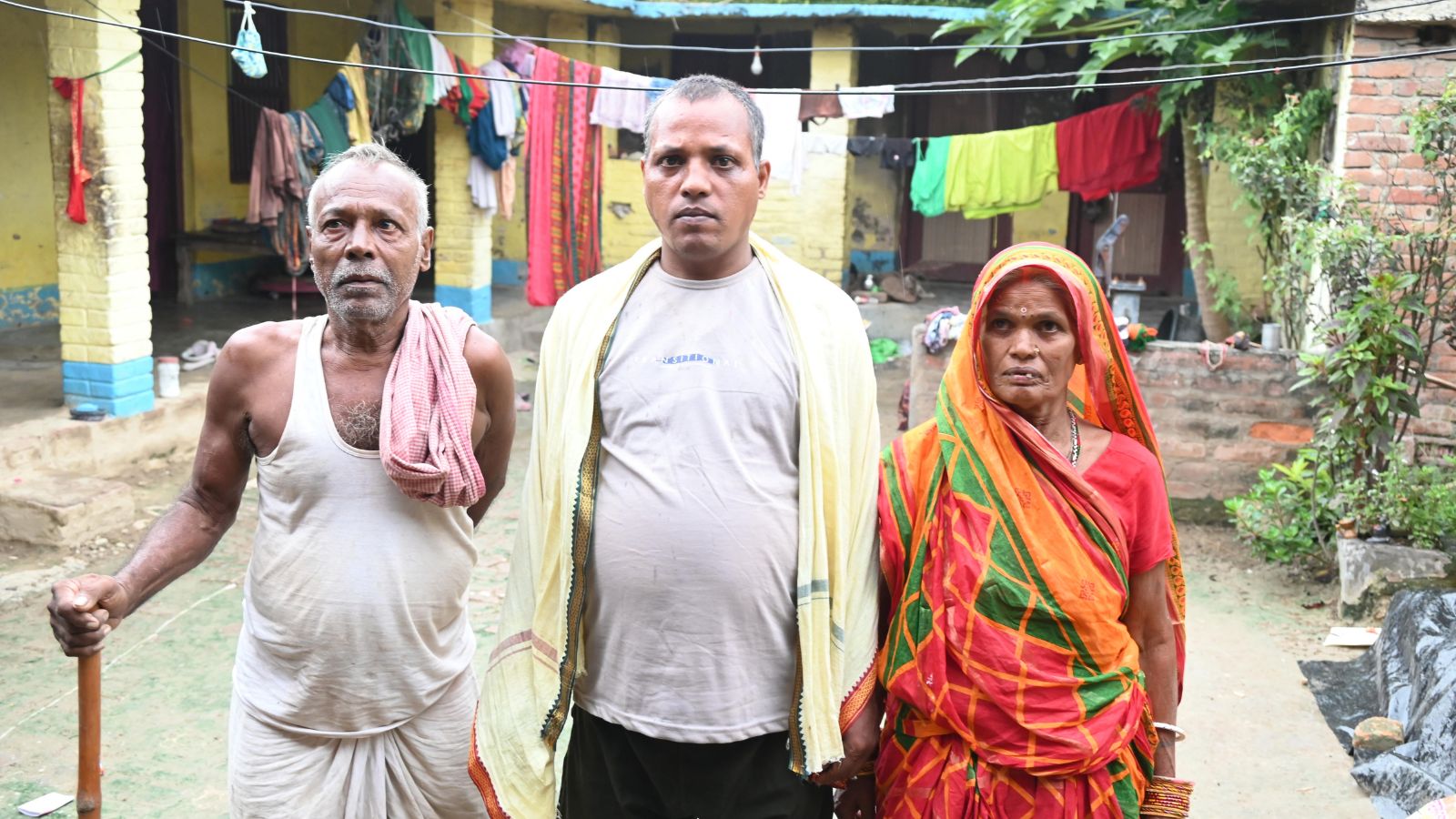
“For years, I had stopped counting past two. Now I can say we have three sons — Lalit, Lallan and Shanker,” his 75-year-old father Rajendra Kushwaha says.
Back home at the Kushwahas’ mud house, Shanker sits with his mother on a cot in the family courtyard, chatting quietly. Much has changed since Shanker was last here: Lallan is a factory driver in Delhi, Lalit has a master’s degree now in Sanskrit, and a room in the family’s home is full of certificates and mementoes — mostly Lalit’s.
“Being the youngest, Shanker was always pampered,” says his mother, Lakshmi. “He refused to go to school, and after two failed enrolment attempts, we just let him be.” Ask if Shanker wants to get married, and you get a quick look, a blush, a bow of the head, and a retreat to his safe place — his ‘Lalit Bhaiya’s’ room.
For some years after Shanker disappeared, his family still looked for him but never beyond Bihar. They also did not file a formal missing persons’ report, still holding onto the belief that he would board a train back home one day. But as years went by, that hope faded too.
Those lost years still yawn between them, and with Shanker’s memory still hazy, he can’t fill his family in. But what he remembers most is how he spent the first few days in Ayodhya.
“I spent time at a temple in Patna after leaving Ayodhya, cleaning floors in exchange for meals. I would participate in kirtans (devotional singing) and pass the time,” he says.
But it’s not only the family that’s happy to have him back.
“We have never witnessed a return like this after so many years. It has filled the village with hope. Now, our focus must be on keeping Shanker meaningfully engaged,” Ram Kumar Mahto, a local school teacher, says.
It’s what his family thinks too. “Shanker is strong and capable of physical labour. He could do well in rearing cattle. We have plans, but we want him to settle down first. Our priority now is making sure he doesn’t take another train to nowhere,” Lalit says.
Santosh Singh is a Senior Assistant Editor with The Indian Express since June 2008. Exper... Read More