Karnataka my karmbhoomi, Bharat my dharmbhoomi: Anant Nag in Dadasaheb Phalke speech
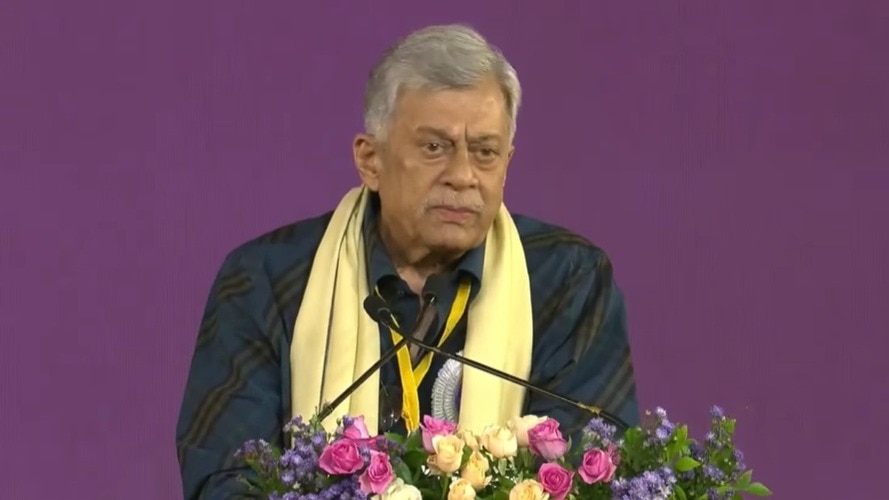
"This great country has been my janmabhoomi, Karnataka my karmabhoomi and Bharat my dharmabhoomi."
For Anant Nag, those few words perhaps said more about his five-decade journey than any award citation could. As the veteran Kannada actor stood on the National Film Awards stage on Tuesday, September 22, to receive the Dadasaheb Phalke Award, he looked back at a life that began with no certainty of becoming a career, a theatre journey that became his training ground and a home state that eventually became the foundation of his life and work.
It was a speech filled with memories, gratitude and a sense of wonder at how far the journey had taken him. From being sent to Mumbai at the age of 12 and finding his way to a stage, to working across languages and becoming one of Indian cinema's most respected actors, Nag spoke less about the honour itself and more about the people, places and circumstances that brought him there.
"It's a great honour to be here with you, and I am trying to digest the majesty of this function. I have not attended many, or perhaps any, such gatherings, but I am very happy to be with you all today," he said after receiving the award from President Droupadi Murmu at the 72nd National Film Awards ceremony in Ekta Nagar, Gujarat.
As Nag made his way to the stage, the auditorium rose to its feet. Among those applauding him were fellow awardees and actors, including Mammootty, Dhanush, Sanjay Mishra, Yami Gautam, Aditya Dhar and Kartik Aaryan among others. Celebrities giving Anant Nag a standing ovation. (Photo credit: Youtube/Doordarshan National)
Nag, who was accompanied by his wife and actor Gayathri, appeared visibly moved as he took in the moment. A special video tribute was also screened at the ceremony, tracing his journey from his early days as a theatre artiste to some of his career-defining performances and his more recent work. The tribute also acknowledged his contributions to Karnataka as a politician and writer.
Addressing the gathering after receiving the award and exchanging pleasantries with the dignitaries on stage, Nag admitted that he was still trying to take in the magnitude of the occasion. For someone whose acting career began without any certainty about where it would lead, the moment was particularly significant. Nag recalled growing up in an ashram and a mutt and being sent to Mumbai when he was 12. It was there that he got an opportunity to act in a play as Chaitanya Mahaprabhu, the saint-poet from Bengal.
“That is how my career started. But when I say ‘career’, at that point I had no idea what would happen in the future,” he said.Veteran actor Anant Nag receives the #DadasahebPhalkeAward at the 72nd National Film Awards, recognising his remarkable contribution to Indian cinema. #IndiaCelebratesCinema #FilmsThatUnite pic.twitter.com/4MDY4LNqcP— PIB India (@PIB_India) September 22, 2026
Nag then reached back to something he had learnt during his childhood — a line from Adi Shankaracharya’s Bhaja Govindam: ‘Udaradhimitham Bahukruthavesham’. He explained that ‘udara’ refers to the stomach and connected it to a similar thought expressed by Karnataka’s saint-poet Kanakadasa: ‘Ellaru maduvudu hottegagi, genu battegagi’.
The line, he explained, refers to how people put on different facades to earn a livelihood and fill their stomachs. He also recalled featuring in a Kannada film that carried the line as its title, while pointing out the familiar phrase ‘paapi pet ke liye’ in Hindi, conveying a similar sentiment.
From theatre, Nag found his way into cinema. In around five years, he acted in 50 different plays, describing the period as his training ground. He eventually began receiving film offers, first in Kannada and later in Hindi, where he worked with filmmakers including Shyam Benegal.
Although Nag acted in several Hindi films, he eventually chose to return to Karnataka as the opportunities there continued to grow.
“Although I did act in many Hindi films, the atmosphere for new-age films, commercial films and other opportunities in Karnataka was great. So I thought, let me move to Bangalore and settle there, and that became my karmabhoomi,” he said.
Over the past 15 years, Nag has also worked across several Indian languages. He described those opportunities as a chance to travel outside Karnataka while carrying a part of his home state with him.
“I was invited to do many films in other languages as well, and I went there as an ambassador of Karnataka,” he said.
The Dadasaheb Phalke Award also comes a year after Nag was conferred the Padma Bhushan. Reflecting on the coincidence of receiving both honours from President Droupadi Murmu, he said, “Last year, I had the good fortune of receiving the Padma award at the magical hands of our President, Droupadi Murmu ji, and this time too, I have the opportunity to receive the highest award in the field of cinema from her.”
But Nag was quick to shift the focus away from himself. After more than five decades in cinema, he dedicated the honour to the people who had been part of his journey and the audiences who had embraced his characters.
“At this point, I would like to remember all the people who have been with me throughout this career of 50-55 years. This award does not belong to me alone, but to everyone who has worked with me tirelessly. It belongs to the millions of people who have opened their hearts and minds to my characters over the last five and a half decades,” he said.
Nag briefly lost track of his speech while delivering his address, but composed himself before bringing it to a close with words that perhaps best summed up his relationship with Karnataka and the country.
“This great country has been my janmabhoomi, Karnataka my karmabhoomi and Bharat my dharmabhoomi. Once again, I thank you all, all the people of India who have been my great benefactors.
“With that, thank you. Jai Hind and Vande Mataram.”
The honour makes Anant Nag only the second actor from the Kannada film industry to receive the Dadasaheb Phalke Award, after Dr Rajkumar, who was honoured in 1995. For Nag, the recognition marks another significant chapter in a career that has moved effortlessly between languages, genres and generations.
The Government of India announced Nag as the recipient of the Dadasaheb Phalke Award on September 16, describing it as recognition of his “outstanding and invaluable contribution” to Indian cinema and his journey spanning more than five decades.
Nag, who turned 78 earlier this month, has acted in more than 300 films across Kannada, Hindi, Telugu, Tamil, Malayalam and Marathi cinema. His work has also extended to television, most notably through Malgudi Days. His filmography has taken him from the parallel cinema movement of the 1970s to mainstream Kannada cinema and, later, to some of the most memorable character roles of his career.
The Dadasaheb Phalke Award, presented for outstanding contribution to the growth and development of Indian cinema, now adds another landmark to that journey.
For an actor who began on a stage in Mumbai with little idea of what the future held, Anant Nag’s journey has come full circle in perhaps the most fitting way — with the nation applauding not one role, but five-and-a-half decades of them.- EndsPublished By: Sanjay Ponnappa CSPublished On: Sep 22, 2026 19:06 ISTALSO READ | Anant Nag's Dadasaheb Phalke Award is more than an honour. It's a five-decade story