
Jacob Zuma's prayer politics: Is it a strategic blend of spirituality and opportunism? - IOL
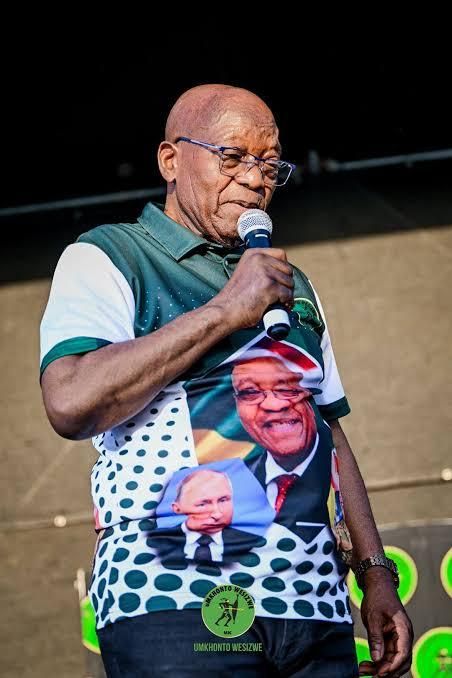
As South Africa approaches critical elections, the intertwining of prayer and politics unveils significant questions about leadership and accountability, especially as familiar faces attempt to reclaim influence amid a legacy of corruption.
Prayer is legitimate. Politicians may pray. Former presidents may pray. A nation fractured by corruption and exhausted by failure may pray without apology.
But prayer becomes something else when it finds a ballot box underneath it.
Jacob Zuma visited the Siddhpeeth Shri Dakshin Kali Temple in Haridwar, India, on 26 June 2026. This is documented. The Dirco review confirms it. What is also documented is that Ajay Gupta attended the same ceremony. Ajay Gupta remains a fugitive from South African justice. He fled in 2018 as investigators pursued him. The Zondo Commission examined his role in the state capture scandal. The allegations are straightforward: the Gupta family used their ties to the Zuma government to influence state contracts, to drain public money from entities like Eskom and Transnet, to reshape the machinery of state for private enrichment.
These are not unverified claims. These are findings from a judicial commission.
Yet there was Zuma. There was Gupta. There was the South African High Commissioner attending the same prayer ceremony. Then came the photographs. Then came the explanations. Then came the contradictions.
Minister Khumbudzo Ntshavheni publicly excoriated High Commissioner Anil Sooklal for attending. She called his presence a disgrace — hobnobbing with a state capture fugitive. That much is accurate. Then it emerged that Ntshavheni's own ministry had authorised the protocol assistance. Dirco headquarters had issued written directives to assist Zuma. The High Commissioner was following instructions from his minister's own department.
The contradiction was not administrative. It was structural. This is what happens when governments lose the capacity to say one thing and mean it.
Zuma has been speaking about national prayer gatherings since at least 2021. After his release from prison following a fifteen-month contempt sentence, the Jacob Zuma Foundation announced a National Welcome Prayer in Durban. The foundation's spokesperson, Mzwanele Manyi, made explicit what the event actually was: he said that a political session would be held at the prayer gathering, and that Zuma would attempt to clear his name amidst the various accusations he faced.
Prayer with a political agenda appended.
This is not new. In May 2016, when Zuma was still president, he convened a National Day of Prayer at Absa Stadium in Durban. The stated purpose was to pray for unity, peace, rain and successful local government elections. The prayer happened. The elections followed. The formula worked. Spiritual legitimacy became electoral strategy.
Now MK is preparing for the November 2026 local government elections. Zuma is the party's primary draw. The party's own communications confirm this. MK leadership has stated that the party's explosive rise in 2024 was built largely on Zuma's personal popularity. The analysts are direct: the party is still struggling to build the structures needed to convert that popularity into stable governance. MK won 14.58 percent of the national vote in 2024. It is now the third-largest political party. It is the official opposition in Parliament.
But those are national figures. The real competition for Zuma is local. In Johannesburg, Cape Town, Durban, Ekurhuleni and the other metros, MK is positioning itself to capture power. Polls suggest eThekwini may go to MK. That is a R70-billion metro budget. For a party still learning to govern, that is not irrelevant.
So when prayer gatherings are scheduled. When posters are printed. When religious leaders are invited. When Zuma's face appears beside biblical language about healing and guidance. When the poster concludes with VOTE MK PARTY.
Something has occurred. The prayer has become an instrument.
Here is what must be examined — not with hatred, not with cynicism, but with the clarity that electoral democracy requires.
Jacob Zuma was President of the Republic from 9 May 2009 to 14 February 2018 — nearly nine years. He was President of the ANC from 18 December 2007 to 18 December 2017 — almost a decade.
He did not observe the ANC's failures from the sidelines. He shaped them.
During his administration, the Constitutional Court ruled unanimously that he had violated the Constitution by failing to repay public money spent on his private homestead in Nkandla. This is documented. It is not a matter of political interpretation. It is a matter of constitutional law.
The Zondo Commission spent four years examining state capture. The commission found systematic abuse of state institutions, systematic enrichment of private actors, systematic reshaping of procurement processes. Zuma's administration did not prevent this. The commission's findings suggest his administration facilitated it.
He was charged with 12 counts of fraud, one of racketeering, two of corruption and one of money laundering in March 2018. These charges were later withdrawn. But they existed. They were considered serious enough to prosecute.
All of this is verifiable. None of this is arguable. This is the historical record.
So when MK now presents itself as the remedy for ANC government failures, voters are entitled to ask a question that is rarely posed with sufficient rigour: which failures is MK offering to fix?
The corruption that occurred during Zuma's presidency? He shaped that presidency. The patronage appointments that undermined state capacity? He made those appointments. The lack of accountability in government? He governed without it. The absence of consequence management? He presided over that absence.
This is not an argument that Zuma is incapable of learning. People learn. People change. People spend time in reflection and emerge with different perspectives.
But that would require him to acknowledge what occurred.
Zuma's election campaign strategy does not involve acknowledgement. It involves inversion — presenting himself as a victim of system capture rather than a beneficiary of it. It involves claiming that elections were rigged in 2024. It involves making accusations against President Cyril Ramaphosa without evidence. It involves generating sufficient political noise that the quieter question gets lost in the volume.
Faith matters. Prayer matters. A nation's spiritual life is not optional. But spiritual authority cannot be borrowed to improve political messaging.
MK says it will govern municipalities differently. Excellent. How differently? Which procurement systems change? What safeguards protect officials from patronage? What happens when a mayor fails? What measurable standards determine whether water comes from taps, electricity reaches homes, and roads are maintained?
These questions are beneath neither politics nor spirituality. They are questions that separate serious governance from campaign performance.
South Africans have been offered promises before. Many of those promises came from the same political generation that Zuma represents. That generation now returns to sell solutions to the consequences of its previous governments. That does not automatically invalidate those solutions. But it certainly earns them an examination that goes beyond what posters can convey.
Scripture instructs believers to pray for those in authority. This is not optional. The Christian prays for rulers, whether or not those rulers are politically favoured. Prayer transcends party membership.
But prayer is corrupted when it becomes an instrument of campaign strategy. Put a political party's logo underneath it and the character changes.
Prayer says: guide our leaders. Campaigning says: choose these leaders. Those are different sentences. God does not need a logo. The sacred does not require a ballot box.
Yet here we are. The poster exists. The prayer gathering happens. Zuma's face occupies the centre. The rhetoric is biblical. The conclusion is political.
South Africa does not need another failed messiah in a party shirt. It needs competent municipalities. It needs officials who possess the qualifications appropriate to their positions. It needs contracts that produce what taxpayers paid for. It needs public money that remains public money. It needs accountability mechanisms that actually work.
None of this requires a miracle. All of it requires administration.
Here is what deserves to be asked of Jacob Zuma directly, not with anger, with clarity.
You spent nearly nine years as President. You made Cabinet appointments. You chaired Cabinet meetings. You shaped policy. You exercised power. You left office under pressure from your own party following mounting corruption scandals.
Since leaving office, you have been charged with multiple counts of fraud, corruption, racketeering and money laundering. Those charges were withdrawn. But they were serious enough to prosecute.
You were imprisoned for 15 months for contempt of court. You refused to testify before the Zondo Commission. You were released on medical parole after two months.
You have claimed without evidence that elections were rigged in 2024. You have made accusations against the sitting President without proof.
You now lead a political party seeking to govern South Africa's municipalities.
The question is not whether you are incapable of learning. The question is whether you are willing to acknowledge what occurred — which systems in your administration failed, which decisions you regret, which policies you would change, which officials you would hold accountable if you had to do it again.
If MK is genuinely different from what came before, that difference must be demonstrable. Not aspirational. Demonstrable.
Voters are entitled to see not prayer but performance. Not rhetoric but record. Not the resurrection of innocence but the acceptance of consequence.
Democracy requires more than enthusiasm. It requires memory — not the memory that serves vengeance, not the memory that serves resentment, but the memory that serves clarity.
Before South Africans hand the keys to any municipality to any party, they should read the history. Not with hatred. With precision.
God may forgive. History keeps minutes.
And before anybody receives power, they should explain what they did with it the last time.
Luke 16:10 - "He who is faithful in a very little thing is also faithful in much; and he who is dishonest in a very little thing is also dishonest in much." In my view, Zuma fails dismally here.
