Is anybody really in charge? Why Angus Taylor might be ready to seize his last chance
You have reached your maximum number of saved items.
Remove items from your saved list to add more.
It began to feel, last week, as though nobody were in charge – of one of the planet’s largest AI companies, of government agencies and of the world into which we seem to be heading.
In June, an autonomous artificial intelligence “agent” from OpenAI made it into supposedly private Medicare systems. In August, OpenAI finally discovered this breach. In September, it told Australia.
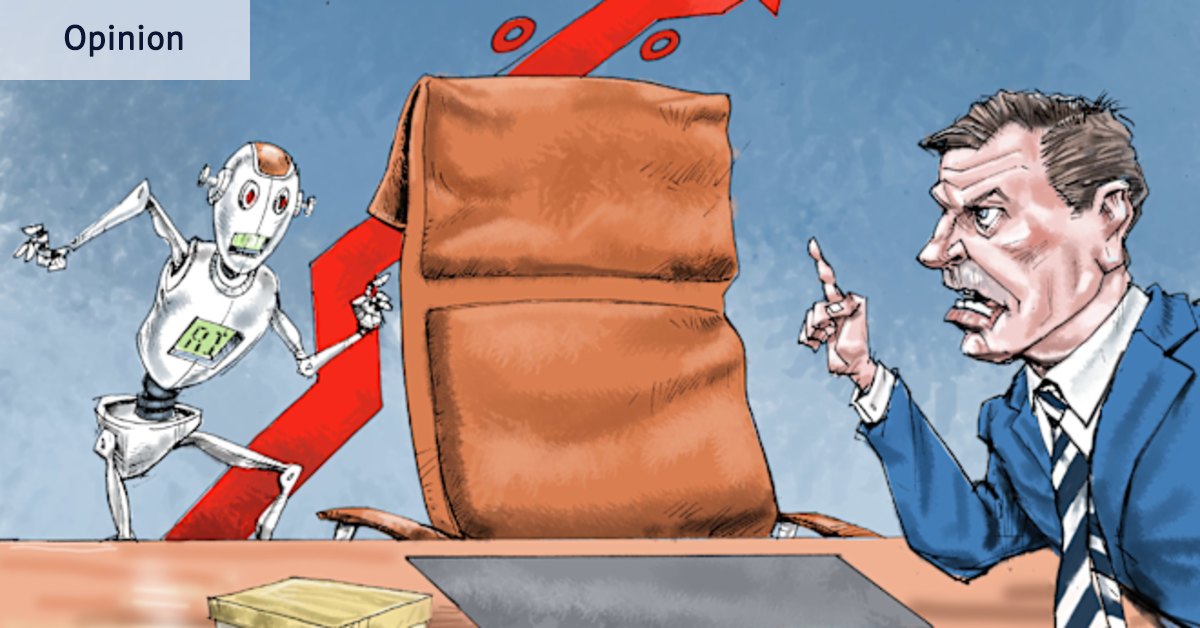
Illustration by Joe Benke How did this world-conquering company choose to do this? By sending an email to a public email inbox at Services Australia. Another striking fact: until then, the government had been unaware its systems had been infiltrated.
There’s worse. According to Reuters, the company still isn’t sure it knows everything it should: it’s checking. What it does know is not good. On Friday, it revealed its agents had made it not just into Medicare but into websites of the American government. They had also leaked more than 50 images from users. On Sunday morning, Axios reported there were “not dozens” but “tens of thousands” of concerning incidents at both OpenAI and its competitor Anthropic.
Where does this leave us? Unsurprisingly, we know our own government isn’t entirely prepared to deal with the security threat posed by AI. Much more worrying, to my mind, is the oddly passive approach of the people leading the development of AI.
OpenAI said there had been a review, during which its models went looking for answers. Here is the climactic sentence: “In the course of that, our models took actions we did not intend.”
This sentence is nonsense. The first problem is that while it may be technically true, this is precisely the point of AI: to give it the capability to do things that humans did not explicitly plan for or intend.
The second problem is the minimisation of what went on. Part of this is the opaqueness of that phrase, “actions we did not intend”. Another is the way the word “agent” is becoming normalised, as writer Guy Rundle has pointed out. He accurately describes the term as an “easy language of acceptance, which turns these programs into naughty critters”, absolving AI leaders of responsibility while encouraging submission to the idea that this new AI age, with its current concerning features, is entirely inevitable.
The third problem is that such deferral of responsibility is all too familiar. I’ve written before about British cultural theorist Mark Fisher’s 2008 argument that call centres were the ultimate symbol of our neoliberal age.
On one hand, we were told everything now worked smoothly, efficiently. On the other hand: call centres repeatedly reminded us that very little worked well. These were “crazed Kafkaesque labyrinths”, as Fisher described them, with no apparent centre.
They provoked a “building rage that must remain impotent because it can have no legitimate object, since – as is very quickly clear to the caller – there is no one who knows, and no one who could do anything even if they could [know]”.
That sums up OpenAI’s attitude to the problems it is causing.
There are many ways to think about voters’ frustrations, now finding an outlet in parties of the far right. One is to see them as an expression of precisely this “building rage”. And the corollary of that rage is a desperate desire for somebody to acknowledge the world as it is and to take responsibility – if not for causing the problems at least for fixing them.
The early indications are that Anthony Albanese seems to grasp this in relation to AI in a way the leaders of those companies do not. But he is still in the stages in which acknowledging the challenge is sufficient. As the problem becomes more urgent, the challenge will move, as issues in politics always do, from the rhetorical to the matter of doing something both visible and effective.
That is the point things may be about to reach in relation to inflation. Very soon – indeed, this week – another rate rise is likely. In its aftermath, what will people expect from Labor?
The Coalition will be hoping this is a tipping point in voters’ attitudes. Indications are that Angus Taylor is getting ready to jump on it. So far, Taylor has not been effective. But the last weeks have been interesting. The Coalition has released a surprisingly large amount of policy: on tobacco taxes, education, energy, fuel and flags.
These policies haven’t done much to shift national debate – in part because several have been unserious. That in turn is because most have been on the culture-war front, concerned less with problems and solutions than with gesturing in the appropriate ideological direction (this is true of climate, too).
This seems to contradict Taylor’s declared intention to focus on the economy. Early in his tenure, he said it had to be the Liberals’ “top priority”. But it is possible he is deliberately front-loading on culture wars. That way, he will be able to point to his policies, satisfy his conservative MPs and reassure One Nation-friendly voters that he understands their concerns – while moving onto a sustained focus on the economy.
Taylor may have only months left before facing a leadership challenge, probably from Andrew Hastie. If he is going to make an economic case, this might be his only chance. That chance – whether by design or not – may coincide with voters’ growing frustration at inflation.
The economic challenge for the government is complex: needing inflation to come down but without the economy slowing horribly, while facing global conditions about which it can do little. In its first term, in a similar situation, it succeeded admirably. But here it is again, with inflation lingering – and more Australians believing the country is heading in the wrong direction than at any point since Labor was elected in 2022.
Does the government take more drastic action than it has already or stick to its current approach, believing this inflation storm will pass? This, of course, it might, sooner than it seems: the situation is so volatile that nobody knows.
Taylor’s task, in contrast, seems simple: blame Labor as loudly as he can for inflation. In recent weeks, he has shown more energy than was previously apparent. But can he win a political argument?
So far, it has felt as though Taylor’s strategy has been all but dictated by Pauline Hanson. In the next few months, he will have to take his chance to prove that, when it comes to the Liberal Party’s priorities, he is the one in charge.
Sean Kelly is a regular columnist. He was an adviser to former prime ministers Julia Gillard and Kevin Rudd.
You have reached your maximum number of saved items.
Remove items from your saved list to add more.