
Iran’s president faces stark choice in UN speech after Trump threatens ‘annihilation’
Want to bookmark your favourite articles and stories to read or reference later? Start your Independent Membership today.
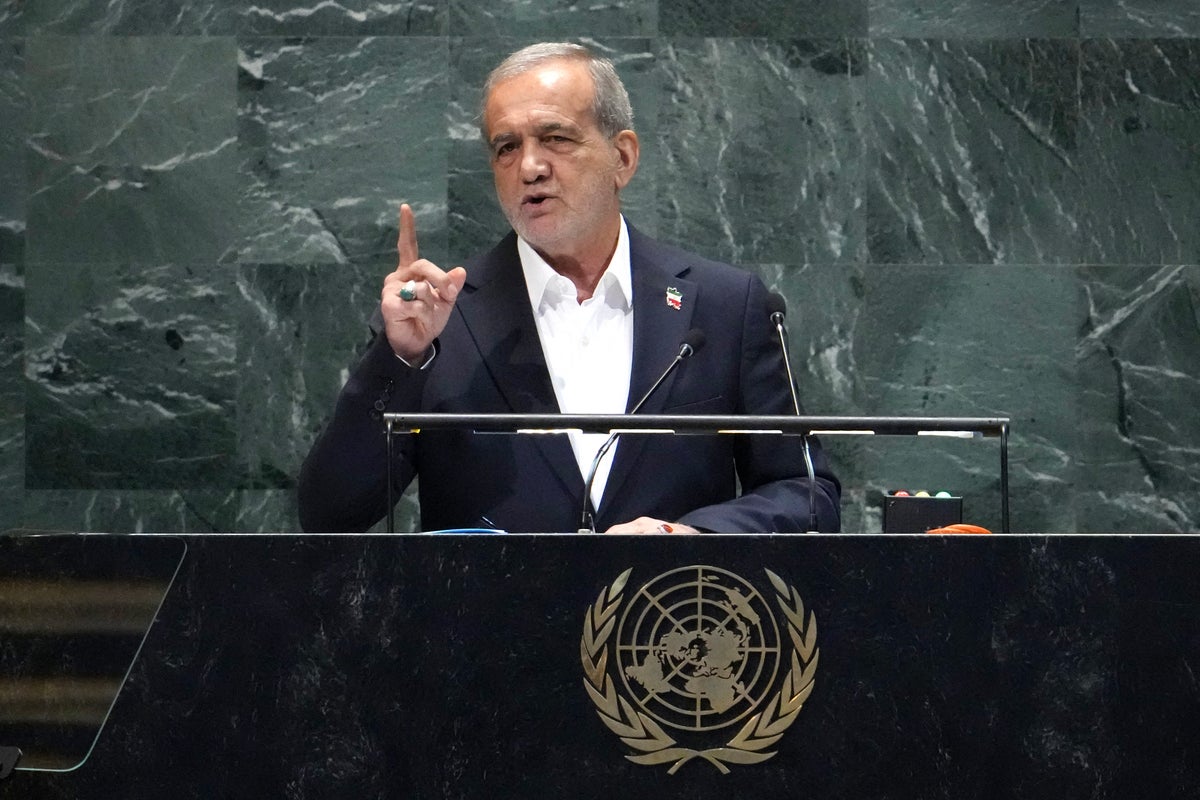
Iran's president Masoud Pezeshkian has arrived in New York ahead of his speech at the UN General Assembly Wednesday, amid renewed hopes for a diplomatic breakthrough to the Middle East war.
At the annual high-level gathering at the UN headquarters, the Iranian politician will get the chance to defend his country’s position on the global stage.
But his speech comes just hours after US president Donald Trump renewed his threats against Iran in his speech to the assembly in New York.
Trump said he faces two choices on how to deal with the Iranian regime, one of which was “annihilation”. The Iranian delegation walked out when he made the remarks Tuesday.
Pezeshkian faces a similar choice in terms of what tone to strike in the speech, either pushing for further diplomacy or bowing to Iranian hardliners at home who want a more aggressive stance.
Below we look at what we know about Iran’s reformer president and the deadlock both sides hope to break.
The 71-year-old has served as the president of Iran since 2024, leading the country through two major conflicts - first the 12-day war with Israel in 2025 and through the US-Israeli conflict that began in February.
Before entering politics, he worked as a heart surgeon, leading him to become president of the prestigious Tabriz University of Medical Sciences in the 1990s. His work eventually lead him to becoming Health Minister, putting him under a spotlight.
A member of the reformist faction, Pezeshkian was elected by over 16 million people on a campaign to moderate Iran’s conservative outlook, including loosening strictures about female dress.
The politician was the only moderate reformist among the six candidates at the time, and went as far as criticising the country’s morality police.
He had pledged to stop street confrontations over the mandatory hijab, particularly after the death of Mahsa Jina Amini while in police custody, which sparked the Woman, Life, Freedom mass demonstrations.
Before the US war, Pezeshkian had promised to improve Iran’s relationship with the West. He had hoped to revive the agreement with the US over his country’s nuclear programme in exchange for lifting international sanctions against it.
But after the assassination of Ali Khamenei in February 2026, he was heavily sidelined from military decisions.
Throughout the war he has welcomed talks with the US, remarking: “If we do not negotiate, what else are we to do?”
Away from politics, Pezeshkian suffered a personal tragedy in 1994 when his wife died and their youngest son were killed in a car crash. He has never remarried, and has raised his daughter and two other sons alone.
Pezeshkian is expected to use his speech to drive forward Iran’s agenda and point the finger at the US and Israel for starting the war in the Middle East, and for alleged war crimes in Minab, where a suspected US strike hit a school, killing more than 121 children along with 26 teachers.
Before departing from Tehran, the president said he would defend Iran’s positions and speak about the suffering of its people, alleged war crimes by its adversaries and the erosion of trust in negotiations, Iran International reported, according to state news agency IRNA.
“We have been at the negotiating table several times and signed an agreement. They [enemies] acted against the negotiations and understandings reached. The world has seen and continues to see that they have easily violated those understandings,” Pezeshkian said.
However, he has already faced backlash at home for even attending the event, given the ongoing conflict and the US strikes on nuclear facilities last year.
A former senior Revolutionary Guards said he should have stayed in Tehran - and used that as the opportunity to protest US aggression, Iran International reported.
Hossein Kanani-Moghadam, a former commander in Iran's Revolutionary Guards, said the General Assembly could still give Pezeshkian a useful diplomatic platform, but added: “If I were Pezeshkian, I would not go to New York.”
Given that he is attending however, hardliners in Tehran called on Pezeshkian to not show any signs of weakness and to criticise other countries in the region that have provided support for the US, Iran Insight reports.
Even before the Iranian delegation landed in New York, the US took a hostile stance and denied visas to the media team joining the president.
Pezeshkian said the measure shows that the US is concerned about its actions being brought to the world’s attention.
“They are trying to prevent the voice of the Iranian people from being heard and have blocked the presence of Iran’s media delegation,” he said. “However, many international media outlets are present, and if we manage our message effectively, we will be able to make the voice of the Iranian people heard.”
Iran’s Foreign Ministry spokesperson Esmaeil Baqae also complained earlier about the US decision, saying the administration is “seeking to hide the truth” by barring Iranian journalists.
“When an administration slams its doors shut - even on American journalists it happens to dislike - and bars foreign reporters, including the Iranian president’s media team, whose voices it would rather silence, it is not managing access; it is trying to hide the truth and further its misinformation campaign by trampling on the right of access to information,” he said in a post on X.
“A nation that once took pride in tearing down the Iron Curtain now finds itself standing behind one of its own.”
US authorities have not yet commented on the matter.
A senior Iranian official earlier told Reuters that the delegation in New York has full authority to revive diplomacy with the US, even though Pezeshkian has not had a central role in the negotiations process.
They said that the government has offered to reopen the Strait of Hormuz within seven days if the US begins easing military pressure and lifts its blockade on ports.
In the past, Iranian officials have been reluctant to meet with US officials, but that may change as pressure is piling on from the energy market. Brent crude continues to hover around $100 (£74) per barrel, up from about the $70 (£52) range in the weeks before the start of the war.
Trump meanwhile has said he is still in “deciding mode” about the next steps in the conflict. However, he has not ruled out meeting with his Iranian counterpart during his trip.


