Iran-US war latest: Trump denies offering Tehran sanctions relief to rein in its nuclear programme
Want to bookmark your favourite articles and stories to read or reference later? Start your Independent Membership today.
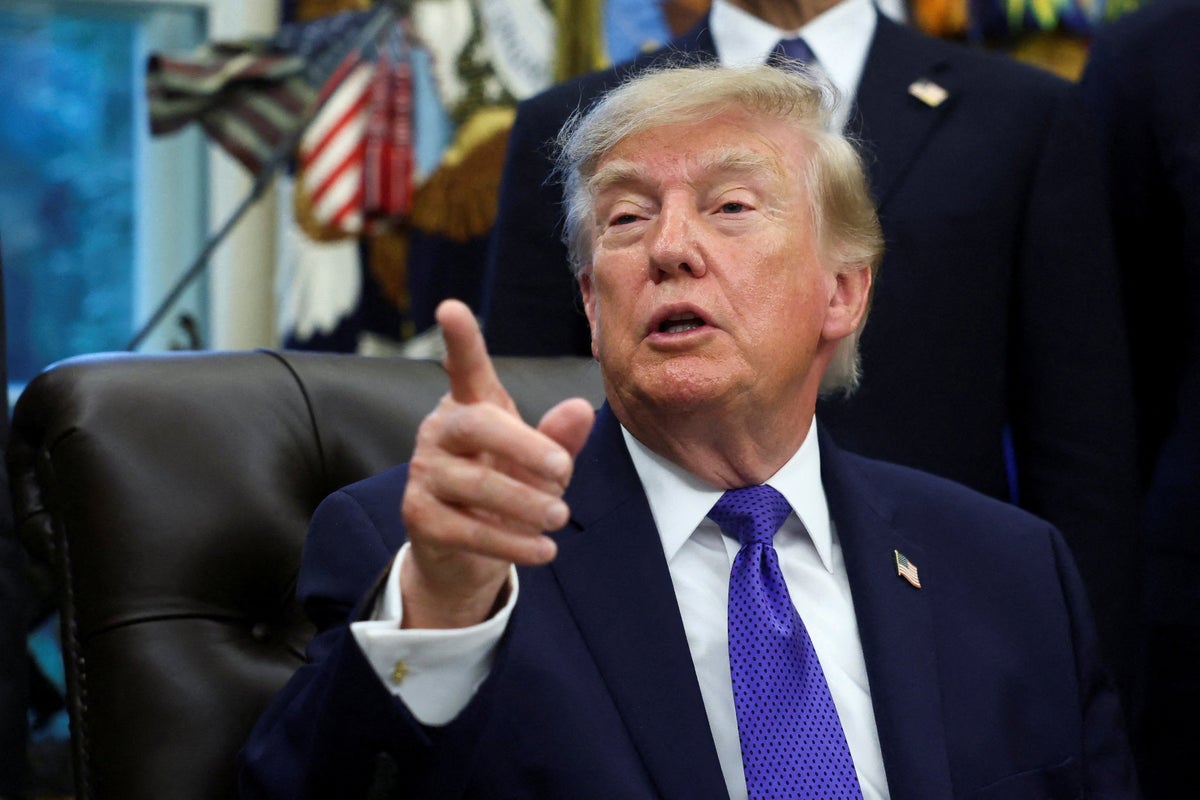
Donald Trump has rejected reports that Washington had offered Tehran sanctions relief.
Trump dismissed reports that his administration had offered Iran access to frozen funds or sanctions concessions in exchange for nuclear commitments.
Both Axios and CNN cited US officials as saying the Trump administration was preparing to offer sanctions relief in exchange for “concrete” steps to rein in Iran’s nuclear programme.
“This is untrue. I offered them NOTHING,” Trump wrote on Truth Social.
Trump did confirm on Monday that US officials had spoken with mediators in New York, as he insisted the US will win its war in Iran “very soon”.
Speaking to reporters from the Oval Office, the US president promised the price of gas would come tumbling down after the war, adding he believed it would be over “quickly”.
“We’re going to win, as far as I’m concerned, it’s going to be one way or the other,” Mr Trump said. “It’s going to go pretty quickly.”
Iranian foreign minister Abbas Araghchi said Tehran was prepared for a “doomsday” war with the US, while at the same time keeping channels for diplomacy open.
US secretary of state Marco Rubio said the Strait of Hormuz remains largely open, with oil flows close to pre-war levels apart from Iranian oil, but warned that a nuclear-armed Iran would pose an “unacceptable risk”.
He said Tehran could use nuclear weapons to “blackmail the world and to kill people”, potentially controlling the strait and energy supplies.
Rubio also criticised Iran’s leadership, saying: “Who calls the shots in Iran are radical Shia clerics with an apocalyptic vision of the future. They believe that it is a religious calling to trigger about the last days of the world, the apocalypse.”
.“They use the money to fund Hezbollah, they use the money to fund Hamas, they use the money to fund Shia militias in Iraq… they use the money to sponsor terrorism and assassination plots,” he said.
Five British men in their early 20s have been released on bail after being arrested near RAF Fairford over suspected terrorism and explosives offences.
British counterterrorism police said the investigation was ongoing and that they were examining possible links to Iran, Russia or non-state armed groups, including whether the suspects may have been acting as proxies for a foreign government.
Police have not publicly tied Iran to the arrests.Iran has categorically denied any involvement, calling the allegations “unfounded and malicious”, according to a statement by Iran’s embassy in London.
US president Donald Trump said the incident “might be” connected to Iran, while UK ministers warned of threats from Iran and its proxies.
Donald Trump has rejected reports that Washington had offered Tehran sanctions relief.
Trump dismissed reports that his administration had offered Iran access to frozen funds or sanctions concessions in exchange for nuclear commitments.
“This is untrue. I offered them NOTHING,” Trump wrote on Truth Social.
Meanwhile, Trump confirmed on Monday that US officials separately spoke with mediators, without giving further details.
He also said: “We’re going to win, as far as I’m concerned, it’s going to be one way or the other. It’s going to go pretty quickly.”
Five men arrested over a suspected bomb plot near an RAF base have been released on bail, the Metropolitan Police has said.
The suspects, who are all British nationals aged in their twenties and from London, were arrested over potential terror offences in Whelford, Gloucestershire, in the early hours of Sunday.
They were arrested on suspicion of explosives offences and later on suspicion of terrorism offences, after a villager dialled 999 when she saw three vans and a group of masked men near the base.
British intelligence has issued a warning after finding Iranian spies have targeted dissidents with spyware that can enable tracking of their movements.
Dissidents, activists and journalists were targeted by state actors that impersonated their contacts on messaging apps to trick them into downloading spyware called Chosen Brick, the National Cyber Security Centre, part of GCHQ, warned.
The malware gave agents access to the person’s contacts, emails and social media messages as well as a device’s microphone and content on the screen.
Iran’s president Masoud Pezeshkian launched a defiant attack on the United States and Israel at the UN, the day after President Donald Trump threatened to “annihilate” the Islamic Republic.
The US leader warned he could send Iran to “hell” during his combative address to the United Nations General Assembly Tuesday, seven months after the war he started alongside Israel’s Benjamin Netanyahu.
In his address to the gathering in New York on Wednesday, Mr Pezeshkian insisted that Iran would never surrender and held up images of children killed in a strike on a primary school in Minab.
When Iran shut down the Strait of Hormuz at the beginning of the war, cutting off sea passage for some 15 million barrels of oil a day, many feared that prices would skyrocket.
Instead, nearly seven months on, oil is expensive but not exorbitant, and analysts suggest current supply is sufficient to meet current global needs, even as the higher prices cause political problems for US President Donald Trump and others.
That's because Saudi Arabia and other Gulf producers quickly found alternative routes and reached for unused pipeline capacity. When Iran and its militant allies targeted those, the oil exporters and the U.S. military found further workarounds in an often clandestine game of whack-a-mole.
If this was a ploy to use old school techniques in the age of drones it was doomed from the start, says world affairs editor Sam Kiley.
Explosions heard tonight in Iran’s Qeshm Island are likely a result of warning shots fired at violating vessels in the Strait of Hormus, according to Iran’s state TV.