Iran-US war latest: Houthis claim attack on major Saudi oil refinery as ships attacked in Strait of Hormuz
Want to bookmark your favourite articles and stories to read or reference later? Start your Independent Membership today.
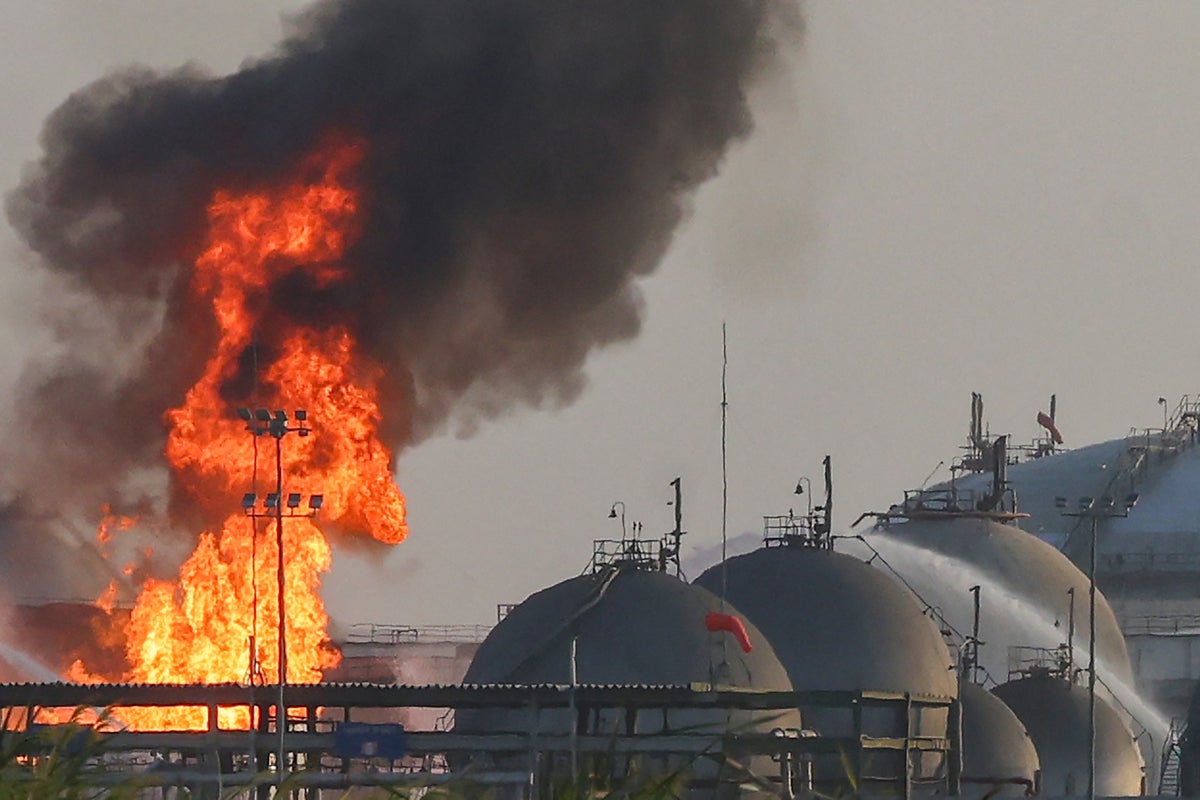
Yemen's Houthis have claimed responsibility for carrying out a ballistic missile attack on the Aramco oil refinery in Riyadh, Saudi Arabia.
The Houthis said the attack was carried out in retaliation for Saudi attacks on Yemen's Sanaa and other provinces.
Smoke and fire was seen emerging from on Saturday, a witness told Reuters.
The Armaco fire comes amid escalating hostilities between Saudi Arabia and Houthis, who have stepped up attacks on Saudi cities and energy infrastructure.
Last week, the Houthis said they had attacked Saudi’s Aramco facilities in Yanbu with missiles and drones.
It comes as a crude oil tanker was reportedly struck by an unknown projectile off the coast of Oman, near the Strait of Hormuz, the UKMTO said on Saturday. All crew were reported safe and no environmental impact was recorded.
On Friday the UKMTO said a tanker was struck by a projectile while transiting the waterway, causing a small fire, which was extinguished.
Axios reported on Saturday that members of Donald Trump’s administration met in secret at Camp David to discuss the next steps of the war and the conflict between the Houthi rebels and Saudi Arabia.
Yemen's Houthi rebels have claimed responsibility for a coordinated missile and drone strike targeting a Saudi Aramco facility in the capital city of Riyadh.
Witnesses reported seeing a large plume of smoke and fire rising near an Aramco installation in Riyadh earlier in the day.
The Houthi military has stated the assault was launched in direct retaliation for recent Saudi coalition airstrikes against Sanaa and other Yemeni provinces.
The reported strike marks a sharp escalation in cross-border targeting following claims last week of Houthi strikes against Aramco assets in Yanbu.
Yemeni government-aligned forces claim they conducted 97 “precision targeting operations” against the Houthis using aircraft, drones, artillery, missiles and snipers.
The attacks led to “neutralising (260) elements of the militia”, Yemeni military spokesperson Brigadier General Majid Abdullah Al-Nuzaili said in a post on X.
Earlier in the day, the Houthi military said it launched coordinated attacks targeting a Saudi Aramco facility in Riyadh in retaliation for recent Saudi coalition airstrikes against Sanaa and other Yemeni provinces.
The Strait of Hormuz will not reopen until conditions set out in a June interim agreement with the US are met, Nournews reported Iran's parliament speaker Mohammad Bager Ghalibaf as saying on Sunday, a few days after Tehran received Washington's reply to its diplomatic proposal.
“The Americans, who say something different in the media, have recently put forward proposals through a mediator. But they must understand that the period of dragging out the process and dictating one-sided demands is over,” he was quoted as saying.
“The position of the Islamic Republic of Iran is completely clear and firm, and the Strait of Hormuz will not be opened until our seven conditions, based on the Islamabad Memorandum of Understanding, are met.”
Two Iranian diplomats who were part of the delegation to the UN General Assembly in New York were “kicked out” of the US yesterday, Axios reported, citing a US official.
They were found still in New York “long after the UN General Assembly had passed,” despite the US State Department demanding that the entire Iranian delegation leave immediately after the session.
One of the Iranian diplomats left on Friday night and the second left on Saturday, according to the US official.
Yemen's armed forces said today that it was conducting strikes against the Iran-aligned Houthis in the capital, Sanaa.
A Yemeni armed forces spokesperson said forces were targeting what he described as "vital targets", without providing further details.
Yemen's Houthi-run Al Masirah TV reported earlier an attack that it said was carried out by Saudi Arabia on Sanaa.
US president Donald Trump said yesterday that Iran has been “decimated” and has “virtually given up any plans for a nuclear weapon”.
Trump claimed that oil prices were currently decreasing.
“Oil is coming down. Oil is right now lower, and it's been lower than it was under the Biden administration, and they did nothing about the fact that Iran cannot have a nuclear weapon,” Trump told reporters as he departed the White House to attend a rally in Ohio.
“By the way, Iran, as you know, has virtually given up any plans of a nuclear weapon,” he said.
Iran has executed a detainee over the protests in January for allegedly firing at police, the judiciary said yesterday.
The man, Siavash Jamshidi Kheirabadi, fired at least three shots at police on 8 January and was arrested two days later in Shahrekord in southwestern Iran, it said.
He was accused of contacting people online to organise "anti-security" activities and seeking payment for a "mission".
Portuguese prosecutors have opened a formal inquiry into the government's decision to allow US military flights to use Lajes Air Base in the Azores during the ongoing conflict with Iran.
The prosecutor general's office confirmed the probe following a legal complaint filed by the opposition Left Bloc party, which claims allowing US transit operations violates international law.
Under a 1951 bilateral treaty, Washington can utilise the strategic Atlantic hub freely during peacetime, but must secure explicit Portuguese approval once active hostilities begin.
Foreign minister Paulo Rangel defended the authorisation, stating Lisbon received firm assurances from Washington that US operations would remain defensive, necessary, and proportionate.
Unlike neighboring Spain, which restricted US access, Portugal's approval has ignited fierce political debate over the nation's indirect involvement in the conflict.
Iran’s rial has plummeted to a historic low, with the US dollar now trading above 2.68 million rials in spite of emergency central bank intervention.
State banks began selling up to $2 billion in foreign reserves to stabilise the currency, which has lost more than half its value over the past year.
However, severe sanctions and a naval blockade on Iranian oil exports continue to choke off the regime's primary source of foreign revenue, pushing domestic inflation past 70 percent.
Central bank officials dismissed the market crash as a temporary panic, accusing Washington of spreading false economic predictions to induce capital flight.