
Iran relies on China and Russia as US pressure grows, but both powers are pursuing broader interests
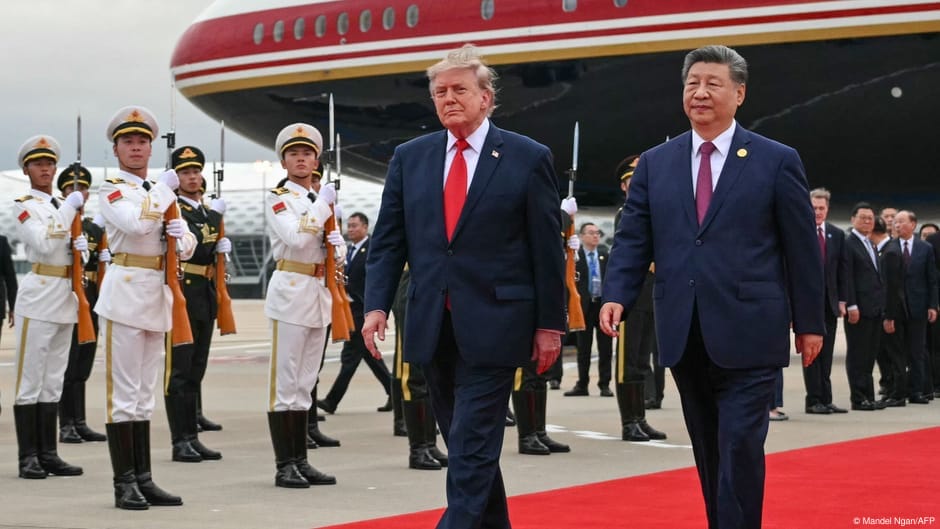
As Trump, Xi and Putin meet in Shenzhen, China and Russia back Iran but must balance that support against broader interests with WashingtonImage: Mandel Ngan/AFPAdvertisementAs Donald Trump, Xi Jinping and Vladimir Putin meet in Shenzhen, Washington wants to tighten its blockade of Iran, but China remains Tehran's main oil buyer and Russia offers it political and logistical support.
And when Trump, Xi and Putin sit down together, Iran will not be at the table, even though Washington's pressure campaign against Tehran is expected to be among the issues discussed.
For Tehran, relations with both China and Russia are routinely described as strategic. That relationship looks more complicated from Beijing and Moscow.
Both countries oppose Washington's efforts to isolate Iran and maintain political and economic ties with Tehran. But both have broader interests in their relationships with the United States and may see Iran partly through the prism of their own negotiations with Washington.
That raises a central question: Can Trump's strategy of economically isolating Iran succeed if China and Russia refuse to fully cooperate?
China is currently the most important destination for Iranian oil.
In 2025, it was widely reported that Chinese buyers took more than 80% of Iran's seaborne crude exports, much of it through independent refiners and at steep discount because of sanctions.
And as China provided Tehran an economic lifeline, Iran also became increasingly dependent on Chinese manufactured goods, machinery and industrial inputs.
Mohsen Solhdoost, an assistant professor of international relations at Xi'an Jiaotong-Liverpool University, says China is important to Washington's strategy but not decisive on its own.
"If the objective is to reduce Iranian export earnings, restrict access to equipment and make economic and military recovery more difficult, the United States can achieve substantial results without Chinese cooperation," he told DW.
But forcing Iran to accept Washington's preferred nuclear or regional policies is another matter.
"The ability to interrupt trade is much easier to demonstrate than the ability to determine another government's political choices," Solhdoost said.
That distinction has become more important as US sanctions enforcement and maritime blockade efforts have increased pressure on Iranian crude oil exports.
In November, Washington announced Task Force Iron Gate, an initiative aimed at disrupting the movement of sanctioned goods, military equipment and revenue through Iran's land borders and the Caspian Sea.
Even so, these trade links have not disappeared. The commercial and security interests of countries including Iraq, Pakistan and Turkey mean that goods continue to move across the region, albeit under greater scrutiny.
As a result, China's role in Iran's economy remains significant, but Solhdoost argues that demand alone cannot sustain Iranian exports. The oil must be able to reach international markets.
"A Chinese buyer cannot keep Iranian export revenues flowing simply by remaining willing to buy if newly loaded tankers cannot reach the market," Solhdoost said.
This economic pressure is shaping Tehran's financial planning.
A senior official at Iran's Plan and Budget Organization recently said the government was preparing its 2027-2028 budget under several scenarios, including one in which oil revenue falls to zero.
That does not mean Iran has adopted a zero-oil budget, but considering such a scenario illustrates how seriously Tehran views the situation.
At the same time, Chinese trade can preserve critical parts of the Iranian economy even if overall commerce shrinks.
Machinery, electronics, spare parts and industrial components can still reach Iran by rail and road. Such trade cannot replace maritime commerce at comparable scale or cost, but it can keep selected factories and infrastructure operating.
Such Chinese support could help Iran endure pressure without preventing economic deterioration, says Solhdoost.
But even for Beijing supporting Iran economically does not mean supporting every Iranian policy.
A prolonged conflict around the Strait of Hormuz threatens wider energy supplies and global shipping. China therefore benefits from continued access to Iranian oil but also from regional stability.
Chinese Foreign Minister Wang Yi has maintained support for cooperation with Tehran while calling for negotiations, safe passage through Hormuz and stable energy supplies.
Russia creates another obstacle to Iran's isolation. The two countries share access to the Caspian Sea and have expanded military, transport and economic cooperation.
Iranian officials have discussed ways of using Russian and northern trade routes to reduce the impact of American restrictions. There has also been speculation about oil swaps and deeper Russian assistance, although these claims remain difficult to verify.
Ahmad Vakhshiteh, director of the Moscow-based Center for Strategic Research on Developing Relations with the Middle East, believes the summit should be viewed within a larger attempt to manage the wars in both Ukraine and the Middle East.
"Russia, China and the United States appear to be seeking constructive dialogue and results that could shape a new security architecture in the international system," Vakhshiteh told DW.
The summit could be significant if it establishes a continuing format for dialogue rather than producing symbolic statements, Vakhshiteh says, while cautioning against expecting a dramatic settlement from a single meeting.
Solhdoost also warns against overstating Russian support for Iran.
The strategic partnership between Moscow and Tehran provides for security cooperation and efforts to counter unilateral sanctions, but it does not require Russia to enter a war on Iran's behalf.
Since Russia is deeply engaged in Ukraine it likely has its own priorities in negotiations with Washington, says Solhdoost.
"Russia would prioritize its own national interests in negotiations with the US over Ukraine and Iran," he said.
Moscow could support Iran while simultaneously using its relationship with Tehran as leverage in talks with Trump over Ukraine.
For Iran, ties with China and Russia remain essential. They provide alternative trade routes, export markets and diplomatic support that complicate Washington's efforts to isolate Tehran.
Yet neither Beijing nor Moscow views Iran solely through the lens of strategic partnership. Both weigh support for Tehran against their own economic interests, security concerns and dealings with Washington.
In the end, the summit may be less about whether China and Russia support Iran than about how much that support is worth when larger bargains are on the table.


