
Iran receives US response to latest proposal as Gulf shipping recovers
By continuing to browse our site you agree to our use of cookies, revised Privacy Policy and Terms of Use. You can change your cookie settings through your browser.
Iran said on Wednesday it had received a US response to its latest proposal to resurrect the collapsed ceasefire in the Gulf, days after US President Donald Trump said he had rejected it.
An official briefed on the talks, who is not Iranian and spoke to Reuters on condition of anonymity, said the Qataris had briefed Iranian Foreign Minister Abbas Araghchi on the US response on Tuesday when Araghchi stopped off in Doha on his way home from New York.
According to the official, the two sides largely agree on the steps needed to reach an agreement but remain divided over the order in which those steps should be taken.
The latest diplomatic exchanges come as the conflict between the United States, Israel and Iran enters its eighth month. Iran put forward a proposal last week under which the US would lift its blockade of Iranian ports and Iran would reopen the disrupted Strait of Hormuz within seven days.
Iran wants an eventual deal to grant it control over the Strait of Hormuz, the world's most important oil shipping route, which runs past its coast.
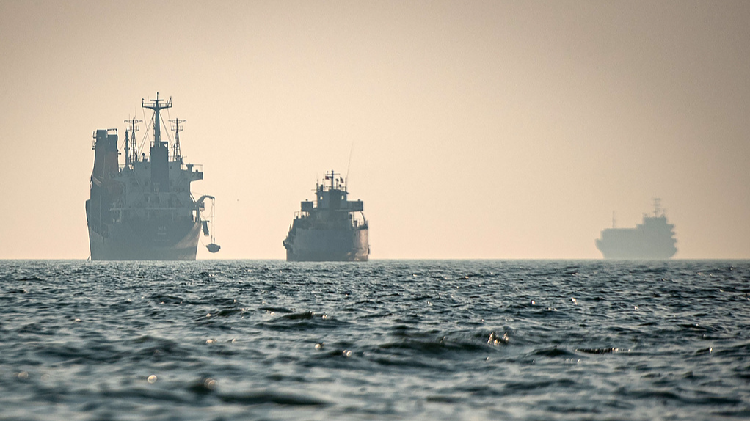
Cargo vessels are anchored in the Strait of Hormuz off the coast of Bandar Abbas, Iran, September 30, 2026. /VCG
Shipping activity through the strait has increased in recent weeks as ship tracking data from Kpler showed a significant recovery in crude oil exports from major Middle Eastern oil producers in September.
According to Kpler, the combined daily oil exports of Saudi Arabia, the United Arab Emirates, Iraq, Oman, Qatar, Kuwait and Iran reached nearly 16.33 million barrels in September. That was about 3.2 million barrels per day below the roughly 19.51 million barrels recorded before the conflict involving Iran broke out in February.
Kpler estimated that crude oil exports from the Middle East had recovered to about 80% of their pre-conflict level in September.
Despite the recovery, flows of crude oil, refined petroleum products and natural gas remain substantially disrupted. In the latest incidents, the United Kingdom Maritime Trade Operations, a British maritime security organization, said on Wednesday that two vessels had been struck by projectiles the previous day.
Gas prices are displayed in Miami, Florida, US, September 29, 2026. /VCG
The conflict is also creating political and economic pressure in the United States. Polls have shown that the war has faced opposition among Americans since its outset, while disruptions to global energy supplies and a resulting rise in fuel prices have posed challenges for Trump's Republican Party as it seeks to retain control of both chambers of Congress in legislative elections five weeks from now.
Iran's Islamic Revolutionary Guard Corps (IRGC) urged Americans on Tuesday to vote out Trump's allies. In a 26-page letter to US voters, the IRGC asked them to remove from power the politicians "who are responsible for America's current state." "Make sure your politicians understand that the world has changed."
Meanwhile, Secretary of Iran's Supreme National Security Council Mohsen Rezaei on Wednesday warned that the United Arab Emirates' (UAE's) hosting of Israeli Prime Minister Benjamin Netanyahu will not have "favorable consequences," just as hosting US military bases had not brought the UAE security.
In a statement released on Tuesday night, Iran's Foreign Ministry condemned Netanyahu's visit to the UAE, warning about the "very precarious" consequences of Israel's presence in the region.
The regional governments are expected to refrain from preparing the ground for Israel's "destructive presence" and letting their territories become a base for destabilizing actions, the ministry said.


