Infrastructure, execution gaps dog national bus fare reduction target - The Guardian Nigeria News
Despite the Federal Government’s push to make Compressed Natural Gas (CNG) and Electric Vehicles (EVs) a cheaper alternative for commuters, transportation costs may remain elevated across Nigeria, exposing the infrastructure and implementation gaps that could limit the impact of the October 1 fare-reduction target.
This is despite assurances from the Presidential Initiative on Compressed Natural Gas and Electric Vehicles (Pi-CNG & EV) yesterday that CNG and electric mobility interventions had already reduced fares on several routes across the country, with more reductions expected as states deploy additional vehicles and expand supporting infrastructure.
The development comes more than three years after the removal of petrol subsidy in May 2023, which significantly increased the operating costs of commercial transport operators and pushed fares higher.
Executive Chairman of the Pi-CNG & EV, Ismaeel Ahmed, said yesterday that the reduction in the cost of transportation promised by President Bola Tinubu has already begun, adding that while there were fewer than 10 CNG stations before 2023, the number increased to 90 refuelling stations in Nigeria when Tinubu launched the initiative.
“What we are going to be seeing, starting today (October 1, 2026), is hopefully a reduction of transport fares in certain routes,” he said. “If you jump on a CNG bus today from Gwagwalada to Abuja, you will be paying nothing less than 40 per cent cheaper than what you should be paying.”
According to the National Bureau of Statistics (NBS), average bus fares within Nigerian cities rose to N1,431.25 in May 2026, representing a 38.63 per cent increase year-on-year. Intercity bus fares reached N9,699.55, while motorcycle fares rose by 52.45 per cent to N1,072.51.
It was against this background that President Tinubu set October 1 as a target for Nigerians to begin seeing measurable reductions in transportation costs through the deployment of CNG and electric vehicles. Recall that on September 19, 2026, President Tinubu directed states to accelerate the implementation of the National Affordable CNG Transit Programme aimed at delivering measurable reductions in transportation costs to more Nigerians from October 1, 2026.
The Executive Chairman of Pi-CNG & EV, Ahmed, noted that the states were adopting different models based on their respective transport needs, stressing that the success of the programme should ultimately be measured by what commuters pay.
“There is no single model that will work everywhere. Some states are deploying CNG buses, others are using electric buses, taxis or tricycles. What matters is that the lower cost of energy translates into lower transportation costs for Nigerians. For us, that is the real measure. If an operator is spending less on energy but the passenger continues to pay the same fare, then our work is not complete,” he said.
However, the pace of infrastructure development remains central to whether the lower operating cost of alternative fuels can translate into widespread fare reductions. The Federal Government has targeted the conversion of one million vehicles to CNG by 2027. Pi-CNG said it had so far converted more than 120,000 vehicles, certified over 400 conversion centres, established more than 90 refuelling stations, trained over 7,700 technicians, secured more than $2.5 billion in investment and created 10,000 jobs.
President Tinubu had also directed the rollout of an additional 500 CNG refuelling stations across the country as part of efforts to expand access to cheaper fuel. But motorists have continued to report challenges accessing CNG in some locations, including long queues and interruptions at some stations, raising concerns about whether the infrastructure can support a rapid expansion of commercial CNG vehicles.
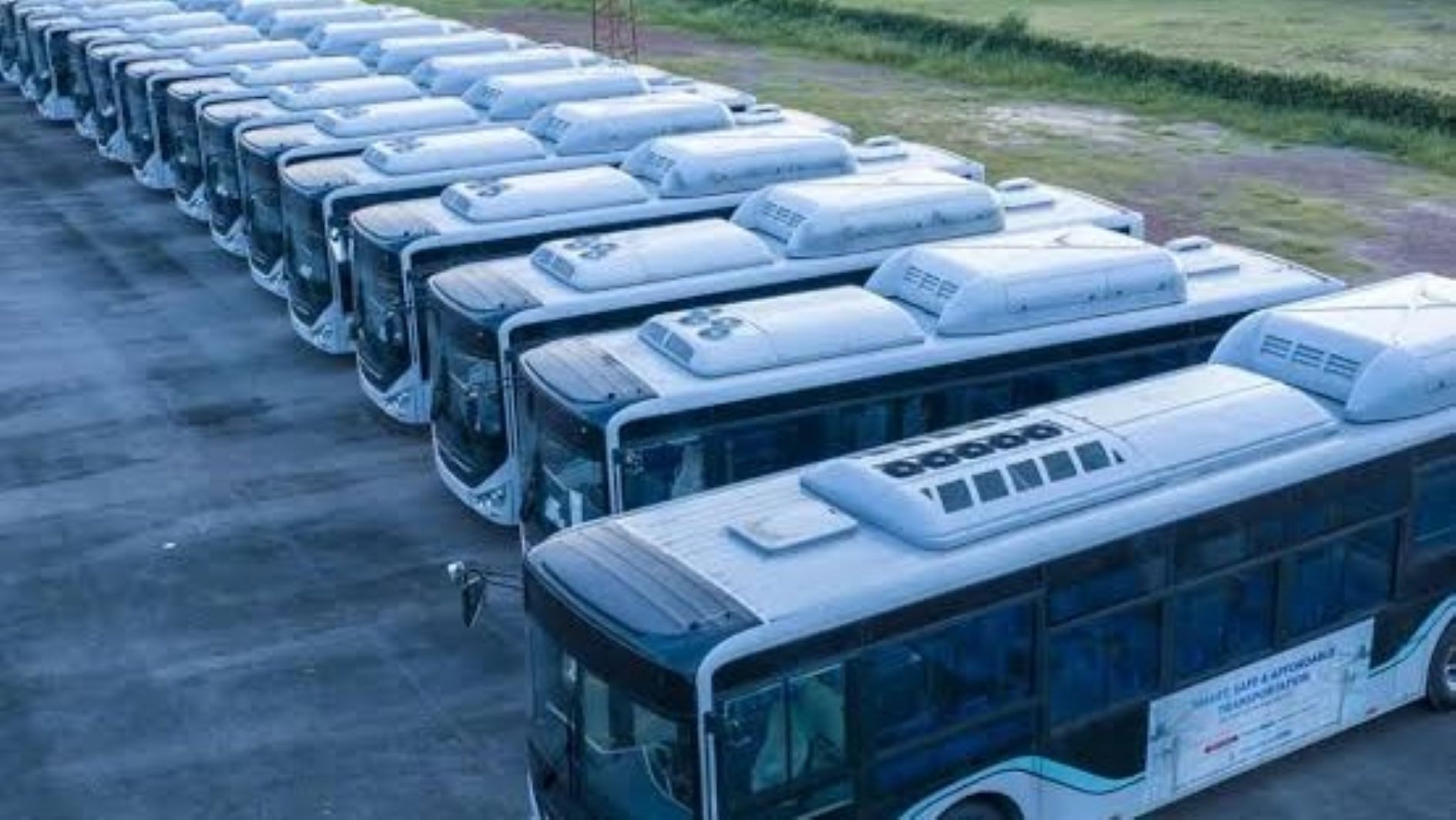
THIS comes as the Lagos State Government yesterday announced it has received 20 additional high-capacity CNG buses under the Pi-CNG & EV scheme. The Lagos Metropolitan Area Transport Authority (LAMATA) announced the handover in a post on X on Wednesday, saying the buses would increase public transport capacity in the state and support the transition to cleaner energy.
At the handover ceremony in Lagos, the Commissioner for Transportation, Oluwaseun Osiyemi, stated that the buses would improve public transport services on the routes where they are deployed. He thanked President Tinubu for the initiative and called for more federal support, including additional CNG buses and infrastructure for their operation and maintenance.
The handover comes amid a longstanding shortage of public transport buses in Lagos. In March 2025, LAMATA said the state needed about 15,000 buses to move passengers effectively, while its operational fleet was slightly above 1,000 at the time. The agency also noted that it expected about 500 CNG buses and 50 electric vehicles by the last quarter of 2025.
LAMATA Managing Director and Chief Executive Officer, Abimbola Akinajo, said the 20 buses would be deployed on selected corridors to increase service capacity. Ms Akinajo stated that Lagos currently had about 150 CNG buses, including 36 allocated to operators under LAMATA’s regulatory framework.
The impact of the existing interventions is already visible on some routes, although largely through government-supported fleets and subsidies. In Borno State, Head, Brand and Communications, Pi-CNG & EV, Onyekachi Eke, said 500 electric tricycles, 20 electric buses and 150 electric saloon cars and taxis had been deployed, supported by eight stand-alone solar-powered charging terminals. She said the state was subsidising fares, with passengers paying N50 for buses, N100 for taxis and N200 for tricycles.
Borno is also developing its CNG infrastructure, with three CNG stations in Maiduguri, one operational and two nearing completion, alongside conversion facilities. In Abia State, Eke said 40 electric buses were providing public transportation at fares subsidised by 50 per cent, while Zamfara State was introducing 100 electric taxis, with fares expected to be 40 per cent lower.
Enugu State has recorded one of the more substantial reductions following the deployment of 100 CNG buses operated by FEMADEC on behalf of the state government.
According to Eke, fares on the Enugu–Nsukka route, which previously ranged between N3,000 and N4,000, were initially reduced to N2,200 before falling further to N1,600 on the CNG-supported service. She said other commercial operators on the route had also reduced their fares, with some charging about N2,500.
In the Federal Capital Territory, Eke said commuters travelling from Kubwa to Berger paid N500 on CNG buses compared with N1,000 on diesel buses. She said Apo–Nyanya/Maraba also cost N500 against N1,000, while Masaka–Berger was N600 compared with N1,000. Berger–Gwagwalada, she added, cost N700 against N1,200.
The FCT fleet is expected to increase, with 26 additional buses scheduled for deployment. In Lagos, Eke said fares on several routes had also declined, with Ikorodu–Fadeyi reduced from N1,200 to N680, Ikorodu–Maryland from N1,000 to N570 and Ikeja–Obalende from N1,400 to N720.
Other states are at different stages of deploying alternative-energy transport. According to Eke, proposed fares across 30 routes in Akwa Ibom represent reductions of about 50 per cent.
She said the Uyo–Ikot Ekpene fare was proposed to fall from N1,300 to N650, Uyo–Eket from N2,500 to N1,250 and Uyo–Oron from N3,000 to N1,500.
In Edo State, proposed fares include a reduction on the Benin–Auchi route from N8,000 to N4,000, while Kingsquare–Ugbowo–Oluku is proposed to fall from N600 to N300. Eke said the proposed Warri–Asaba CNG service in Delta State would cost N4,900, compared with N7,000 currently, while the proposed Dutse–Kano fare in Jigawa State is N2,000 against N3,500.
Delta State has also developed 22 electric-vehicle charging stations, according to the initiative. Kaduna State has adopted a different model, with 100 CNG buses providing free transportation on major routes.
According to Pi-CNG, the buses transported about 3.2 million passengers during their first year of operation and generated estimated savings of more than N3.5 billion for commuters. Niger State is also expanding its alternative-energy transport programme, with CNG-supported transportation between Suleja and Abuja already providing cheaper travel, while additional CNG and electric-mobility infrastructure is being developed.
BUT outside government-backed schemes, the cost and availability of conversion remain major considerations for commercial operators. Kano-based motorist Ibrahim Muktar said his UK-used Honda Civic was not suitable for conversion, while estimating that the process could cost between N600,000 and N700,000 for vehicles that qualify.
An e-hailing operator, Victor Shola, said he had avoided CNG largely because of the queues at refuelling stations, which he said could last between four and six hours and sometimes overnight.
Another e-hailing driver, Mustapha Adesina, who converted his vehicle three weeks earlier, gave a different account. Adesina said CNG had significantly reduced his operating costs, explaining that an 80-litre cylinder holding about 20 to 21 standard cubic metres of gas could cost about N10,000 at N500 per standard cubic metre.
He said the gas could support journeys of about 120 kilometres and allow him to generate between N40,000 and N45,000 in fares. However, he still faces lengthy queues at refuelling stations and estimated that fewer than 40 per cent of drivers in his area had converted.
Lagos has received CNG buses, while Oyo and Ogun were among the earliest states to deploy the vehicles. Oyo has also converted some vehicles free of charge. In Ekiti, however, seven conversion centres were reported to be awaiting operations, while the state was also reported to lack a CNG filling station.
Enugu is developing a mother station intended to support the South-East, while other states including Cross River, Osun, Edo, Plateau and Ondo have reported limited federal support.
Niger State procured 200 buses but has received 100, while Kano has CNG buses and tricycles operating on some routes without the state controlling the vehicles.
Vendor, ASAD Energy, had said no formal subsidy agreement existed with the Federal Government in Kano, making it difficult for operators to reduce fares where CNG remained unsubsidised at the pump.
Pi-CNG said 61 buses in its current deployment were designated for commercial operations, comprising 13 each for the FCT, Kano and Lagos; five each for Delta, Kaduna and Katsina; three for Enugu; and two each for Borno and Niger.
Ahmed said the October 1 target should be regarded as part of an expanding programme rather than the conclusion of the effort to reduce transportation costs. “What Nigerians are seeing today is a process that we intend to deepen. We have routes where fares have already come down, states preparing to introduce reduced fares, and more vehicles being deployed.
“The next task is to expand the number of routes, increase refuelling and charging infrastructure and get more vehicles into commercial transportation so that these savings reach many more Nigerians,” he said.
With average transport fares still significantly above pre-subsidy-removal levels and CNG infrastructure unevenly distributed, the October 1 target therefore puts the Federal Government’s alternative-energy strategy under a broader test: whether the savings achieved on selected government-supported routes can be replicated across Nigeria’s largely privately operated transport system.