Indian PM who left behind no fortune, but unpaid Fiat car loan and a proud nation
A Prime Minister who led India through war against Pakistan, ordered troops across an international border and stood up to the pressures of a food crisis left behind neither a grand estate nor a fortune. India's second PM, Lal Bahadur Shastri, left behind a car loan and an illustrious legacy.
While October 2 is a national holiday in India on account of it being Mohandas Karamchand Gandhi's birthday, it is also the day when Lal Bahadur Shastri was born. Today is Shastri's 122nd birth anniversary. And the Fiat car story stands out not only because of what he achieved as Prime Minister, but because of the striking contrast between the power he wielded and the simplicity with which he lived.
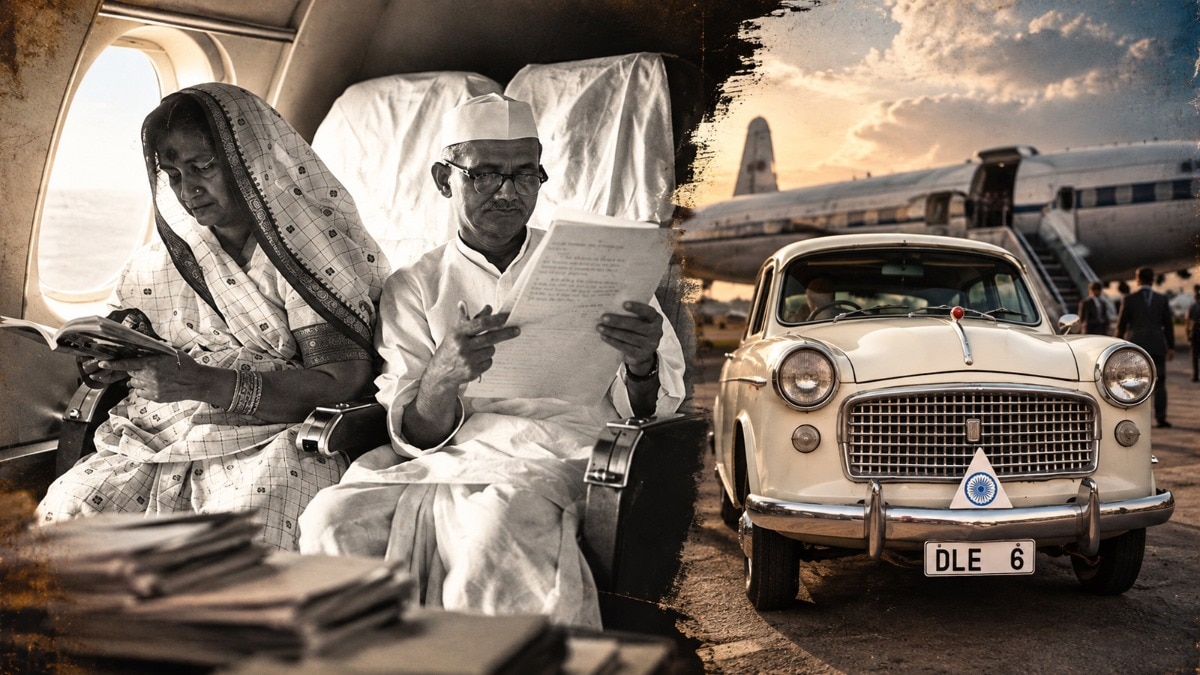
According to Shastri's family, when his children persuaded him to buy a Fiat, the car's value was around Rs 12,000. Shastri had about Rs 7,000 in savings and borrowed the remaining amount from Punjab National Bank (PNB). When he died in Tashkent in January 1966, the loan had not been fully repaid.
His wife, Lalita Shastri, rejected the government's offer of clearing the loan and herself later cleared the dues from her family pension.
The Fiat, now preserved at the Lal Bahadur Shastri Memorial in Delhi, has consequently become more than an old car. It is a reminder of the personal circumstances of a man who occupied the highest political office in India but owned little wealth during his years in public life.HOW LAL BAHADUR SRIVASTAVA BECAME LAL BAHADUR SHASTRI
Shastri was born on October 2, 1904, in Uttar Pradesh's Mughalsarai into a modest family. His father died when Shastri was still a toddler, leaving his mother to raise the family.
He later gave up his caste surname, Srivastava, and adopted "Shastri" after receiving the educational title from Kashi Vidyapith.
Simplicity was not something he adopted after entering politics. It had always been a part of him since his early life.WHEN LAL BAHADUR SHASTRI RESIGNED AS RAILWAY MINISTER
Lal Bahadur Shastri's political career was built over decades before he reached the Prime Minister's Office (PMO).
One of the clearest instances of his approach to public responsibility came in 1956, when he resigned as Railway Minister after a train accident. Then-Prime Minister Jawaharlal Nehru did not want to accept his resignation, but Shastri insisted on taking moral responsibility. Nehru finally had to accept Shastri's resignation.
This became an important part of Shastri's public image, which he carried into the PMO.
When Nehru died in May 1964, Shastri succeeded him as Prime Minister and became the second PM of the country.
He inherited a country dealing with economic pressures, food shortages and an increasingly difficult security environment.THE 1965 WAR AGAINST PAK CHANGED SHASTRI'S IMAGE FOREVER
Prime Minister Shashtri's tenure was short, but the 1965 India-Pakistan war transformed his stature.
Pakistan launched Operation Gibraltar in August 1965, sending infiltrators into Kashmir. It later launched Operation Grand Slam towards Akhnoor.
India responded by widening the conflict beyond Kashmir. On September 6, Indian forces crossed the international border in Punjab and advanced towards Lahore. That took Pakistan by surprise.
Veteran journalist Prem Prakash, in Reporting India: My Seventy-Year Journey as a Journalist, described Shastri's decision to move Indian forces across the international border towards Lahore and Sialkot as crucial and decisive. "The move [by Shahstri] took Pakistan's leadership by surprise and that Shastri's popularity rose sharply after the war, Prem Prakash wrote in his book.
The war ended with a UN-brokered ceasefire in September. But for Shastri, the next chapter was just beginning.THE JAI JAWAN, JAI KISAN SLOGAN THAT RESONATES EVEN NOW
The war with Pakistan had coincided with a serious food crisis.
India was heavily dependent on imported wheat, while domestic food production was under pressure. Shastri appealed to citizens to voluntarily give up one meal a week. The appeal became popularly associated with Monday fasting.
He was also reported to have first tested the idea within his own household before appealing to the country.
His famous slogan, "Jai Jawan, Jai Kisan", brought the two immediate challenges of national security and food security before the country together.advertisementSHAHSTRI IN TASHKENT AND THE FINAL HOURS OF HIS LIFEAfter the war, PM Shastri travelled to Tashkent for talks with Pakistan's President Ayub Khan.
The Soviet Union hosted the negotiations, which culminated in the Tashkent Declaration on January 10, 1966.
"The Soviet leadership was keen to use the talks to prise Pakistan away from the US and exerted considerable diplomatic pressure on Shastri over the return of territories captured by Indian forces during the war," Prem Prakash wrote in his book.
Shastri signed the declaration. The next day, January 11, he died in Tashkent.
His death came barely 18 months after he had become the prime minister.WHAT SHASTRI LEFT BEHIND IS A FIAT AND AN ENDURING LEGACY
Shastri's time in office was brief, but the image he left behind was enduring.
The man who had led India through a war and commanded the country's government had borrowed money to buy an ordinary family car. When he died, the loan remained to be paid. His family eventually cleared it.
That car remains preserved in Delhi, while Shastri's political legacy rests on decisions that reached far beyond his modest household. His decisions left India with the spirit to fight together as a nation. That is Lal Bahadur Shastri's legacy.- Ends(Written by Avinash Kateel)