India has a Rs 1 lakh crore research fund. So why are young scientists struggling?
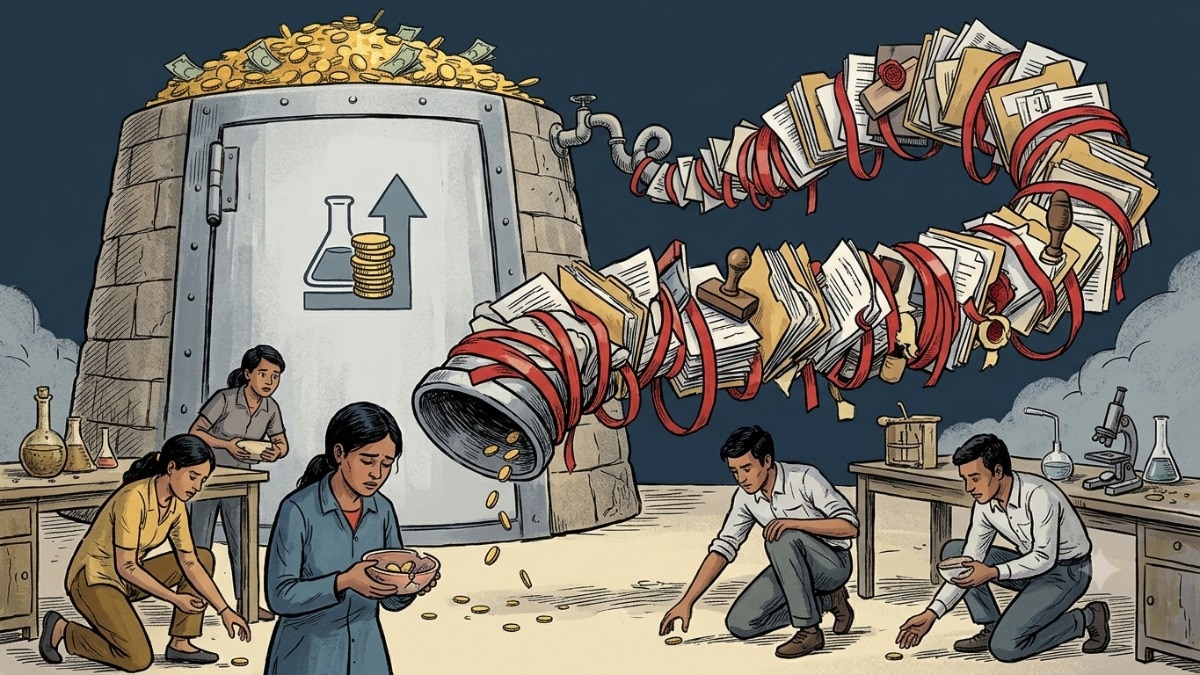
A research scholar can spend years working towards a PhD, only to find that the monthly fellowship meant to support that work has not arrived. A scientist can get a research project approved and then wait months for the money to buy equipment or pay research staff. A student hoping to enter basic sciences may find that an established scholarship route has disappeared.
These are not isolated inconveniences. They point to a deeper problem in India's research ecosystem.
The contradiction has come into focus after Maheshwer Peri, founder of Careers360, listed 10 instances of inadequate funding, delayed fellowships and shrinking research opportunities in a social media post.
Referring to remarks by BITS Pilani Vice-Chancellor Prof Ram Gopal Rao at the Careers360 Research Summit, Peri quoted his description of Indian higher education as having "African budgets, American ambitions, Russian methods, Chinese opacity and Indian bureaucracy".
The examples deserve attention. But the funding problem goes beyond the 10 instances in Peri’s post.WHEN A RESEARCH FELLOWSHIP IS NOT ENOUGH TO LIVE ON
Consider the non-NET fellowship, meant to support full-time MPhil and PhD scholars in central universities who do not qualify for a NET fellowship. Its PhD rate remains Rs 8,000 a month.
The UGC's 2019-20 annual report still listed this amount, tracing the rate revision to 2009. The amount has remained inadequate for years.
The Junior Research Fellowship (JRF) has seen revisions, but the increases have not eliminated concerns about affordability. The monthly amount rose from Rs 25,000 to Rs 31,000 and then to Rs 37,000 from January 2023. The Senior Research Fellowship (SRF) amount rose to Rs 42,000.
Researchers have repeatedly raised concerns about whether these amounts can support full-time academic work, particularly in expensive university towns. (AI-generated image)
The Maulana Azad National Fellowship (MANF) offered another illustration in 2025. Over 1,400 existing beneficiaries faced delayed payments from January that year. The scheme had already stopped fresh admissions from 2022-23, although existing scholars were supposed to receive support until their fellowships ended.
The National Fellowship for OBC students has faced its own administrative hurdles. Peri pointed to selection lists for three UGC-NET cycles in 2024-25 that were held back. The scheme provides 1,000 fellowships annually, and Parliament has previously recorded the additional financial requirement arising from increased beneficiary numbers and revised fellowship rates.GETTING INTO RESEARCH IS GETTING HARDER
The Kishore Vaigyanik Protsahan Yojana (KVPY) was another important entry point for young science enthusiasts. Its aptitude test, taken approximately by around 40,000 – 50,000 students annually, was discontinued in 2022 and the fellowship programme merged with INSPIRE.
There is an important distinction: the government said the number of fellowships would be protected. What disappeared was the separate national aptitude test that had helped identify students interested in basic sciences.
The competition for research fellowships is fierce even after students clear the necessary examinations.
In the UGC-NET December 2025 cycle, just 5,108 of the 7,35,614 candidates who appeared qualified for the combined JRF and Assistant Professor category. That works out to around 0.7%. It is a reminder of how narrow the route to a funded research career can be.
The INSPIRE fellowship programme has faced another problem: payment delays. The government acknowledged that a change in the fund-transfer mechanism from January 2025 required institutions to complete fresh onboarding procedures.
This delayed disbursements, although the government said grants for 3,143 INSPIRE fellows and 458 faculty fellows had been released for the full 2025-26 financial year by February 2026. (AI-generated image)
The Rohith Vemula case also remains a painful reminder of what delayed financial support can mean for a vulnerable research scholar. The University of Hyderabad research scholar's fellowship had been stopped in July 2015. His final letter mentioned seven months of unpaid fellowship.
Vemula died by suicide in January 2016, triggering a national debate over caste discrimination and institutional treatment of students. His financial difficulties were part of a wider and deeply troubling institutional controversy.THE MONEY IS NOT ALWAYS REACHING RESEARCHERS
Perhaps the strongest evidence of a systemic problem comes from NITI Aayog itself.
Its May 2026 report, Ease of Doing Research and Development in India, says that even after a research proposal receives scientific approval, the release of the grant can take more than three to six months. The first fellowship instalment can take four to five months.
The report also describes a particularly damaging feature of the funding system: money allocated to research projects can be withdrawn at the end of a financial year and take another two to three months to be reassigned. This can interrupt research activities and leave research personnel without fellowship payments.
The problem is visible in flagship schemes, too.
A Parliamentary Standing Committee report presented in March 2026 found that actual expenditure under the Prime Minister's Research Fellowship (PMRF) was Rs 200 crore against a budget allocation of Rs 600 crore in 2025-26, as of January 31, 2026.
The committee asked the government to review fellowship disbursement and ensure that all 3,688 scholars received their full amounts on time. (AI-generated image)
It also flagged under-spending under the Scheme for Promotion of Academic and Research Collaboration (SPARC), where Rs 40 crore had been spent against a Rs 50 crore allocation by January 31, 2026.
They do not, by themselves, establish that funds were cut. They point to a different problem: allocating money and actually getting it spent on research are two separate tasks.INDIA'S RESEARCH AMBITIONS NEED MORE THAN BIG ANNOUNCEMENTS
India's gross expenditure on research and development rose to Rs 2.45 lakh crore in 2023-24. Yet R&D spending stood at just 0.84% of GDP. It had fallen to 0.64% in 2020-21 before recovering.
There is also a revealing imbalance in where the money goes. Higher education institutions accounted for just 12.6% of total R&D expenditure in 2023-24. Private-sector funding, meanwhile, accounted for 51.8% of the national total, while private industry alone performed 45.2% of research and development.
The government has announced a Rs 1 lakh crore Research, Development and Innovation (RDI) Fund, approved in July 2025 and formally launched in November 2025, to encourage private-sector investment in strategic and high-risk research. But this is a financing mechanism for private enterprises, startups and industry, not a direct Rs 1 lakh crore scholarship or university-grant budget.
The Anusandhan National Research Foundation (ANRF) has a separate target of mobilising Rs 50,000 crore over 2023-28, including Rs 14,000 crore in central government funding. The remaining amount is expected from non-government sources.
Both initiatives are important. But neither automatically solves the everyday financial problems faced by PhD scholars, university laboratories and early-career scientists.
India wants more patents, breakthrough technologies, world-class universities and global scientific recognition. Those ambitions require more than research missions and large funding announcements.
They require predictable grants, adequate fellowships, functioning universities and a system in which researchers spend their time doing research rather than chasing money already promised to them.
Ultimately, India's research future will depend not just on how much it promises to invest, but on whether its researchers can actually afford to build it.- EndsRead | India now dominates global research paper retractions with 6 universities in top 10Read | Are low stipends pushing India's PhD scholars out of academia?Read | Poor fund use slowing India's science missions, research funding slashed: Report
Roshni has been working in the journalism industry for over a decade, telling stories that matter. She loves writing about student innovations, latest research, and people striving to make the world better for children -- through education, social change, or environmental efforts.
With a special focus on education, the job industry, and mental health, she also enjoys uncovering lesser-known scientists and changemakers from history whose work continues to shape our lives today. Away from work, Roshni finds joy in reading, painting, photography, and exploring the spiritual and the occult.