Illegal mining leaves Johannesburg facing R262m road-repair bill - IOL
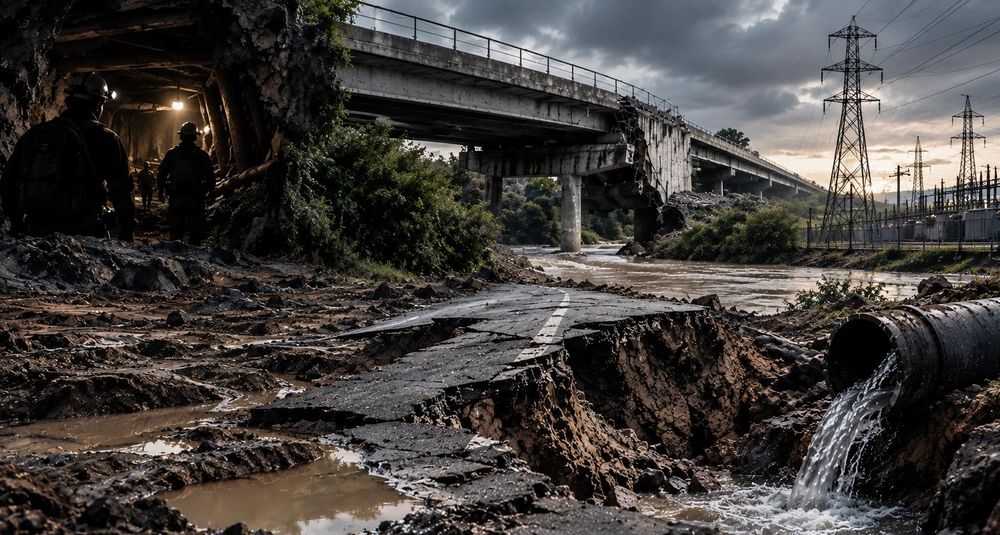
Illegal mining is leaving a multimillion-rand trail of infrastructure damage across South Africa, with roads, bridges, electricity networks and water facilities increasingly bearing the cost of an underground economy that is destabilising communities above ground.
The damage is no longer confined to abandoned shafts and mine workings. Across mining-affected areas, the consequences are surfacing in collapsing roads, unstable ground, damaged public infrastructure, environmental degradation and mounting pressure on the state to fund repairs and rehabilitation.
The Department of Mineral and Petroleum Resources (DMPR) says the scale of the problem is severe.
Departmental spokesperson Lerato Ntsoko described illegal mining as “rife and extremely serious” and said it required urgent attention, while acknowledging its impact on legitimate mining operations and communities.
“Our assessment indeed reveals the adverse way in which this scourge is affecting legitimate mining operations by amongst others, creating unhealthy competition. This has also adversely affected the communities living in the vicinity of these illicit activities causing extreme socio-economic and environmental challenges,” Ntsoko said.
The department said unregulated operations are conducted without the legislative obligations imposed on legitimate rights and permit holders, creating risks that extend from public safety to infrastructure and the environment.
“The illegal mining activities are causing serious health, safety and environmental risks to the people and the infrastructure in the vicinity,” Ntsoko said.
“These areas are also marred with lawlessness and contact crimes which include assaults and robbery amongst others. There are also huge environmental degradation and pollution implications, damage to key infrastructure such as roads and water facilities.”
The DMPR says it is working with law-enforcement agencies through joint operations including Vala Umgodi and Operation Prosper. Government reported in August that Operation Prosper had disrupted illegal mining in Free State, Gauteng and North West, with arrests, shaft closures and seizures of firearms, explosives and mining equipment.
The consequences are particularly stark in Gauteng, where the City of Johannesburg has begun putting figures to some of the damage.
City spokesperson Nthatisi Modingoane said illegal mining remained a significant and growing challenge particularly around historical mining areas and abandoned mine sites.
“The activities also undermine the structural integrity of roads, bridges, stormwater systems, electricity infrastructure, water pipelines, sewer networks and other municipal assets,” Modingoane said.
Investigations revealed by the Johannesburg Roads Agency (JRA) found underground voids as deep as 22 metres beneath the road prism along John and Webber Streets in Booysens, and 17 metres beneath Wemmerpan Road in Turffontein.
In Roodepoort, sinkholes between six and eight metres deep have affected Nick Toomey Boulevard, Mijn Street and Alpha Street in Witpoortjie.
Modingoane said the consequences went beyond damaged roads.
“The closure of these roads severely limits the accessibility of communities, businesses, and emergency services. Without these vital road connections, communities face limited access to essential services, goods, and medical facilities.”
The city estimates that R262 million is required to fully reinstate five roads affected by illegal mining. Preliminary assessments of M1 and M2 bridge structures have put repairs to abutments and parapet walls at close to R23 million, before detailed investigations establish the full rehabilitation bill.
Yet Johannesburg does not know the full cost.
“The City currently does not have consolidated city-wide figures that quantify the full financial impact of illegal mining over the past three years,” Modingoane said.
City Power is confronting a similar threat beneath the electricity network. Spokesperson Isaac Mangena said illegal underground mining was threatening critical infrastructure around the Robertville and Roodepoort substations and along the Main Reef corridor.
“Underground excavations have compromised ground stability, placing substations, transformers, pylons and transmission towers at risk. In some areas, infrastructure has already begun to sink as illegal mining activity continues beneath the surface,” Mangena said.
He said technical teams had also been threatened and, in some cases, shot at by armed groups operating around abandoned mines.
The infrastructure threat is not unique to Gauteng. In North West, the provincial legislature has recently raised concerns about illegal mining and unauthorised chrome wash plants in Bojanala and Madibeng, citing environmental damage, water pollution, unsafe excavations and inadequate enforcement capacity. The committee said about 70 chrome wash plants had been inspected during 2025/26, with around 30 found operating without environmental authorisation.
The province has also faced a deadly human toll. The DMPR confirmed an incident in Nkaneng, Rustenburg, in August in which illegal miners died, while investigations into the circumstances continued.
For UASA, the implications extend into the formal mining workforce.
UASA Divisional Manager: Mining Nico van Rooyen said: “Illegal mining is a serious concern because it threatens the livelihoods and safety of legal employees, while also undermining the sustainability of the companies whose operations are being illegally exploited.”
He said illegal operations also raised concerns about air quality, living conditions and infrastructure maintenance because they do not comply with the Mine Health and Safety Act.
But MACUA National Coordinator Sabelo Mnguni said enforcement alone could not resolve the underlying problem.
“The fundamental contradiction remains: South Africa has thousands of people trying to make a living from abandoned mines, old workings, dumps and marginal mineral deposits, but there is still no realistic pathway through which most artisanal miners can enter the legal mining economy,” Mnguni said.
He warned that criminal networks could exploit the regulatory vacuum.
“Where the state leaves a regulatory vacuum, criminal networks can move into that space, control access to workings, finance operations, purchase minerals and exploit vulnerable miners.”