IAF needs 36-40 jets annually; Pakistan’s fifth-gen jet plan worrying: Air Chief - The Indian Express
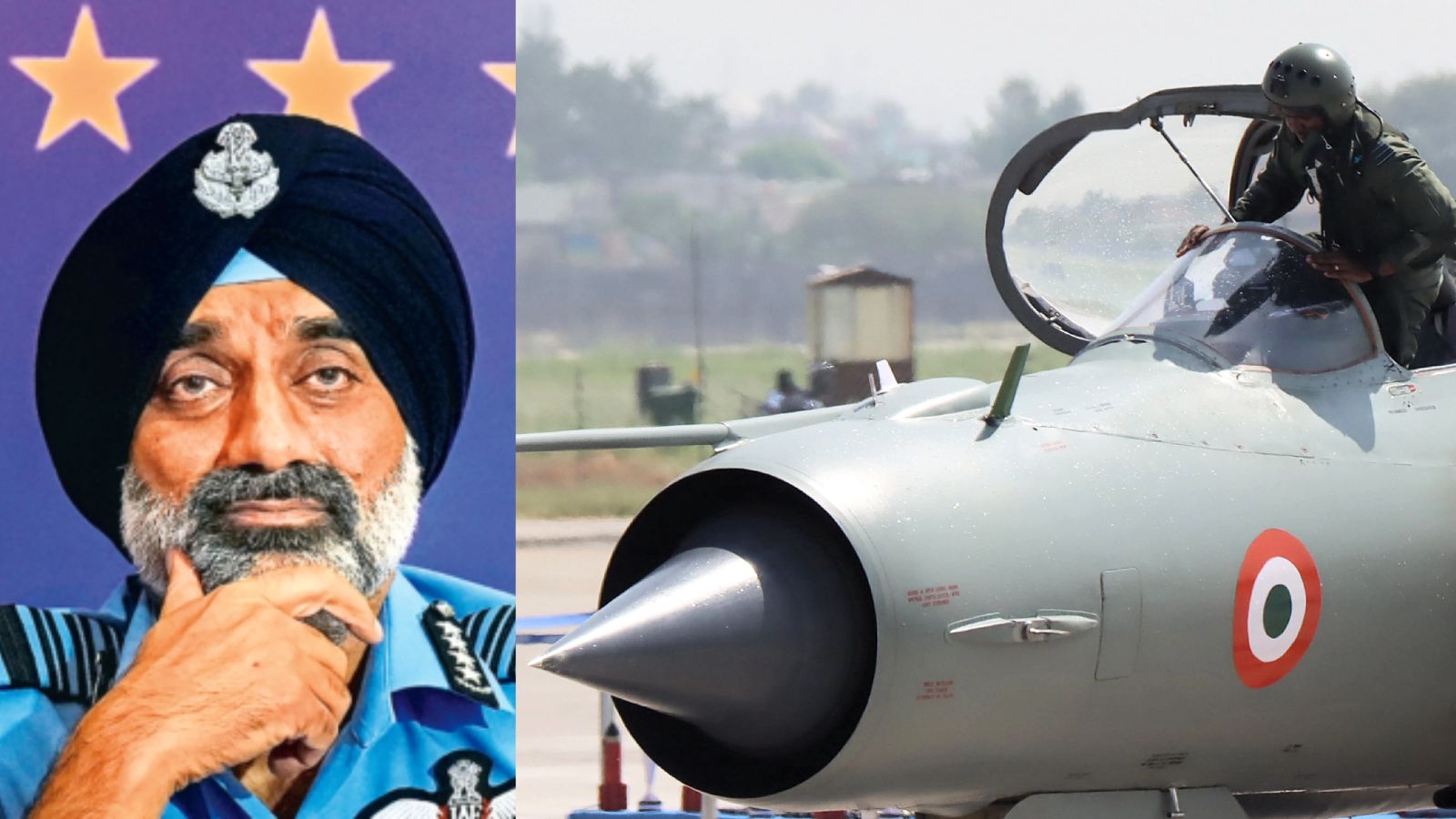
The Indian Air Force (IAF) needs to induct 36 to 40 aircraft annually to prevent its depleting fighter squadrons from falling below 30 and move towards the sanctioned strength of 42, Chief of Air Staff Air Chief Marshal A P Singh said on Saturday.
He also highlighted the ongoing efforts of the IAF to develop a robust beyond-visual-range (BVR) combat capability through the planned induction of the indigenous ASTRA and its variants of BVR air-to-air missiles, along with additional batches of foreign missiles offering longer ranges.
The IAF Chief made the remarks while addressing the media ahead of the 94th Air Force Day, which will be observed on October 8.
Responding to a question about the IAF’s fighter squadron strength, Air Chief Marshal Singh said the force could begin inducting 30 to 35 fighter jets annually “if things go as planned”.
Referring to Hindustan Aeronautics Limited’s target of delivering up to 24 LCA Mk1A aircraft to the IAF annually, he said even if HAL produces 20 aircraft a year and the Multi-Role Fighter Aircraft (MRFA) contract is finalised by the end of this year, the total annual induction would add up to approximately 32 aircraft. The MRFA programme, under which the IAF would receive around 12 aircraft annually, involves the proposed acquisition of 114 Rafale jets.
He said if the proposed contract to acquire 12 additional Su-30 aircraft is included, with six jets delivered each year, the annual induction could rise to between 30 and 35-40 aircraft, provided all the plans move forward as expected.
“So, we are hoping that these things will happen and that we will be able to achieve the pace of growth we have set for ourselves,” he said.
The IAF Chief said it is prudent to have a mix of three to four types of fighter jets in the force’s inventory, so that they can perform different roles effectively.
He said in the near future, the IAF will have a healthy mix of LCA Tejas Mk 1A, LCA Mk 2, the French Rafales and the indigenous fifth-generation fighter jet — Advanced Medium Combat Aircraft (AMCA).
Talking about reports of Pakistan moving to acquire China’s fifth-generation J-35 stealth fighter jet, Air Chief Marshal Singh said it is a cause for worry.
“Is it a no-go situation? I wouldn’t agree with that. We possess the necessary capabilities… it is not just about a single platform, but about how it is integrated into the entire system.”
“Pakistan has possessed other platforms in the past, yet they haven’t been able to achieve anything significant with them during Operation Sindoor. Similarly, if we effectively integrate the platforms we are purchasing and inducting, we should be able to counter this threat — at least for the time being, until they fully integrate these new aircraft into their own systems.”
He also said there is a need to push the AMCA programme and take alternative decisions in case there is a delay in that. He also clarified that Russia has offered the Su-57, but no decision has been taken yet, even as he emphasised the need to consider the need for a fifth-generation aircraft “if our adversaries are getting a fifth-generation aircraft”.
Responding to a question from The Indian Express on how the IAF is working towards augmenting its BVR capability, the Air Chief said three variants — Astra and its Mk2 and Mk3 variants — are currently under production or in stages of research.
The Astra BVRAAM is already in production, while the Mk2 variant is midway through its R&D and the Mk 3 is in the initial stages of R&D, progressing through research and development.
He said the IAF is also making efforts to procure additional batches of missiles with longer ranges from foreign sources.
India has been reportedly looking at procuring Russian R-37M ultra-long-range air-to-air missiles and additional batches of French Meteor Missiles.
Augmenting the BVR capability of the IAF has been in focus since Operation Sindoor was conducted in May last year.
ACM Singh said the Astra, its variants and the additional foreign missiles will fulfil the immediate requirements of the IAF, adding that the development of the Astra Mk2 and Mk3 variants is progressing in the right direction, particularly in terms of ranges.
The first in the family, ASTRA Mk 1, has a range of 80 to 110 km. A more advanced version of the ASTRA Mk 1 — the ASTRA Mk 2 — has an enhanced range of 200 km, up from the earlier decided range of around 160 km.
Earlier this year, the DRDO had conducted a flight test of its Solid Fuel Ducted Ramjet (SFDR) technology for the ASTRA Mk 3, which could have a range of over 350 km.
He also said that while the IAF is growing the number of drones and loitering munitions, there is no need for a separate drone force.
The IAF Chief said that other elements of comprehensive national power of any nation rest on a strong military.
“Military power becomes the ultimate, and without adequate military power, any state remains vulnerable to coercion, and if we have to do things our way, if we have to follow the path that we want to follow, we have to have a strong military,” he said.
“And when we talk about a strong military, in the recent conflicts we have seen that it is the air power which has come to the fore, which has come out as the cutting edge of military power, and it is one instrument on which any nation relies to meet its objectives,” he said.
He highlighted that whether it is “advanced fighter aircraft, long-range precision weapons, integrated air command and control, or unmanned aerial systems — it is all very clear that they all reflect that military power is concentrated around the aerospace domain.”
Separately, the IAF Chief praised Flydubai Captain Smit Machchhar’s bravery during the incident involving an Israel-bound flight. “He showed great physical and mental resolve. It is a lesson for us,” he said.
Amrita Nayak Dutta writes on defence and national security as part of the national bureau of The Indian Express. In the past, Amrita has extensively reported on the media industry and broadcasting matters, urban affairs, bureaucracy and government policies. In the last 14 years of her career, she has worked in newspapers as well as in the online media space and is well versed with the functioning of both newsrooms. Amrita has worked in the northeast, Mumbai and Delhi. She has travelled extensively across the country, including in far-flung border areas, to bring detailed reports from the ground and has written investigative reports on media and defence. She has been working for The Indian Express since January 2023. ... Read More