I want to be swimming's Saina Nehwal or Abhinav Bindra: Dhinidhi Desinghu
When Dhinidhi Desinghu packed for Dakar, her father had to talk her out of taking too many books.
She had already put a couple of textbooks in her luggage. There may have been a third. Her father, Desinghu, looked at the pile and suggested a compromise. She would not have time for all of them, he told her, so she should take the easier ones and leave the rest behind.
“She wants to excel, and she wants to do well in her studies as well,” Dhinidhi’s father, Desinghu, told IndiaToday.in on Monday.
It was a small disagreement, the sort that could take place in any family preparing for a holiday or a school trip. Except this was neither. Dhinidhi was travelling to the Youth Olympic Games, carrying the expectations of a country that has long waited for a breakthrough in swimming. She was 16, had been an Olympian at 14, and was about to become the first Indian swimmer to win a medal at the Youth Olympics.
The textbooks were not a statement about education. They were part of the life she was trying to hold together: races to win, schoolwork to finish and, somewhere in between, the ordinary business of being a teenager.
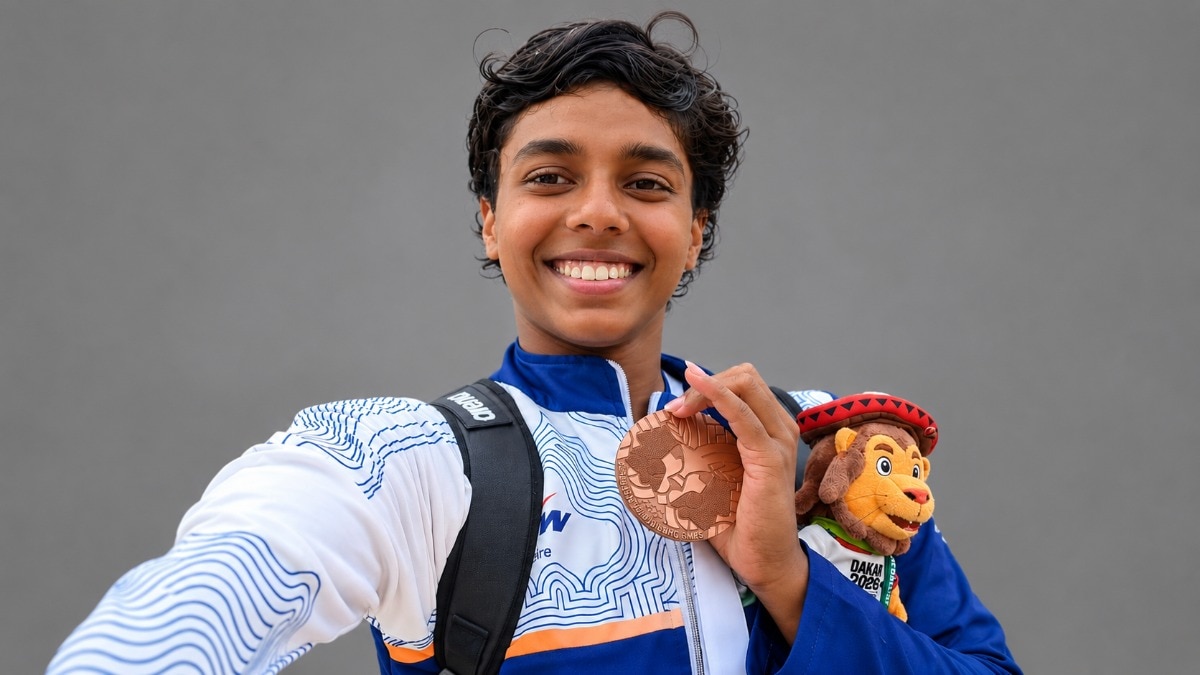
In Dakar, she won bronze in the 100m freestyle, becoming the first Indian swimmer to win a medal at an Olympic event, across both the senior and youth editions. It was also India's first swimming medal at the Youth Olympics, and the first global medal for the country in the sport.
Dhinidhi clocked 56.27 seconds, setting a new national record and bettering her previous mark of 56.57, set at the Senior National Championships in Ahmedabad in June. Croatia's Ana Bobanovic won gold in 55.89 seconds, while New Zealand's Alyssa Lawson took silver in 56.13. Dhinidhi finished just 0.14 seconds behind Lawson, having been fifth at the halfway mark before producing a strong finish to move on to the podium.
Yet when she touched the wall and looked up at the result, her first reaction was not quite the one the country would have expected.
“Uh, it’s a bronze,” Dhinidhi said.The moment Dhinidhi Desinghu etched her name in Youth Olympic history! #Dakar2026 #YouthOlympics https://t.co/XNWqhj8ubG— Olympic Khel (@OlympicKhel) November 2, 2026
For everyone watching from India, it was a moment to celebrate. For the swimmer, the first thought was that she had missed out on gold.
“First was the time. I saw the time and I was like, ‘56.2’, so I was like, ‘Okay, national record.’ But then it hit me, ‘Oh, it’s only bronze, it’s only 56.2.’ Because I wanted gold and I wanted to go 55s.”
“That didn’t really happen. But I was quicker than the morning,” she said.
“After the underwater I was glad that I pulled it off to a third at least.”
“A little later I felt better though. It was like, ‘Okay, my medal is there, India’s first medal.’ It came only later. At that moment I touched the wall, I wasn’t so thrilled.”
She knew what the medal meant for Indian swimming. She had simply entered the pool with a more personal target, and for a few moments that was all she could see.A FACE FOR INDIAN SWIMMING Dhinidhi Desinghu began swimming at the age of 7 (Special Arrangement)
Dhinidhi is not shy about the scale of what she wants to do, or about what she thinks Indian swimming is missing.
She sees a connection between the success of badminton and shooting and the presence of athletes who have won Olympic gold. Saina Nehwal and Abhinav Bindra gave younger athletes proof that such achievements were possible. Swimming, she says, is still waiting for that figure.
“In swimming, there’s no one there yet,” she said.
It is a big ambition for someone who has only just won her first Youth Olympics medal, and she does not play it down.
“I’m hoping to be like Saina Nehwal or Abhinav Bindra for swimming. I think this Youth Olympics is one small stepping stone for that.”
Belief is not the only obstacle. She believes Indian swimmers work extremely hard, often without getting the results their effort should bring, and that the problem is not a lack of commitment. Swimming demands technical precision, sports science and an understanding of details that can make a decisive difference.
“People around the world swim, they go fast, but I don’t think people understand how hard Indians work. But we just don’t get the actual result. We don’t get the result that we are supposed to get,” she said.
She is careful not to suggest that Indian swimmers must train abroad to succeed. She has spent her entire career training in India and believes it is possible to make progress at home, though the sport needs better access to knowledge, technical support and the small improvements that can separate a medal from a near miss.
“I’ve not travelled abroad, I’ve not gone anywhere, I’ve been in India my whole life,” she said.
“I’m not saying international coaching is always the key to success. If you train in India, we can do it. That’s what I’m doing.”
For her coach, Nihar Ameen, the medal could help shift swimming’s place in the country’s sporting imagination. He has seen Indian swimmers succeed at age-group and continental competitions, and he points to Virdhawal Khade’s performances at the Youth Commonwealth Games and his subsequent Asian Games medal, as well as Sandeep Sejwal’s achievements. But he believes a Youth Olympics medal carries a particular significance.
“It definitely is a watershed moment,” Ameen, a Dhronacharya award winner, said.
“The Youth Olympics is a big deal. It’s a really big deal.”A PIN FROM CHAD LE CLOS
Dhinidhi went into the final, as she put it, unusually excited rather than nervous. Freestyle races generally made her anxious. This time, something had taken her mind away from the usual pre-race tension. It involved a swimming legend, a small souvenir and an unexpected encounter with a thousand-rupee note.
The day before her 100m final, Dhinidhi spotted Chad le Clos in the gallery. The South African Olympic champion was watching the competition. Her mother pointed him out, and Dhinidhi went over to take a photograph.
“He gave me a pin, and I was kind of like, ‘Oh my God, he gave me a pin.’ It’s not like I went up to him and was like, ‘Can I have something?’ He just gave it to me and he said that he’s rooting for me in my 100. And I was like, ‘Oh my God, that is insane.’”
She had the photograph, the pin and a message of support from a swimmer she admired. Then, while walking back to her room, she spotted a currency note on the floor, worth Rs 1000.
“You don’t see 1,000 rupees like that on the floor just randomly while walking,” she said.
It was an unusual find in an unfamiliar city, and Dhinidhi began to see it as a sign.
“I was like, ‘Okay, there is something like, there’s God telling me that something will happen.’ And I was thinking there was luck on my side.”
“The pressure kind of went away because you’re distracting your mind with something else.”
It was a welcome distraction for a swimmer who normally spends considerable time thinking about her race.
The bronze was not the only event she had come to Dakar to compete in. Her coach, Nihar Ameen, was quick to point out that the 100m freestyle was not her main event. The 200m freestyle was the race he had been looking towards, and he hoped the confidence from the medal would carry into it.
For Dhinidhi, though, the 100m had already given her a moment she would remember: the first time an Indian swimmer stood on the Youth Olympics podium.‘WHAT OLYMPICS WILL I GO TO?’ Dhinidhi Desinghu was one of India's flagbearer at the Youth Olympics (Team India Photo)
The first Olympics Dhinidhi watched was Tokyo 2020, held in 2021 during the Covid-19 pandemic. She was at home in Bengaluru, watching with childhood friends who knew her long before she became an Olympian.
The friends were children of her mother’s colleagues at the Defence Research and Development Organisation (DRDO). They had grown up together, but swimming was not a sport they followed closely. Cricket and badminton were familiar. The intricacies of a swimming race were not.
During the lockdown, with little else to do, they watched the Games. One of them made a declaration that Dhinidhi still remembers.
“We will not watch the Olympics till Ninnu goes.”
Ninnu is the nickname her friends use for her. At the time, the remark was a joke. Dhinidhi laughed at the idea.
“Ha, what Olympics will I go to?” she recalled saying.She wanted to go, but the prospect felt distant. Three years later she was at the Paris Olympics, aged 14, and the friends who once knew little about swimming were following her races.
“My friends know my times at meets. I don’t even remember how my times are, but my friends do,” she said.
Paris was not a medal-winning experience for Dhinidhi. It was an education in what it meant to be an athlete at the highest level.
“I think more than swimming, it taught me a lot of other things, how to handle myself. I mean, I went at 14, so being at a Games Village, alone, trying to compose yourself for such a big competition, seeing how the athletes, clearly mature or some of them are in their 20s, when they go for the event, what warm-ups do they do, how they are just in the call room, what they eat, when they eat, there were so many things like that that I could learn.”
She remembers watching the athletes and thinking about their discipline.
“I just remember observing a lot of those things and just thinking that, ‘Okay, yeah, no wonder they are so great because they’re so disciplined.’ I mean, it is just insane looking at them. They come, do their work, and just leave.”
She was 14, and admits she does not remember every detail of the experience.
In Paris, she was learning how to inhabit the environment. In Dakar, she wanted to win.THE GIRL WHO WANTED TO WIN EVERYTHING
Dhinidhi’s relationship with swimming did not begin with a grand sporting ambition. Her parents put her in the pool when she was around seven, largely so she could learn a life skill, meet other children and socialise.
“We never really put her into sports for the sake of competing. It was mostly for a life skill, to socialise with people, make friends. That’s how we started,” her father said.
She showed an aptitude for swimming, and by the age of eight she was training more regularly. A year later, she won her first national medal in the under-10 sub-junior category at a competition in Rajkot.
Her father remembers a child who took instructions seriously, in the pool and out of it.
“She likes to be sincere in whatever she does, be it class work or even her craft or painting or whatever she does. She likes to be very sincere and do it.”
Dhinidhi remembers being competitive well before she began thinking about international swimming. She wanted to be first at everything. Once, she rushed through an examination because she thought finishing before everyone else would mean she had won.
“I remember for an exam, I finished the paper as quickly as possible, thinking that I was going to win. But clearly that was like, you were supposed to take your time and make the answers. Because I didn’t do that, I wanted to win, so I wrote the paper quickly.”
She did not do well in that test. Swimming, she says, gave that competitive instinct somewhere more useful to go.
There was no single moment when she fell in love with the pool. Asked about the often-repeated story that she initially disliked water, she said the change was gradual.
“I really don’t know exactly. There wasn’t really like a switch suddenly, it’s not like an on-off switch. It was kind of very gradual.”
Winning national medals was enough at first. The bigger idea came later, helped along by watching Tokyo during the lockdown.
Her parents, meanwhile, were still adjusting to the scale of what their daughter had taken on. Desinghu works as a hardware engineer at Google, while her mother is employed at DRDO. The family has lived in Bengaluru since 2002. Their home is in Ramamurthy Nagar, while Dhinidhi trains at the Centre for Sports Excellence near Yelahanka.
The distance between the two and Bengaluru’s infamous traffic meant a different routine for the family. During the week, they stay in a smaller rented home closer to the training centre. Weekends are spent at their regular home before the cycle begins again.
It is a practical arrangement, and a measure of how far the family has reorganised its life around swimming: where they stay, how they travel, how they use their weekends.
Her father says there was a time when she felt the absence of outings and time with friends more acutely. She has since grown more accepting of the compromises.
“If you have to accomplish something, you might have to give up something. That’s perfectly fine,” he said.
He is careful, however, not to claim credit for her discipline. In fact, he is still surprised by it.
“It is all hers. We are sincere, I would say, but not to the level that she is. She’s next level. We are sometimes shocked to see how sincere she is.”
He remembers mornings when the family had to leave for training at 4.30. Dhinidhi would wake up before her parents and tell them it was time to go.
“When we had to train at 4.30 in the morning, she would get up ahead of us and then say, ‘Let’s go for training.’ And that’s not how we were. When school, yes, there is an exam, we would like, it’s fine, we will get up at 6 o’clock and study. But she’s like, she would get up ahead of us and say, ‘Let’s go swimming, let’s go for training.’”
She was also particular about punctuality. Her father says she likes to arrive five minutes early and that he cannot remember her ever being late to training.
Dhinidhi puts some of that down to her mother, who is more particular about timing. Her father, she says, is more organised. But she does not think discipline is something that needs a complicated explanation.THE LAST 100 METRES Dhinidhi Desinghu has been training at Dolphin Aquatics in Bengaluru (Special Arrangement)
To Dhinidhi, discipline is not exceptional. It is a basic requirement of wanting to be an Olympian.
“People keep telling, ‘Oh my God, you’re so disciplined, you do this, you do that, you’re so locked in.’ I’m like, if you really want something, then you’re going to do it.”
She offers a comparison with a student preparing for the IIT entrance examinations.
“If you want to go to IIT, there are going to be people who are going to sit for coaching, they’re going to sit for hours with their books, because that’s what it takes. That’s kind of just discipline. You can’t expect to be an Olympian and by coming late to practice, not doing your warm-up, not doing your cool-down.”
She has a particular problem with swimmers who skip the final part of a session. The cool-down may be easy swimming, often the last thing anyone wants to do after a hard workout. But Dhinidhi is not willing to let it slide.
“I keep telling my team, ‘Guys, we can’t skip the cool-down. Yes, it’s 100 metres we are skipping, but that 100 metres, if you keep skipping, that’s so much distance we’re not swimming.’ It’s just general discipline. Yes, it’s just easy swimming, it’s late at night, but you have to still finish it.”
But the routine is not always fuelled by enthusiasm.
Dhinidhi is candid about the parts of swimming she finds difficult. She does not consider herself the quickest swimmer in training, despite the results she produces in competition.
“Every day. Every day, so I just keep thinking it’s so hard,” she said when asked whether training ever feels tiresome.
“I’m actually not the best trainer. Like, yes, I do well in the competition, but I think that’s more because mentally I feel like, ‘Yes, I can do it.’”
There are days when she can beat the boys in her training group. On others, she is struggling to keep up.
“There are days where I can beat the crap out of the boys. There are some days, very rarely, that happens. I’ll be flying and they’ll question what happened to me. But at the same time there are days where I’ll be so slow. I’ll be dying in the back, everybody will just be like, ‘What happened to her? Why is she so behind?’”
The coach places her in lanes with boys who swim at a similar or slightly quicker pace. It gives her a target to chase and, she says, makes the sessions more enjoyable. She does not mind losing to them. Beating another girl, however, is a different matter.
“If a girl beats me, that’s an issue,” she said.
“For me, there’s no pressure at all. You’re not expected to really win, but if you win, it’s like, ‘Okay, that’s a good thing.’ So when those special days do come, then I take full credit for it.”
There have been days when the pool has felt particularly lonely. In the months before Dakar, she had to complete workouts of around five kilometres on her own.
“There are a lot of days where I just hate going to the pool. Especially these few months leading up to this competition, there were days where I have to do like 5km worth of workout alone. It was so depressing. I was tired, there was nobody in the pool and all that. It was really difficult. It was rough to train.”
At Dolphin Aquatics, coach Nihar Ameen says Dhinidhi’s programme is designed around the demands of her events and the areas in which she can improve. She has been part of the academy for several years, beginning at its Ulsoor branch under coach Madhukumar before moving to the Abhinav Bindra-Rahul Dravid Centre for Sports Excellence.
“She is an incredibly hard worker,” Ameen said.
“She has got great support from her family. She’s a very, very hard-working girl and she deserves every bit of what she has got, because she’s really worked for it.”
A typical training day is demanding even by the standards of elite swimming. There are two-and-a-half hours in the pool in the morning, followed by breakfast and at least an hour and a half in the gym. In the evening, she returns for another two-and-a-half-hour swim, followed by stretching. The schedule runs from Monday to Saturday.
Ameen says the programme is tailored to the individual rather than built around a standard routine for every swimmer. The work involves small adjustments to technique, including the start, breakout and turns.
“She has matured quite a lot. She was a much more nervous swimmer earlier. I think she’s a lot more sure of herself now,” he said.
He puts the improvement down to details spectators may not notice: a fractionally quicker start, a better breakout, a more efficient turn. In a sport decided by tiny margins, those adjustments matter.
“We always focus on the process, perfecting the process and improving our times in very, very small margins,” Ameen said.
“It’s not like you must get a medal or how many medals you can get. The medals will come when they’re supposed to come.”
He has a phrase for the impatience that can creep into an athlete’s development: “You can’t put the cart before the horse.”ASTROPHYSICS + SWIMMING Special Arrangement
For all the hours spent in the pool, Dhinidhi’s life is not defined by swimming alone. She is in Class 11, studying physics, chemistry, mathematics and computer science. She scored 93 per cent in her Class 10 CBSE examinations, a result that pleased her family more than it pleased her.
“The thing about me is that my expectations for myself are super high,” she said.
She had wanted 97 per cent. She generally struggles to sit and study for long stretches, but worked hard in the months leading up to her board examinations. Some papers went well; others did not meet her expectations.
“I would want Olympic gold and to be the smartest person in the world,” she said, describing the standards she sets for herself.
There was a time when she was a class topper, regularly scoring in the mid-90s. As swimming became more demanding, maintaining the same academic performance became difficult. She does not pretend to be someone who loves studying, although she enjoys mathematics, partly because of the way her tuition teacher explains it.
“I didn’t really like studying that much. I still really don’t,” she said.
“I don’t know a person who actually likes to study. Everybody wishes to be smart without really sitting with the books, but then you kind of have to.”
She is also realistic about the fact that swimming cannot be the only plan for the rest of her life.
“I actually wanted to do astrophysics,” she said.
The idea appealed to her because it was different and challenging. But she began to understand that pursuing astrophysics while continuing to swim at an elite level would be difficult.
“That’s a taxing project, and if you want to keep swimming, it’s not easy to do astrophysics and swimming.”
“Honestly, I don’t know what I want to do,” she said.
Her father had been right about one thing: there was not much time. Dhinidhi had races to swim, recovery to complete and interviews to give. She was also looking ahead to the mid-term examinations waiting for her when she returned.
“I have my exams,” she said, when asked what came next after the competition.
She laughed off the idea that she would necessarily get through all the books she had packed. She had taken them because she thought she might study. Whether she would actually open them was another question.A WORK IN PROGRESS
Ameen is clear that one medal cannot, on its own, transform a sport. Dhinidhi has years of development ahead of her, and he believes she will reach her peak between 19 and 21.
“This is a work in progress. On to the next one,” he said.
The pressure that follows a breakthrough can be difficult to manage, particularly when people begin to expect a podium finish every time she enters the pool. She has already experienced that after a year in which she repeatedly broke national records.
At a recent selection meet, she finished sixth in the 200m freestyle. She found the result difficult to accept, especially because she had been so consistent in the event. But she had competed under a full training load and had not been preparing specifically for that meet.
“It’s not like every day you’re going to win,” she said.
“For me, that’s hard to accept, that, okay, yeah, that day just wasn’t my day. I just couldn’t do it. It just didn’t happen.”
The important meets are planned around the training cycle, and the aim is to be ready when it matters.
Her father does not want to burden her with medal targets. He has seen how difficult fourth- and fifth-place finishes can be for a young swimmer who has invested so much in every race, and prefers that she concentrate on her timings and take each competition as it comes.
“We never set goals in terms of medals,” he said.
“Every race was a learning for her and for her to be here, all those experiences are what helped. It is not like suddenly one day you go and win a medal. It has been like a learning and growing.”
The road ahead is also not entirely in her control. India is not yet a swimming powerhouse, and the facilities and support available to an athlete can shape how far she can go. Her family has been helped by the Olympic Gold Quest programme, which has supported her for four years. Her father is grateful for the assistance, particularly the organisation’s willingness to increase its support and reimburse expenses. The support matters to a family that has built its routine around training. So does the decision not to turn every race into a test of whether Dhinidhi is fulfilling somebody else’s ambition.
The swimmer herself is still working out how to manage the demands of school, family, training and the expectations that come with being a young athlete. She admits she does not always get it right.
“As a kid, I was a lot more enthusiastic about going to the pool,” she said. “You’re just so carefree. You don’t have to worry about school, you’re just going there for fun, you talk with your friends and come back.”
Growing older has brought a different awareness: studies, family responsibilities, competitions and the pressure of understanding what it takes to keep swimming at this level.
“Even I am like any other 16-year-old. I struggle with all this most of the time,” she said.
For now, there is another session to get through, another race to prepare for and another small improvement to chase. Her father will keep worrying about the books in her luggage. Her coach will keep looking for the details that can make her faster. And Dhinidhi will keep arriving early at the pool, even when she would rather stay in bed.
The swimmer who once laughed at the idea of going to the Olympics has already been there. The teenager who carried textbooks to Dakar is not yet ready to decide what she wants to be when she grows up. She is clear, though, about what she wants Indian swimming to believe.
“I feel like we just need to believe,” she said.- Ends
Chennai guy who is making money out of watching and writing on sports from New Delhi. Ex-Engineer who loves going that extra mile for keeping people informed. My girlfriend tells me that I keep watching cricket a bit too much. I have fallen in love with racquet sports as well.