How Long Will Nor’easter Last? Latest Forecast As East Coast Impacted - Newsweek
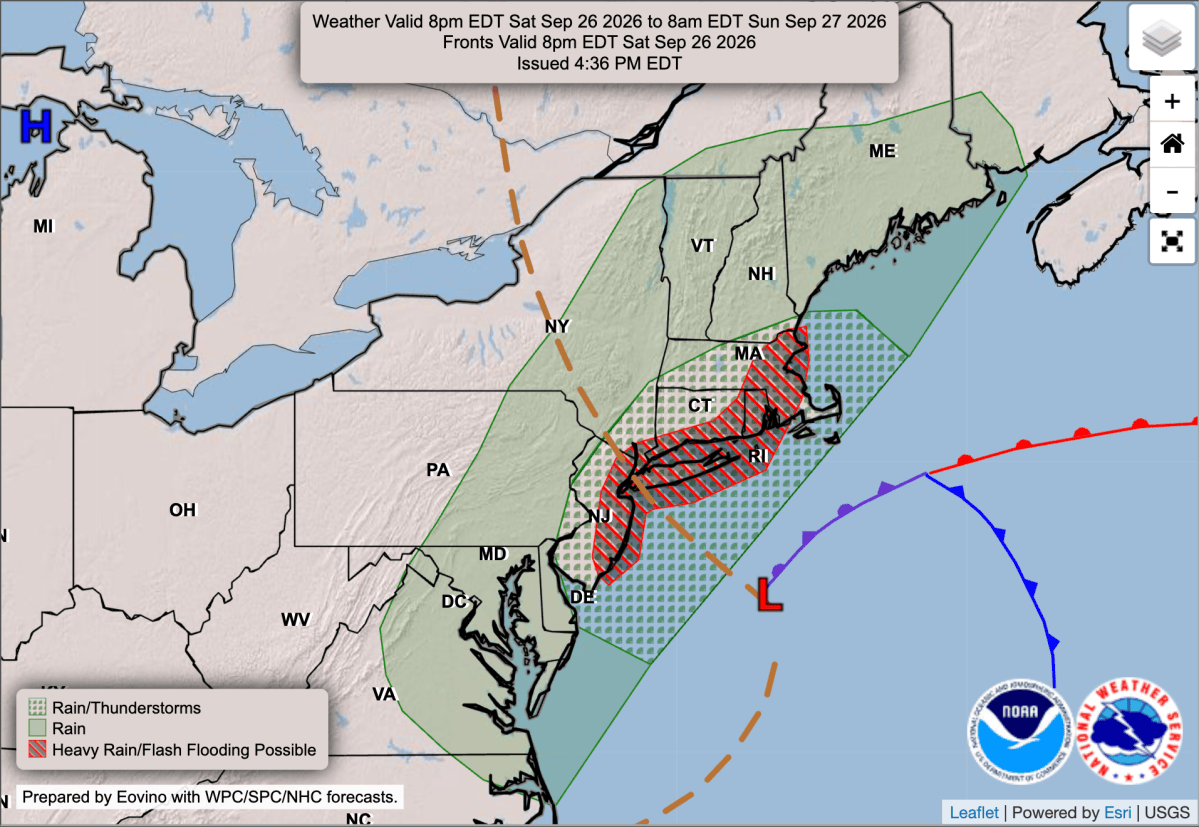
Millions of people in the Northeast, including New York City and Boston, are facing “dangerous coastal flooding and beach conditions, strong winds and heavy rainfall” as a nor’easter hits the region this weekend, the National Weather Service (NWS) warned.
The storm has already claimed at least one victim, with a 56-year-old man in Brooklyn killed by a falling tree on Saturday, and left more than 100,000 households in New Jersey, Massachusetts, Delaware and New York without power, according to tracker PowerOutage.
Several events have been cancelled, including the Global Citizens Festival scheduled for Saturday in New York City’s Central Park and Ed Sheeran’s concert at Gillette Stadium, Massachusetts. More than 450 flights were also canceled and 3,000 delayed on Saturday.
Forecasters said weather conditions will reach their peak from Saturday into early Sunday, though they warn that strong winds, rough surf and coastal flooding will linger into Monday, with rain showers continuing on and off.
The nor’easter has brought dangerous wind gusts and coastal flooding to the entire Northeastern region, but the New York City metropolitan area and New Jersey are expected to take the brunt of the storm, according to forecasters.
The National Oceanic and Atmospheric Administration (NOAA) has warned that the strongest wind gusts and widespread coastal flooding will most likely occur near the waterfront and shorelines of New Jersey, New York City and Long Island, while the worst flooding is expected with the daytime high tide cycles Saturday and Sunday.
Flooding will also extend inland from the waterfront along tidal rivers and bays.
By Friday afternoon, both New York and New Jersey had declared a state of emergency. In New York, Gov. Kathy Hochul placed New York City and Westchester, Nassau and Suffolk counties under a state of emergency and issued a Coastal Flood Warning for Long Island, New York City and the lower Mid-Hudson.
The worst flooding, the governor’s office stated, is expected along the south shore of Long Island, as well as parts of lower New York Harbor and coastal areas of the Bronx, Westchester, and northern Nassau County along the Long Island Sound.
In New Jersey, Gov. Mikie Sherrill declared a state of emergency for eight counties expected to face the most severe impacts from the nor’easter, including Atlantic, Burlington, Cape May, Cumberland, Middlesex, Monmouth, Ocean and Salem.
Showers and thunderstorms, including some severe ones, may produce localized heavy rain from the Southern Plains to the upper-Mississippi Valley, NWS forecasters said.
The latest NWS update warns that high tide cycles through Sunday afternoon will see potential for moderate to locally major coastal flooding for most of the local coastline, with the worst likely to hit the southern and eastern bays of Long Island. Some two to four inches of additional rainfall is expected across New York City, Long Island, and
southern Connecticut, while 1.5 to 3 inches are expected anywhere else.
Widespread minor urban, poor drainage, and small stream flooding, with isolated instances of flash flooding are likely through Sunday Night, forecasters said.
The nor’easter is expected to gradually weaken on Sunday, though its impacts will continue into Monday, including on-and-off rain showers, gusty winds and some coastal flooding.
“Storm won’t leave region until Monday night,” John Davitt, chief meteorologist for Spectrum News NY1, wrote on X, referring to New York City, adding that “waves of rain are coming.”
In the Big Apple, strong to damaging winds will peak on Saturday night into Sunday morning, according to the city’s NWS branch.
Both Sherrill in New Jersey and Hochul in New York have urged residents to take the weather warning seriously and be cautious in the next couple of days.
“I urge all New Jerseyans to take this storm seriously, stay safe, and be prepared. Please charge your phones, secure loose items outside, stock up on food and water, and stay off the roads if possible,” Sherrill said in a statement. “If you need to travel, please plan ahead and stay up to date on alerts, as conditions can change quickly, and never drive through flooded roads.”
“Take this storm seriously. Stay alert, and avoid unnecessary travel,” Hochul said.
NOAA recommends residents of areas affected by the storm make sure they have food, water, medications and other basic necessities for themselves, their family and their pets “to sufficiently ride out the storm and its aftermath.”
Contact Newsweek editors on this story: Ben Kelly and Cristina Diciu.