How India's oil shock absorbers are exhausting
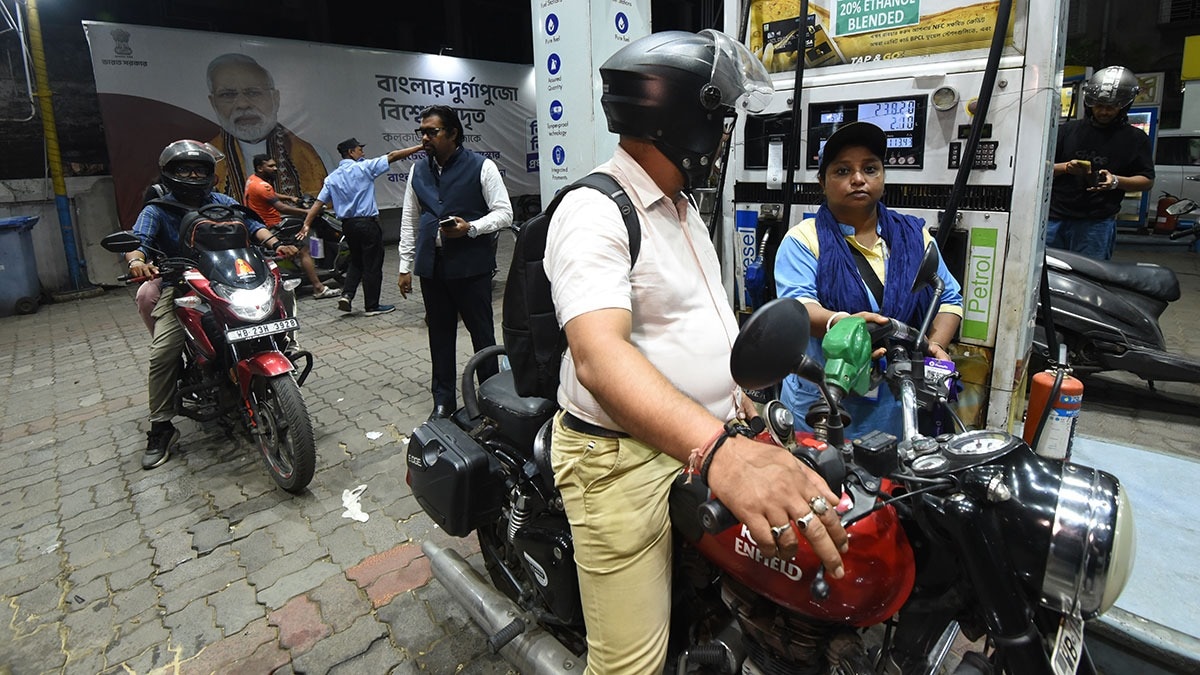
There is a curious contradiction at the heart of India’s inflation story. The global oil shock has intensified, yet public-sector pump prices for petrol and diesel have risen by only about Rs 3 a litre since the West Asia war began.
The shock has also changed shape. Crude has risen by roughly half: Brent traded at around $70-75 a barrel before the war began in late February, and futures were about 45 per cent above pre-war levels in early September, with India’s crude basket near $109 per barrel.
Diesel has nearly doubled. US diesel prices crossed $200 a barrel in early September, 94 per cent above pre-war levels, with Asian and European prices not far behind. Asian diesel refining margins—that is the premium a refiner earns over the cost of crude—have climbed from about $22 a barrel before the war to a record above $87 a barrel. Petrol has been a calmer market. ICRA puts the gap between Indian pump prices and import cost at about Rs 5 a litre on petrol against Rs 23 on diesel.
This is now a refining shock as much as a crude shock, and it is squeezing both of the Gulf’s exits. With the Strait of Hormuz blocked, Saudi Arabia rerouted its exports through Yanbu on the Red Sea. Since July, Yemen’s Houthis have been enforcing a declared blockade of Saudi shipping there, firing missiles at tankers and striking a Saudi refinery.
Yanbu’s exports roughly halved in August. Elsewhere, Ukrainian drone strikes have brought Russia’s fuel exports to a near-halt, and Moscow is extending its ban on diesel exports to the end of October.
The International Energy Agency estimates that diesel exports from the Gulf and Russia, which together supplied almost half of the world’s seaborne diesel trade before the war, were 1.6 million barrels a day lower in August than in February. That is roughly as much diesel as India consumes every day. Global refining capacity was already stretched after Covid pandemic-era closures, and stocks have fallen to record seasonal lows just as heating and farm demand picks up.
That matters for India because diesel is the economy’s workhorse fuel. It moves trucks, tractors, irrigation pumps and generators. It is also where holding pump prices steady is most expensive.
For the consumer, the shock is largely invisible at the pump. For the economy, it is not. Next door, it is not even invisible to the consumer: Pakistan, Bangladesh and Nepal are rationing fuel or reporting empty pumps, and Sri Lanka has brought back QR-coded fuel passes that cap weekly purchases.
Alongside, the time to find out how much longer India’s insulation can last is running short. On October 7, the Reserve Bank of India’s (RBI) Monetary Policy Committee (MPC) may announce its first decision since the oil shock re-escalated. Brent crossed $100 a barrel on September 9. What MPC will be asking is this: is the shock still contained or has it started to leak into everything else?
ICRA estimates that at September’s average prices so far, oil marketing companies (OMCs) are under-recovering about Rs 23 a litre on diesel, Rs 5 on petrol and Rs 200 on every domestic LPG cylinder. India consumes roughly 280 million litres of diesel a day. At that volume, the diesel gap implies an exposure of about Rs 650 crore a day or over Rs 9,000 crore a fortnight.
That is not a daily accounting loss. Refining profits offset part of it, and international prices have not stayed at today’s level throughout. It is a measure of the shock being absorbed somewhere in the system. Increasingly, that somewhere is the public sector alone.
IOC, BPCL and HPCL have carried the load. Their integrated model is what makes this possible: when crude and product prices rise, refining margins can offset losses on fuel marketing.
The first quarter showed the limits. Despite exceptional refining margins, HPCL lost Rs 11,526 crore, BPCL Rs 3,962 crore and IOC Rs 2,661 crore, hit by frozen pump prices and mounting LPG losses. When crude eased in late June, brokerages expected Q2 to improve. September’s escalation has put that recovery at risk.
India ran this experiment four years ago. In 2022, after Russia invaded Ukraine, the same three companies held pump prices unchanged for a record seven months. They lost Rs 21,201 crore in the first half of FY23, and the government paid a one-time Rs 22,000 crore grant to cover past LPG losses. The strategy worked, eventually, because crude prices fell and marketing margins recovered.
This time the arithmetic is different. In 2022, the problem was mainly crude. In 2026, it is increasingly the refining margin on diesel, and the routes that carry refined fuel out of the Gulf are themselves under fire. Crude can fall on a ceasefire headline. Refining capacity and shipping lanes cannot be restored in a quarter. The US Energy Information Administration expects most Gulf production and trade flows to return to pre-war levels only in the second quarter of 2027. Waiting for the shock to pass is a bet that worked once, on a different kind of shock.
Private retailers faced the same costs and made a different choice. Nayara Energy raised petrol by Rs 5 and diesel by Rs 3 a litre in March. Shell went further, lifting diesel in Bengaluru by over Rs 25 a litre.
Customers responded predictably. In April, Nayara’s petrol sales fell 30 per cent and its diesel sales 46 per cent. Shell’s diesel volumes collapsed by 77 per cent. Sales at public-sector pumps rose nearly 9 per cent. Reliance’s Jio-BP kept prices in line with the PSUs and gained share instead.
Industrial users face market-linked prices too: the PSUs raised bulk diesel by about Rs 22 a litre in March, and bulk buyers have been reported shifting to retail pumps where the fuel is cheaper.
The result is that the subsidy is concentrating. Every litre that moves from a private pump or a bulk contract to a PSU retail pump is a litre sold below cost by a state-owned company. The freeze protects consumers but it also hands volume, and losses, to IOC, BPCL and HPCL.
The government has not left the OMCs entirely alone. In March, it cut the special excise duty on petrol to Rs 3 a litre and on diesel to zero, a sacrifice Emkay estimated at about Rs 1.55 trillion a year. At the same time, it reimposed a windfall tax on fuel exports, recalibrated every fortnight. That tax peaked at Rs 55.5 a litre on diesel in April and stood at Rs 20 after the September 16 revision.
The logic is a redistribution. Refiners earning windfall margins abroad pay part of them to the state; the state gives up excise revenue at home, and the PSU retailers absorb the rest. It is an elaborate machine for keeping one number, the pump price, still.
But the adjustment does not disappear. It moves into OMC margins, government revenue, the import bill, and freight and input costs. Eventually it can move into the broader inflation basket. The August data suggest some of that is already happening.
Consumer inflation rose to 4.82 per cent in August from 4.45 per cent. The telling number is inside it: goods transport services inflation exceeded 14 per cent, even though pump prices had not moved since May. Truckers and logistics firms are passing on costs that motorists are not yet seeing.
Wholesale prices say it more loudly. WPI inflation reached 9.92 per cent, with fuel and power at 22.93 per cent and mineral oils above 38 per cent. Industrial buyers paying near-market prices for fuel are already absorbing the shock.
Core inflation, which strips out food and fuel, is estimated by HDFC Bank principal economist Sakshi Gupta to have risen to about 4.2 per cent from 3.86 per cent. Some of that reflects gold and silver prices rather than oil, so the rise is a signal to watch, not yet proof. Food inflation, at 5.95 per cent, is largely a weather story, but it compounds the pressure.
There is a less visible leak too. Elsewhere, higher pump prices force people to drive less and firms to economise on fuel. In India, the freeze removes that signal. Crude import volumes in April-July were almost unchanged from a year earlier, at 81.9 million tonnes, but the import bill rose 56.5 per cent to $63.4 billion. Motilal Oswal estimates the current account deficit could widen to 1.7 per cent of GDP, about $71 billion, if crude stays above $90 for much of the second half of the year.
That feeds the rupee. Higher oil means more dollar demand and a weaker rupee, and a weaker rupee raises the rupee cost of every imported barrel. The US Federal Reserve’s rate hike last week widens the gap between American and Indian rates and adds to that pressure. The RBI has been intervening to smooth the slide, but it cannot suspend the arithmetic. The pump price can be administered. The entire economy cannot.
At its August 3-5 meeting, the MPC held the repo rate at 5.25 per cent and kept a neutral stance. It trimmed its FY27 inflation forecast to 5 per cent and raised growth to 6.7 per cent. But it also projected inflation peaking at 5.9 per cent in the October-December quarter.
The minutes were more hawkish than the headline decision. RBI governor Sanjay Malhotra said monetary policy would have to respond if the supply shock began to generalise, de-anchor expectations or persist. He added: “Any evidence of these risks materialising may need policy tightening.”
RBI deputy governor Poonam Gupta said a case for a hike may emerge during the year. The RBI has since announced bond sales to drain surplus liquidity.
The world has moved faster. In the past fortnight, the US Federal Reserve raised rates for the first time since 2023, the European Central Bank delivered its second hike of the year, and the Bank of Japan took its policy rate to a 31-year high, all in response to the same energy shock.
Closer home, Bank Indonesia and the Philippines’ central bank have been tightening since the war began to defend their currencies. The Bank of England held, but three of its nine members voted to hike, and the bank warned that a prolonged conflict and rising second-round risks would likely force it to tighten. That is almost exactly the language of Malhotra’s minutes.
India is increasingly an outlier, and it has less excuse than most. The Bank of England is holding against a softening labour market, and the Philippines hiked into falling investment. India’s economy grew 7.8 per cent in the April-June quarter, and Morgan Stanley and Citi have raised their full-year forecasts to 7.3 per cent. If the RBI waits, it will not be because growth demands it.
There is still a serious case for waiting. A rate hike will not lower the price of diesel, which is being set by refinery outages and missile strikes thousands of miles away. The RBI’s own August assessment was that broad-based price pressures remained modest, and even in Europe, European Central Bank policymakers say they see no clear second-round effects yet.
A deal to restore shipping through the Strait of Hormuz, discussed between Iran and Oman and postponed only last week, could pull crude down quickly. Tightening into a supply shock that then reverses would be an expensive mistake.
That makes the October 7 MPC meeting more than a routine review. August’s headline inflation print is roughly on the RBI’s path, but its composition and the oil market have both shifted since the committee last met. ICRA’s Aditi Nayar expects a rate hike in December if inflation broadens and crude stays high, and says it could come as early as October. Sakshi Gupta expects the RBI to hold and wait. Either way, the committee will be setting rates against a fuel price that someone else controls, and without September’s inflation data, which arrives the week after.
The easy levers have been pulled. Special excise on diesel is already zero, pump prices have been raised once, and the windfall tax on exports is set by formula. What remains is harder: let the PSUs absorb more, raise retail prices again or find fiscal support elsewhere.
Each has a cost. More absorption deepens losses that are already concentrating on three state-owned balance sheets. Fiscal support competes with a budget that has already given up excise revenue. A retail price increase repairs OMC margins but feeds inflation directly, and if inflation is already broadening, that option becomes considerably more expensive from a monetary-policy perspective.
The fuel-price freeze has bought time. On October 7, the RBI will signal how much of it is left. If the shock stays on the balance-sheets of IOC, BPCL and HPCL, it remains an oil-company problem. If it migrates into transport, manufacturing, services and household budgets, it becomes an inflation problem. And then it becomes the MPC’s problem.