How has the CHL changed since NCAA hockey opened its doors to Gavin McKenna and other young stars? - Toronto Star
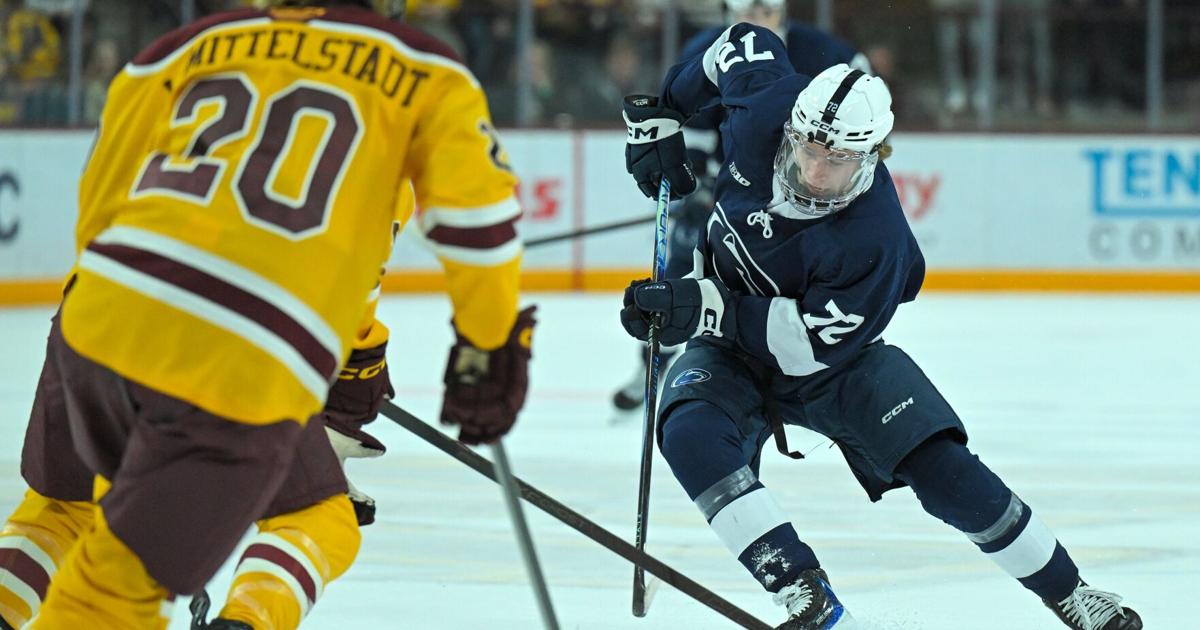
Trends have formed in the Canadian Hockey League over two years since the NCAA's eligibility shift.
Gavin McKenna was drafted No. 1 by the Maple Leafs after a brief star turn with the NCAA’s Penn State Nittany Lions.
GUELPH—George Burnett sits behind a desk in the type of featureless office occupied only by people focused exclusively on the task at hand. There’s no art on the walls, not a single sentimental item in sight.
Burnett, general manager of the Guelph Storm, is in his 34th Ontario Hockey League season as a player, coach or GM. For the first time he’s with a team hosting the Memorial Cup, major junior hockey’s century-old championship.
“We’re trying to make sure there’s nothing left untouched,” Burnett said in late October, eyeing a colour-coded depth chart across the room.
He was referring to an organization-wide dedication to staging the event mere feet from his office, at the 4,700-seat Sleeman Centre in May. But the veteran executive could have been talking about the grind of assembling a championship-calibre team amid unprecedented player movement across leagues below the NHL. It has been two years since the NCAA Division I council voted to let players from Canada’s three major junior leagues (OHL, QMJHL, WHL) retain eligibility and play for colleges in the United States.
“The landscape has changed,” Burnett said plainly.
“It’s no longer an either/or proposition for players,” OHL commissioner Bryan Crawford said in a phone interview. “For decades, it was a proposition of us or them — CHL or NCAA, junior or college — and now it is really a proposition of when.”
Anaheim Ducks prospect Eric Frossard arrived in Guelph via the USHL in early 2025 (just two months after the NCAA rule change) and will move on to Notre Dame in 2027-28.
Like most of the 61 CHL teams, the Storm have watched junior-aged players leave earlier than expected and welcomed previously unattainable talent bound for the NCAA. Pittsburgh Penguins prospect Quinn Beauchesne, for one, left for Boston College in the off-season after three OHL seasons, which stung. Anaheim Ducks prospect Eric Frossard, meanwhile, arrived via the USHL in early 2025 (just two months after the rule change) and will end up playing a solid two-and-a-half seasons for Guelph before moving on to Notre Dame in 2027-28.
The pool of players has deepened, but they rarely stay in one spot in this new era.
“I don’t know if we can plan four years out like we used to,” Burnett said. “You might get three years from your core group, but I think you actually have to plan for two, just in case. Our league is probably going to be a little younger moving forward.”
Added Storm head coach Cory Stillman: “If you get off to a good start and you’re a good team, that might be the year you need to go for it in the OHL — even if that wasn’t the plan — because players just might not be back the following year.”
The average age of players across the CHL’s three leagues has dropped to 18 in 2026-27, after holding firm at 18.8 for four seasons, according to data provided by the CHL. Based on 61 opening-day rosters, the player population is 70 per cent Canadian, 19 per cent American and 11 per cent from other countries.
Recent top-10 NHL picks Gavin McKenna, Porter Martone, Roger McQueen, Keaton Verhoeff, Daxon Rudolph and Carson Carels started in the CHL but jetted to colleges prior to or shortly after the draft. Projected 2027 No. 1 pick Landon DuPont left the WHL’s Everett Silvertips for the University of Michigan this fall.
Brampton’s OHL roster was decimated ahead of the 2025-26 season when three difference-makers fled to U.S. colleges, including Philadelphia Flyers prospect Porter Martone.
The NHL’s latest collective agreement delivered another gut punch to the CHL. First-round picks (including the OHL’s Jake O’Brien and QMJHL’s Caleb Desnoyers this season) can now be assigned to the AHL at 19 years old; in the past, North American-born CHLers had to be 20.
Still, more than 350 players who might previously have taken another path have joined CHL clubs since November 2024, most notably top-10 picks Caleb Malhotra and Chase Reid, who made a detour to the OHL before heading to college.
Some trends have formed two years in. Has water found its level, or does the sport need a larger sample to draw conclusions?
“It’s going to be the wild west for the first three years, four years, maybe five; we’re only in Year 2,” said Brampton Steelheads GM/head coach James Richmond.
“What we haven’t seen yet,” said CHL president Dan MacKenzie, “is a full cycle of players who’ve gone through the system start to finish, are now at that next level in terms of pro hockey, and are at a spot in their careers where we can really evaluate the impact of their decisions. That’s still the unknown piece to all of this.”
CHL teams play roughly twice as many games as U.S. colleges, and CHL players assume bigger on- and off-ice roles at a younger age. NCAA programs, in many cases, have access to better facilities, focus more on strength and conditioning, and can attract talent with name, image and likeness offers.
McKenna, who spent one year at Penn State, reportedly made around $700,000 (U.S.) in NIL money last season, which is an anomaly. College players generally earn more than juniors, but the vast majority (including legitimate NHL prospects) get less than $100,000 a year via NIL or revenue sharing.
CHLers receive stipends of $470 per month ($900 for 20-year-olds) and one year of post-secondary school funding for each season played. The education package is forfeited if a player leaves the CHL for college or the pros before their major junior eligibility expires.
A popular narrative is that the OHL, WHL and QMJHL have quickly become feeder leagues for Division I. MacKenzie and Crawford vehemently disagree.
“The CHL is still where the best 16- to 19-year-olds in the world play hockey,” Crawford said. “There’s no other league that’s even close to our three in terms of the quality and talent of players. That’s something we’re very proud of.”
The CHL is growing in part because of the deeper player pool. The WHL hits 24 teams next year, while the 18-team QMJHL is eager to add U.S.-based franchises. Crawford said the 20-team OHL, which last expanded in 1998, is “actively engaged in a number of conversations” with prospective owners and “hopefully within the next couple seasons we’ll be able to see some growth.” York and Halton regions, Cornwall and Chatham are Ontario-based markets expressing interest. The biggest hurdle: any expansion franchise would need a large, modern arena.
The NCAA rule change got competitive juices flowing across Canada, MacKenzie noted, with leagues and teams looking for more ways to elevate the player and fan experience. Richmond is also keeping tabs on the Team USA Act, now moving through the American political system. There’s an outside chance the number of NCAA athletes hailing from outside the U.S. will be capped.
Nashville Predators prospect Jack Ivankovic.
Brampton’s roster was decimated ahead of the 2025-26 season when three difference-makers fled to colleges: Martone, Jack Ivankovic and Luke Misa. While any lingering bitterness would be understandable, Richmond has since beefed up Brampton’s U.S. scouting presence and says he isn’t hiding from NCAA programs. He believes CHL GMs and coaches who choose to “coexist” with American colleges will thrive in the new era. Hockey is a business of people and results.
“When you’ve got a loaded cargo plane, you want as long a runway as you can. Well, the NHL’s loaded with really high-end hockey players, so it’s not easy for anyone to make it there,” Richmond said. “So, get as long a runway as you can, and we’re still the best league to help you do that.”
Burnett has seen a dramatic transformation in the OHL over three-plus decades with seven franchises, including significant upgrades to facilities, travel conditions, nutrition and off-ice support.
What hasn’t changed: The Memorial Cup host automatically qualifies for the four-team championship tournament, which is both a privilege and a burden.
“We don’t want to be a team that backs our way into the tournament,” Burnett said of the Storm (13-3-0-0 before Friday’s games) challenging for the OHL title. “We want to come through the front door.”
It will be the seventh Memorial Cup appearance for the Storm, with zero wins so far, and the fourth of Burnett’s career, also with no national championships.
“If you have an opportunity like this,” he said, “you don’t want to be a player short.”
Error! Sorry, there was an error processing your request.
There was a problem with the recaptcha. Please try again.
You may unsubscribe at any time. By signing up, you agree to our terms of use and privacy policy. This site is protected by reCAPTCHA and the Google privacy policy and terms of service apply.