How Edjop’s death turned into a story of redemption - Rappler
Already have Rappler+? Sign in to listen to groundbreaking journalism.
This is AI-generated. Read the article for full context. Report any errors.
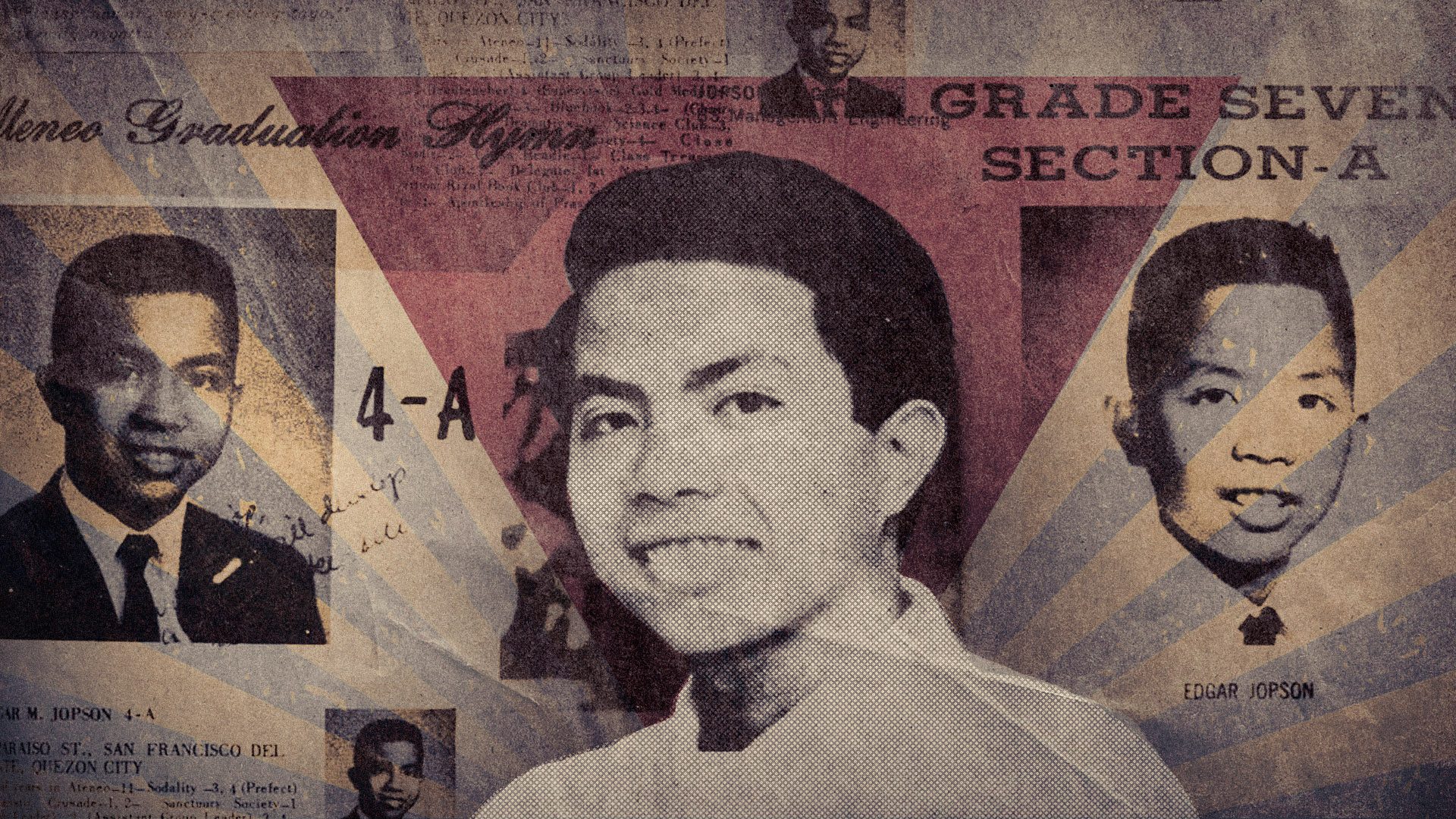
Even in death, Edgar Jopson was a life force, a beacon of hope and courage.
One of the most powerful stories in Edjop’s journey happened shortly after he was killed in a military raid at Skyline Subdivision in Davao on September 20, 1982.
Edjop lived at the Skyline home with other U.G. (underground) activists, including Father Orlando “Dong” Tizon, the late respected activist priest whom church and human rights activists have endorsed to be included in Bantayog ng Mga Bayani’s Wall of Remembrance. Edjop’s other housemates included Betty De Vera, who was the last person with Edjop before he was gunned down, and an activist referred to in U.G. An Underground Tale as Laura.
There’s a strong belief that her mistake led to the raid and to Edjop’s death. The raid itself plunged Laura into a world of brutal violence, a nightmare that pushed her to the edge before rage over what happened to Edjop unleashed a surge of strength.
Laura was a former UP student who was part of the wave of youth activists who embraced the revolution and the fight against the Marcos dictatorship. Like many, she wanted to work directly with workers and farmers in urban poor communities and barrios. But because of her background, Edjop and the U.G. leadership in Mindanao assigned her to a different kind of work.
The Skyline collective was responsible for writing and reproducing documents and reports using typewriters and mimeographing machines. Their U.G. house was located in an exclusive neighborhood. To avoid arousing suspicion, they worked in an airconditioned room with blankets nailed to the walls to muffle the sound of the machines.
“I felt suffocated,” she told me when I interviewed her in 1987. “I was sick and tired of seeing the same faces, of working with documents every day. I felt isolated as though I was in prison.”
Tensions emerged in the U.G. house. Laura started going out without permission, a violation of security policies. Her housemates began to resent her desire to leave the group. Laura called what she was going through “the gut level dilemma of an urban petty bourgeois.”
“Only Edjop tried to understand my problem, from my point of view,” she said.
That, in a way, highlighted a change in Edjop. During his early years in the U.G., Edjop was known for being a stern manager, a grim and determined leader to the point of being inflexible, even insensitive.
“With comrades who had a lot of angst, who had sensitive, or what is sometimes called artistic, temperaments, Edjop was not effective as a friend or counselor,” the late Roz Galang, a former journalist who worked with Edjop in the Manila U.G., told me. “These cadres were often indecisive, submerged in self-doubt and bore many personal frustrations. Edjop was the exact opposite. He knew what he wanted and worked for its fulfillment. He was never wishy-washy. He never went through the same anxieties.”
After nearly a decade in the U.G., Edjop had mellowed. He began to embrace a less rigid management style in Mindanao.
Edjop eventually agreed to let Laura to transfer to another group to do the work she found fulfilling. The change meant Edjop would have to delay a planned move to Manila where he was supposed to take on more responsibilities.
Laura recalled Edjop’s thoughtfulness as he helped the collective prepare to move to another U.G. house. “I know that you are disappointed with the way I behaved,” she told Edjop. He told her not to worry and to take care of herself.
“At that time, he was like our dad,” she recalled.
Unknown to Edjop’s U.G. collective, Laura apparently had been spotted during one of her unauthorized trips by a former cadre who had turned into a military informer. The Skyline home had been identified as a U.G. safehouse.
Laura was not home when the military struck. She returned the day after the raid, unaware that the house had been compromised.
The military grabbed her the moment she stepped into the house. A soldier slapped her face, a tactic she knew was meant to make it hard for her to think. She remembered what Edjop told her: “Think of a simple story and stand by it.”
But after she was taken to the military camp, the torture intensified. She was blindfolded with masking tape. An agent banged her head with encyclopedia volumes. Another undressed her and watched her shiver as she stood in front of an air-conditioner. They mashed her breasts and put a piece of pepper and eggplant into her vagina.
“I clung to the hope that I was the only one who had been captured,” she said. “I constantly reminded myself of my oath to serve the people and to protect my comrades.”
But the abuse began to take its toll.
“I no longer had any will power to resist,” Laura said. “I was ready to surrender, to cooperate with my persecutors.”
Then, one night, one of her tormentors showed her the front page of a Davao City newspaper with the headline: “Top CPP Man Killed in Davao City Raid.” The page featured Edjop’s photo.
The agent probably hoped to finally break her will. But the move backfired. As she stared at the photo of Edjop, Laura felt a surge of energy that exploded into defiant rage.
“I will not fail you this time,” she thought as she stared at the photo.
“I began to hate those who had killed a good man like Ed. I began to fight back. I didn’t care anymore about dying. Edjop had given everything for our cause. I could do no less.”
Laura became unruly and loud. She cursed and yelled at her captors. She knocked down chairs and whatever she could reach with her feet. She kicked and spat at the military agents. She deliberately urinated on the floor.
Eventually, her captors got tired of torturing her. Laura was allowed to join her comrades in another part of the camp. Together, they wrote the Jopson family a letter. “We loved him and he loved us.” Edjop, they said, “stood by his comrades and the people.”
Laura and I spoke in 1987. I don’t know what has happened to her after that. I tried to find a way to reach out to get her permission to use her real name before U.G. An Underground Tale was published in 2006. But I was unsuccessful.
Meanwhile, Edjop’s story has attracted much attention thanks to the powerful film directed by Katski Flores and produced by his daughter Joyette and which features impressive performances by Elijah Canlas, Frankie Pangilinan, and Jodi Santa Maria. (READ: Encounters with Joy and sadness in ‘Edjop’ film release)
The film turned the spotlight on an amazing life, even though questions about, and even criticisms of Edjop’s chosen path remain. I understand the criticisms and objections. For when it comes to the history of U.G. movement, we’re talking about two narratives. (Editor’s note: As of Saturday, September 26, Edjop: The Movie was still showing in 3 cinemas in Metro Manila: Gateway Cineplex, Robinsons Manila, and Market! Market!)
One is about hard-line cadres capable of incredible, narrow-minded violence based on calcified dogma, a story of purges and destruction, of stunted claims of having the “correct ideology.” That’s probably the side most Filipinos are familiar with today.
It’s about young Filipinos who sought to change an unjust system and who realized that the best path forward was to align themselves with the weakest and most oppressed in society — even if it meant tremendous personal sacrifices in a time of dictatorship, one of the darkest chapters in our history.
That’s the tradition that Edjop and Laura, the young woman whom he inspired even after his death, symbolized.
“We knew the danger in joining the movement,” Betty De Vera, one of Edjop’s comrades during the Davao City raid, told me recently. “Death was a common occurrence so we were always ready.”
The late poet Alfrredo Navarro Salanga, Edjop’s best friend during their college days at Ateneo, offered the most beautiful and most fitting eulogy.
“We may not agree with what you died for,” Freddie, who passed away in 1988, wrote. “Your circle of friends will remain divided on that question as will, sadly, your country. But one thing we will always be sure of: you died a brave man, a just man and a good man. You died believing in what you lived for and that is something we may never even have the privilege of sharing.” – Rappler.com
Benjamin Pimentel is the author of ‘U.G. An Underground Tale,’ published by Anvil Publishing which just released the 2nd printing of the 3rd edition. He is also a journalist and technology editor based in the San Francisco Bay Area, California, USA. Royalties from ‘U.G.’ are donated to Bantayog ng Mga Bayani.