How America’s Data Center Capital Became an Unexpected House Battleground - Newsweek
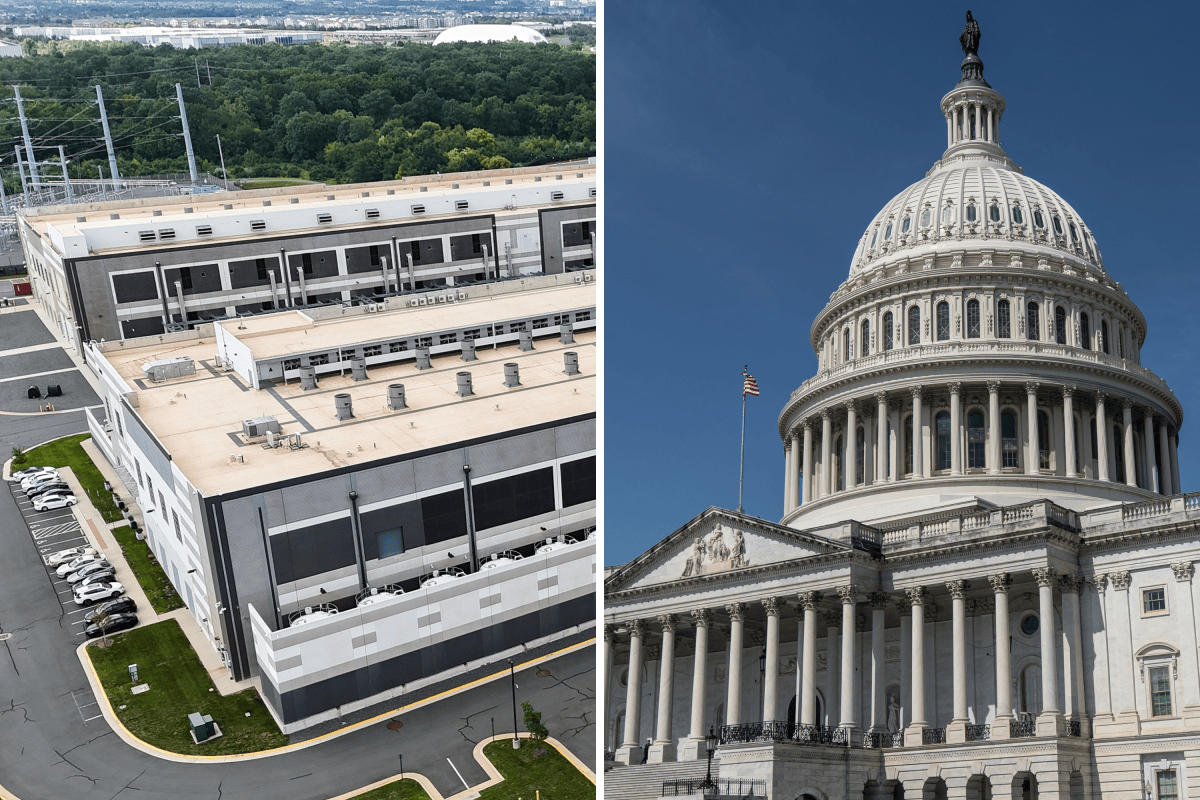
Three Republican-held districts in the nation’s data center capital have become more competitive ahead of November’s midterms, according to recent race rating changes and internal polling seen exclusively by Newsweek.
Earlier this year, Virginia appeared destined to recede from the national battlefield when its Supreme Court nullified a redistricting effort that could have improved Democratic prospects in four GOP seats.
The ruling required the state to retain the congressional boundaries used in 2022 and 2024.
Speaking to Newsweek, a Democratic campaign operative described Virginia as an “unexpected state” in this year’s House battlefield, arguing that Republicans had assumed the redistricting effort’s failure would insulate their incumbents.
But this week, Sabato’s Crystal Ball moved Republican Representative Jen Kiggans’ 2nd District from Toss-up to Leans Democratic, shifted Representative Rob Wittman’s 1st District from Leans Republican to Toss-up and changed Representative John McGuire’s 5th District from Likely Republican to Leans Republican.
And Democratic-sponsored surveys reviewed by Newsweek point in the same direction, showing narrow one-point Republican leads in the 1st and 5th districts, while party groups and candidates are directing money toward contests once expected to receive less national attention.
Democrats are now targeting a fourth Virginia seat, adding Republican Representative Ben Cline’s 6th District to the Democratic Congressional Campaign Committee’s offensive battlefield on Friday. Democrats need only a narrow net gain to take control of the House.
It comes as Virginia’s expanding data-center industry provides a local fault line within that wider Congressional battle.
Democratic candidate Tom Perriello has seized on the issue in District 5, accusing incumbent McGuire of backing corporate tax breaks available to developers and opposing a transmission line associated with the industry’s growing electricity demand.
Newsweek’s AI Policy Scorecard offers a new way to examine the incumbents’ records in this emerging technological space. It ranks sitting members from AI Skeptic to AI Booster using votes and public positions across regulation, energy and data centers, employment, safety and national security. The scorecard ranks McGuire as "Lean Booster," with a score of 3.5.
Newsweek reached out to the Republican National Committee and the Democratic and Republican candidates running in Virginia’s Congressional races mentioned above for comment via email on Friday morning.
Public opinion offers a reason for candidates to engage with an industry that brings investment and tax revenue while drawing concerns about energy, land, and household costs.
A Washington Post-Schar School survey conducted from March 26 to 31 among 1,101 registered Virginia voters found that just 35 percent would be comfortable with a data center being built in their community. Its margin of error was plus or minus 3.4 percentage points.
National findings point to stronger resistance.
A University of Massachusetts Amherst survey found that 65 percent opposed construction of an artificial-intelligence data center locally, while 11 percent supported one and 24 percent neither supported nor opposed it. The poll questioned 1,000 people from August 21 to 26 and carried a margin of error of 3.5 percentage points.
Respondents were matched against a sampling frame based on gender, age, race and education before the results were weighted through propensity scores and adjusted to presidential vote and demographic benchmarks.
Opposition extended across partisan lines, reaching 76 percent among Democrats, 67 percent among independents and 52 percent among Republicans.
When respondents explained their views, 28 percent cited environmental harm or depleted natural resources, 15 percent pointed to local disruption and land use, and 10 percent identified higher utility bills or an economic burden on residents. Meanwhile, 12 percent emphasized economic benefits, technological necessity or national competitiveness.
A CBS News/YouGov poll connected the subject more directly to the ballot.
Among likely voters, 54 percent preferred a congressional candidate who opposed building data centers locally, compared with 15 percent who favored a supporter; 31 percent said the position would make no difference.
Conducted online from September 8 to 11, the survey questioned 2,460 U.S. adults and had a margin of error of plus or minus 2.3 percentage points for the full sample. The results were weighted to gender, age, race, education and 2024 presidential vote, while likely voters were identified through a model incorporating stated intention, demographic information and voting history.
Virginia's 1st Congressional District places a veteran Republican against a challenger whose political identity was built in a courthouse rather than Congress.
Shannon Taylor, the Commonwealth’s Attorney for Henrico County, is presenting her prosecutorial background as evidence that she can attract voters who might not otherwise support a Democrat. Her campaign has also proposed banning members of Congress from trading stocks and permanently barring former lawmakers from becoming lobbyists.
The Democratic Congressional Campaign Committee (DCCC) argues those public-safety credentials make Taylor unusually suited to a district that remains Republican-leaning but includes changing communities around Richmond.
Its internal poll put Wittman at 47 percent and Taylor at 46 percent, with 7 percent undecided. Respondents in the sample reported voting for Trump by two points, while party identification was Republican by seven.
Conducted from September 15 to 17, the survey questioned 519 likely general-election voters through telephone and text-to-web interviews. Its margin of error was plus or minus 4.3 percentage points at the 95 percent confidence level.
The one-point difference is therefore not statistically meaningful, nor does it establish that Taylor is ahead.
More revealing for the DCCC argument is that Wittman, first elected to Congress in 2007, remained below 50 percent in this particular partisan poll.
The memo also found 37 percent approved of Trump’s performance and 55 percent disapproved, despite the sample reporting a Republican presidential vote advantage.
That creates a possible route for Taylor if the election becomes a referendum on the administration rather than a comparison of the two congressional candidates.
Virginia's 5th Congressional District presents Democrats with more difficult underlying terrain but a challenger who has won there before.
Perriello, a native of the Charlottesville area, captured an earlier version of the district by 727 votes in 2008. However, he lost two years later during a Republican wave after supporting the Affordable Care Act, a decision that has become part of his case for returning to Washington rather than something he has sought to avoid.
An Expedition Strategies memo shared with Newsweek placed McGuire at 46 percent, Perriello at 45 percent, independent candidate Cooke C. Harvey at 6 percent and undecided voters at 3 percent after leaners were included.
The poll comprised 400 interviews with likely general-election voters from September 21 to 24. It reported a margin of error of plus or minus 4.9 percentage points, with greater uncertainty among subgroups.
Data centers provide Perriello with a newer way to connect federal policy to local costs.
In a campaign video, he accused McGuire of supporting $362 billion in corporate tax breaks available to developers. The provisions were broader business-investment incentives, rather than benefits written only for data-center companies.
Perriello has also attacked Dominion Energy’s proposed Valley Link transmission project, which would cross nine counties as Virginia prepares for projected power demand associated with the industry’s growth.
Whether that argument can overcome the district’s Republican lean remains uncertain.
It nevertheless gives the former congressman a geographically specific campaign issue rather than relying entirely on the national political climate.
Trump has backed data center expansion amid rivalry over AI dominance with China, despite some hesitation over the controversial developments within his own party.
“The only reason that communities throughout the U.S.A. should not want Data Centers is if they want to end up being backwards and poor,” he wrote in an August post on the Truth Social platform. “China could not be happier with this anti Data Center movement.”
Last week, Trump met with tech CEOs to discuss the future of AI, potential guardrails and even a name-change for the technology.
During the meeting, the president signed an executive order directing federal agencies to stop using the terms "artificial intelligence" and "AI" in official communications, policy documents and correspondence, and to replace them with "Super Intelligence" and "SI."
Trump also signed a voluntary accord alongside six key names in AI, including Google CEO Sundar Pichai, Anthropic CEO Dario Amodei, Meta CEO Mark Zuckerberg, OpenAI President Greg Brockman, xAI CEO Elon Musk and Nvidia CEO Jensen Huang. The document said that the signers vowed to advance their AI models safely as safety concerns around the technology continue to grow.
Speaking to the press during the event, the president turned to data centers, saying Americans wanted them and that they were about to become "very popular."
"The areas with data centers have become very rich. Their taxes have gone down, not up. And a lot of good things have happened," Trump said. "I think they’re going to do things for the community that will be really financially beneficial."
Newsweek’s reporters and editors used Martyn, our AI assistant, to produce this story. Learn more about Martyn here.