
How a soccer pitch became a lifeline for people with Parkinson’s: ‘It’s a big family’ - Toronto Star
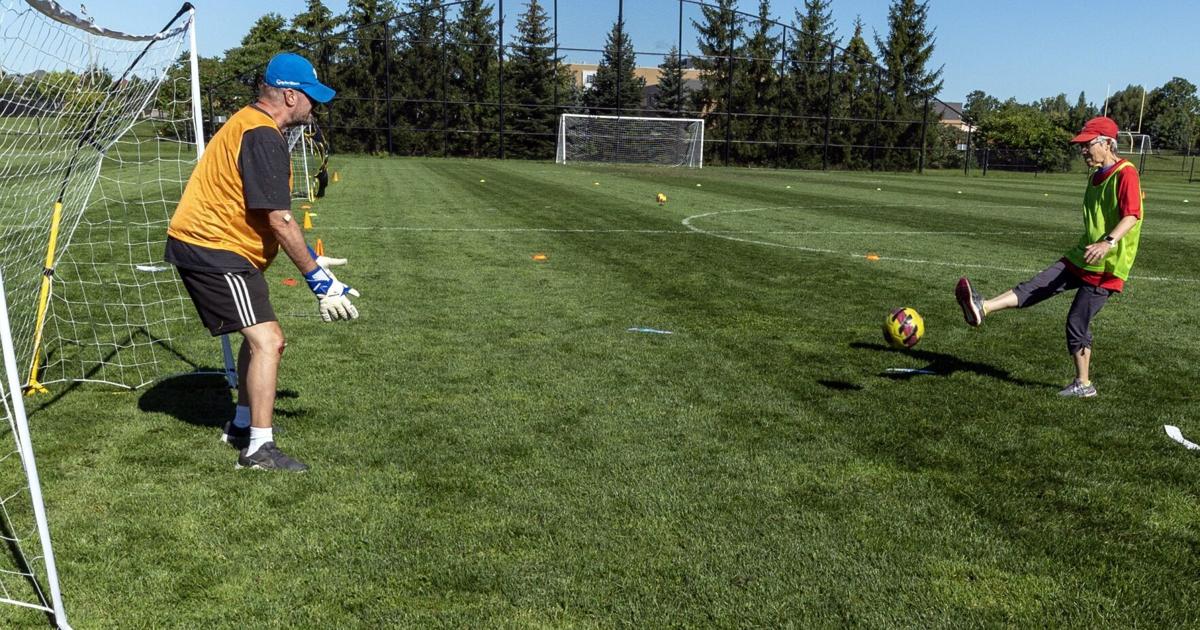
A partnership between Passion for Parkinson's and the Toronto Walking Soccer Club is using a simple focus to make a difference: movement is medicine.
Michael Borden can barely walk. He forces his feet forward in halting, awkward steps determined to get to the soccer pitch. He’s been looking forward to these two hours all week.
Borden was diagnosed with Parkinson’s disease 12 years ago. He has tremors, poor balance and trouble walking. Even standing is hard. But on the soccer field in Oakville, with two dozen other people with Parkinson’s, no one judges him or questions whether he’s drunk.
Best of all, playing soccer lessens his symptoms — and that physical benefit can last for hours afterward.
Borden leans precariously and stumbles backward as he works to stay upright, but when he goes for the ball, his gait gets smoother and he even jogs a few steps back to the line after kicking the ball in the goal on a drill. He doesn’t know why he’s able to walk better when he’s going for the ball in a game or dribbling to the goal in a drill.
“I’ve asked myself that question about a hundred thousand times, and a few doctors, too, and none of them have really been able to tell me why,” says the 60-year-old who worked in finance until his symptoms became too severe.
“I’ve had times when I’ve gone to an exercise class and I’ve even needed help to get into the class … and then walked out afterwards and went for a walk.”
Michael Borden, right, shows up to multiple sessions per week. “There’s more to it than just the exercise,” he says.
Borden shows up to multiple weekly sessions through Passion for Parkinson’s, a non-profit that offers free exercise programs and has built its philosophy around a simple idea: movement is medicine. Its new soccer program, offered in partnership with the Toronto Walking Soccer Club, has quickly become one of its most popular programs.
On Thursday, its players will face England’s national Parkinson’s players at Toronto’s Cherry Beach — the first event of its kind in Canada.
Parkinson’s disease is a progressive brain disorder that affects movement and other body functions and strangers often don’t understand the symptoms, which just adds to the burden of the disease.
“It’s no fun being in your home, not doing anything. I’d probably be laying on the couch now if I were at home,” Borden says at a Friday morning soccer session. “There’s more to it than just the exercise. It’s all the people, they’re very supportive.”
Passion for Parkinson’s was started by Laura Zega and Tamara Boaden in 2021 when they realized they were pretty good at fundraising and wanted those efforts to provide practical benefits for the local Parkinson’s community. They started with three exercise programs in Mississauga and have expanded to sites in Burlington, Oakville and Hamilton, and draw participants from as far east as Etobicoke.
The Toronto Walking Soccer Club approached them to start a soccer program for people with Parkinson’s this summer.
“Next to medication, exercise is the biggest form of therapy you can do,” says Boaden, who lost her husband to complications from the disease.
The joy of learning new skills and the socializing and camaraderie that comes from playing a team sport — walking soccer is their only team offering — have also attracted new participants.
Christine Hartley, right, says concentrating on playing helps her forget about her Parkinson’s symptoms.
Christine Hartley, originally from football-mad Manchester in the U.K., was keen to learn to play the game for her first time at 82 years young. “Girls didn’t play in those days,” she says of her childhood.
She enjoys playing with people who understand what she’s going through and says concentrating on kicking the ball helps her forget about her Parkinson’s symptoms.
“If you’re doing something silly, everybody laughs, it’s a big family. And you are always told you’re doing a good job, whether you are or not, which is important.”
An added bonus for her is that her teenage grandsons, who all play the game, are impressed that grandma plays, too. She plans on kicking the ball in the yard with them. “They don’t know it, but I’m going to do it,” she says smiling.
Toronto Walking Soccer Club coach Aidan Butterworth explains a drill during this event with Passion for Parkinson’s.
On the Oakville field, Aidan Butterworth — a Toronto Walking Soccer Club player and coach — leads the players through warm-ups, ball handling exercises, shooting drills and finishes up with short games.
He was inspired to start Canada’s first Parkinson’s walking soccer program after learning about the benefits from Parkinson’s UK, the global leader in this field. As well as the program in Oakville, which moves indoors for the winter, they recently started a pilot program in Toronto that runs to the end of October.
“I’ve been playing football all my life and this is about as rewarding (an experience) as I’ve ever had,” says Butterworth, who played for Premier League club Leeds United in the early 1980s.
People with Parkinson’s are finding strength, energy and connection at this Etobicoke boxing club’s specialized program that began in January.
