
Hong Kong's Northern Metropolis tests new path for urban growth
By continuing to browse our site you agree to our use of cookies, revised Privacy Policy and Terms of Use. You can change your cookie settings through your browser.
Editor's note: This article was translated from the original Chinese and first published on MNA. It reflects the author's opinions and not necessarily the views of CGTN.
China's Hong Kong Special Administrative Region (HKSAR) has never lacked ambition when it comes to urban development. The greater challenge has been finding ways to turn long-term plans into complete communities that support both economic activity and daily life.
The Northern Metropolis represents an attempt to address that challenge. Located in the northern part of the Hong Kong Special Administrative Region near Shenzhen, the development area is being positioned as a new space for innovation, industry, housing, and regional cooperation. It is also a test of whether Hong Kong can move beyond traditional approaches to land development and create a more integrated model of city building.
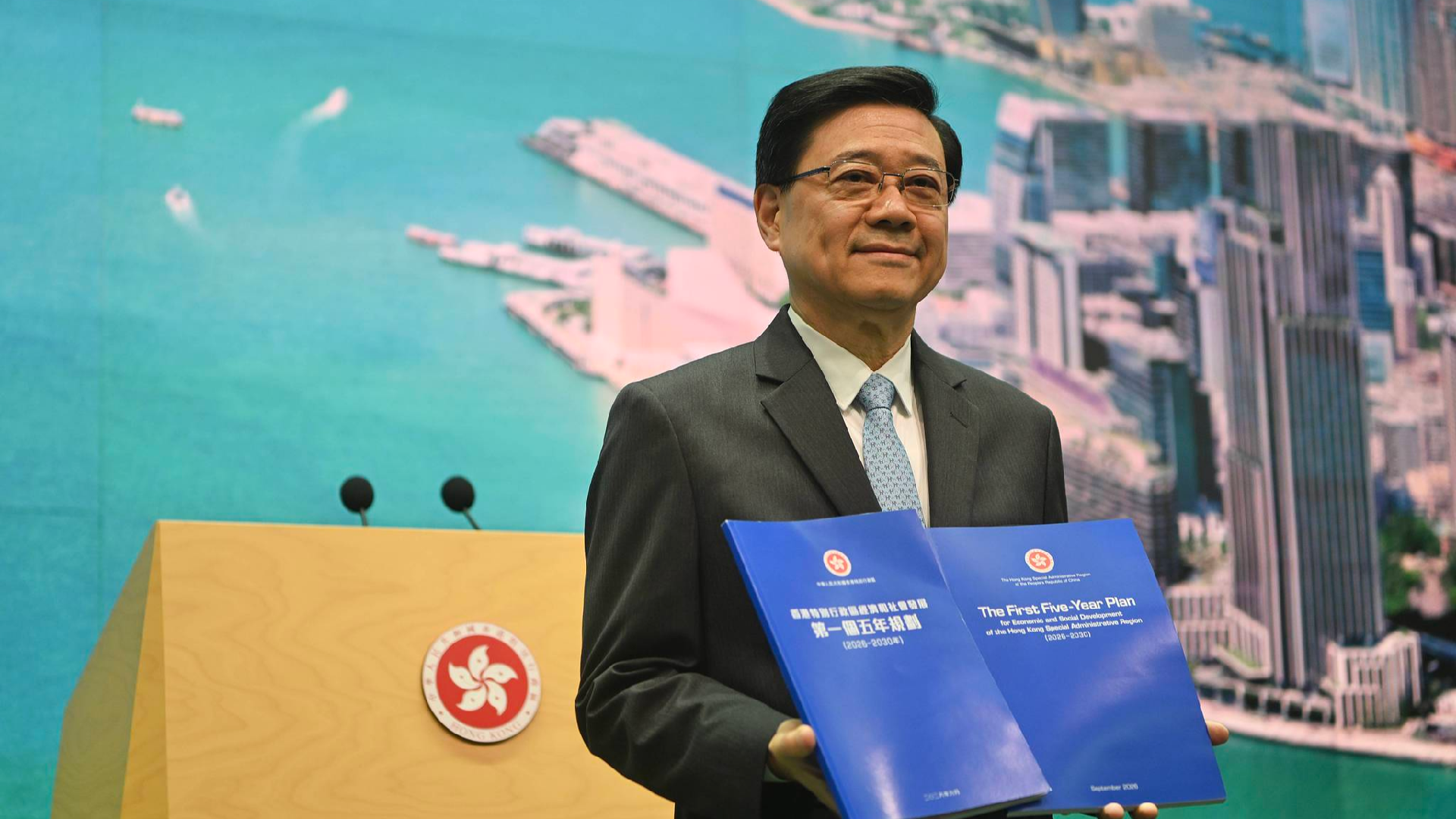
This is why the Northern Metropolis features prominently in Hong Kong's first five-year plan for economic and social development (2026-2030). The significance of the project is not only the amount of land being developed, but the way development itself is being reconsidered.
Hong Kong Special Administrative Region Chief Executive John Lee to deliver the city's first five-year development plan and annual policy address, on September 16, 2026. /VCG
For decades, Hong Kong's urban growth has been shaped by limited land supply and a highly developed city environment. Under traditional approaches, land parcels are often developed separately, with housing, commercial activity, transport links, and community facilities delivered through different processes and timelines.
The "area-based development" model introduced for the Northern Metropolis aims to change that pattern.
Instead of dividing a large site into separate pieces, the model brings together different functions — including housing, industry, and public facilities — under one integrated development framework. A single consortium takes responsibility for overall planning and construction, allowing different parts of a community to be developed in coordination rather than in isolation.
The idea is simple: a city is not built from individual buildings alone, but from the relationship between where people live, where they work, and how they move.
Construction of Hung Shui Kiu Station on the MTR Tuen Ma Line is underway in the Hong Kong Special Administrative Region, China, on August 5, 2026. /VCG
The first pilot project in the Hung Shui Kiu & Ha Tsuen New Development Area provides an early test of this approach.
A consortium involving China Overseas, China Merchants Land, China Resources Land (Overseas), China Travel Group Investment and Operation, JD.com, and Sino Land Company secured the project, which combines logistics facilities, residential development, retail services, and public recreational spaces.
With an estimated investment of about HK$16.8 billion ($2.14 billion), the project is expected to deliver more than 3,000 residential units and create jobs through construction, operations, and related industries.
But the broader significance lies in the type of economic activity the project seeks to support.
Hong Kong has long been recognized as an international financial and trading centre, but the city is also looking to expand its capabilities in areas such as innovation, technology, and modern logistics. The Hung Shui Kiu project reflects this shift by placing industrial functions alongside residential and community development.
Its proximity to Shenzhen Bay Port also highlights another dimension of the Northern Metropolis: connectivity.
An aerial view shows construction progress at the Fanling North New Development Area in the Hong Kong Special Administrative Region, China, on September 10, 2026. /VCG
As Hong Kong becomes more closely linked with the Guangdong-Hong Kong-Macao Greater Bay Area, locations near the boundary with Shenzhen are gaining new strategic importance. Logistics networks, technology industries, and talent flows increasingly operate across regional boundaries, creating demand for new forms of urban planning.
Sustainability is another part of the development approach, with the project incorporating measures such as renewable energy applications, rainwater recycling, and waste reduction initiatives. However, the long-term success of the Northern Metropolis will depend less on the ambition of its blueprint and more on execution.
Large-scale urban transformation requires coordination between government planning, private investment, infrastructure delivery, and community needs. The challenge is not simply constructing new buildings, but creating an environment where economic activity and quality of life develop together.
For Hong Kong, the Northern Metropolis is therefore more than a new development area. It is an experiment in how a mature city can rethink growth when traditional expansion models face new constraints.
Whether this approach becomes a lasting model for urban development will ultimately be judged by results on the ground. The Northern Metropolis is moving from vision to implementation — and that transition will be the real test.


