Hearing-impaired girl’s doctor dream, a stethoscope question, a tech answer - The Indian Express
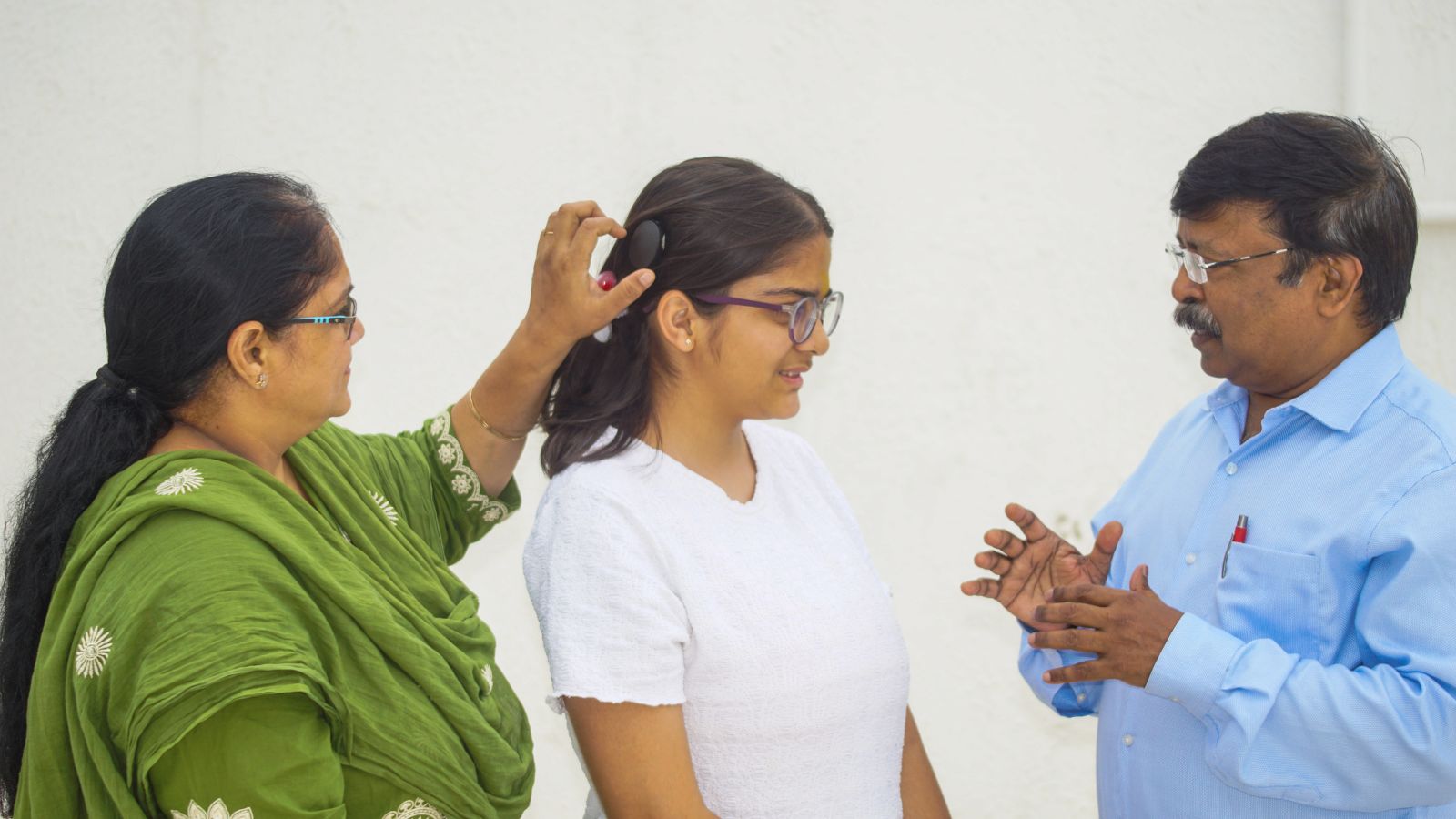
For each of the 22 lakh candidates who took the NEET exam in May, the cancellation over a suspected paper leak was a massive blow. Among them was 17-year-old Vidhita Gupta; the development threatened her long-cherished dream, seen despite unimaginable odds. Born with congenital hearing loss, Vidhita was sure of a good score in the May test. She wondered: What if I cannot repeat it in the re-test?
But she did. Vidhita recently got admission to MP Shah Government Medical College in Gujarat’s Jamnagar. She is sure she would have ranked better in the May exam.
“I waited for the NEET result, but it never came. I was very disappointed and didn’t know what to do. I started looking at options such as nursing and physiotherapy and BSc. Then re-NEET happened. I was unhappy about the result because I believe I would have scored higher the first time,” said Vidhita, who wrote her tests in Gujarati.
Vidhita’s dream to become a doctor faced a practical question. How will she use a stethoscope? She came to accept that the image of a doctor she grew up with would not be hers. But technology had an answer.
Vidhita uses a cochlear implant. She cannot hear with her ears, so she cannot use a conventional stethoscope. But a cochlear implant connected to a wireless stethoscope would help her keep up with her peers in medical college and in building a career.
ENT surgeon Dr Rajesh Vishwakarma, who implanted the device in 2013, said he has been monitoring Vidhita’s progress. “Cochlear implants can be said to give a new life to patients. The day these implants are activated, patients can hear; then they learn to speak, get a normal education and are integrated into the mainstream from a very young age. With the advances in technology, the addition of Bluetooth to these devices enables patients to use phones and now even stethoscopes, making them more independent and able to pursue goals in life,” he said.
Vidhita got her cochlear implant at the age of four. Since then, she wears two units – an over-the-ear device and a head implant. This helped her hear, but led to other problems. Vidhita says she faced “isolation” at every school she changed because of her father’s transferable job as a judicial officer, and this made her shy.
Her mother, Meena, said that a student even pulled the audio processor unit one day. All of this, coupled with her father’s frequent transfers, made it immensely difficult for Vidhita to make friends. Vidhita said it was only in Class 12 that she found peers who treated her well.
Vidhita’s mother, who is helping her pack for college, told The Indian Express, “We first realised that Vidhita couldn’t hear when we went to get her vaccination shots. The doctor there informed us that she possibly couldn’t hear and that we should get it checked immediately.”
“While we were first taken aback, we soon accepted the situation after audiometry tests confirmed her condition, and then we began looking for solutions. We initially used a hearing aid for her,” she said.
Her father, Harish Gupta, said that they first consulted a friend, Dr Bhavesh Mehta, at the ENT Department at Jamnagar Civil Hospital, and then Dr Bhavin Parikh, who suggested the cochlear implant.
The family spent the next five years taking Vidhita to speech therapists.
While Guptas’ mother tongue is Hindi, Vidhita has studied in Gujarati medium. Her father said, “We took a conscious decision to enrol her in Gujarati medium because it is the dominant language in the state, and we thought that even in English language schools, most communication takes place in Gujarati outside class. It is better to give her a common language rather than English or Hindi, which she could learn later.”
Vidhita is now focused on the new phase of her life. She has not decided on a specialisation yet, but that choice is half a decade away.
A cochlear implant has two parts. One is the implant – the receiver stimulator, which has to be surgically placed inside the skull vault, just above and behind the ear. The second part is the speech processor unit that goes over the ear.
With advances in this technology, expensive versions with Bluetooth and other features have reduced the size of the audio processor to about one and a half inches. This is magnetised and can be directly placed over the implant point without any support. In fact, some models even have wireless charging. Vidhita recently got one of these new models in black, which is covered by her hair, making it invisible.
Notably, government-funded cochlear implants in Gujarat became available starting December 2013 under the School Health Programme, under which children are screened for basic medical conditions and advised on management. In August 2024, the Gujarat government decided to provide a one-time free replacement of speech processing units for children previously implanted with these devices under the Programme.
Brendan Dabhi works with The Indian Express, focusing his comprehensive reporting primarily on Gujarat. He covers the region's most critical social, legal, and administrative sectors, notably specializing at the intersection of health, social justice, and disasters. Expertise Health and Public Policy: He has deep expertise in healthcare issues, including rare diseases, Antimicrobial Resistance (AMR), the complex logistics of organ transplants, and public health challenges like drug-resistant TB and heat health surveillance. His on-ground reporting during the COVID-19 pandemic and Mucormycosis was critical in exposing healthcare challenges faced by marginalized communities in Gujarat. Social Justice and Legal Administration: He reports on the functioning of the legal and police system, including the impact of judicial philosophy, forensics and crucial administrative reforms (. He covers major surveillance and crackdown exercises by the Gujarat police and security on the international border. Disaster and Crisis Management: His work closely tracks how government and civic bodies respond to large-scale crises, providing essential coverage on the human and administrative fallout of disasters including cyclones, floods, conflict, major fires and reported extensively on the AI 171 crash in Ahmedabad. Civic Infrastructure and Governance: Provides timely reports on critical civic failures, including large scale infrastructure projects by the railways and civic bodies, as well as the enforcement of municipal regulations and their impact on residents and heritage. ... Read More