
H.E.R. and Liza Soberano on 'Forgotten Island,' Philippine folklore, and their new song 'BRB' - GMA Network
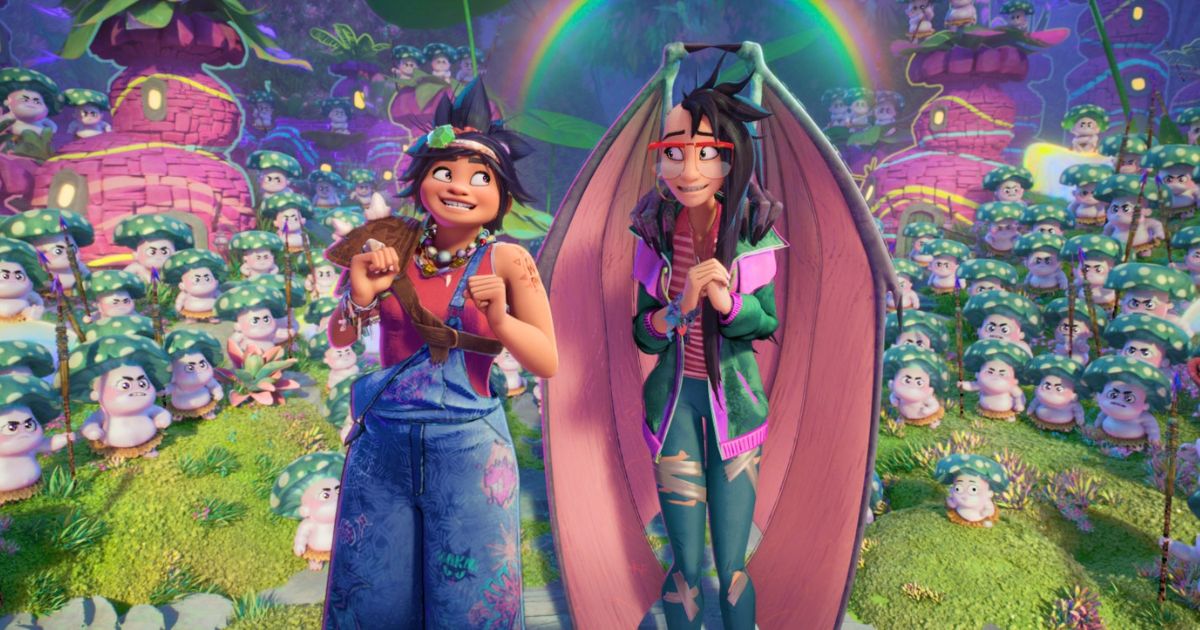
It was an absolute joy to watch the love letter to the Philippines of filmmakers Januel Mercado and Joel Crawford, the DreamWorks animation "Forgotten Island."
They were able to capture every little nuance, culture, and mythology that you can squeeze into the 108 minutes. We got goosebumps when we saw an advance screening of the movie in early August.
They captured everything from the party regular scenes of karaoke and lechon, the Titas using their pursed lips to point to something, the popular Christ image staring at you, the jeepney, the accents, the humor of the Lola, and of course, the mythological creatures of the duwendes, the manananggal, the aswang, the kapre, among others.
We actually found out about this project early on during the "Puss in Boots: The Last Wish" (2022) days of Crawford and Mercado when they teased to us that they were working on something about Philippine culture and mythology.
The talented filmmakers are also best friends since they have been working on several DreamWorks projects all these years. They finish each other's sentences, and they heartily laugh at each other's jokes. They treat each other like family.
Similarly, the movie spotlights the friendship of Jo (H.E.R.) and Raissa (Liza Soberano). Two childhood friends whose relationship is tested when one of them has to leave to go to the US for college.
Others in the cast includes Dave Franco (Raww, a were-aspin), Manny Jacinto (Bungi, a Tiyanak), Jenny Slate (Batiba, a Batibat), Lea Salonga (Manang, the dreaded Manananggal), Dolly de Leon (Lola Fatima, Jo's grandmother), Jo Koy (Datu, a Kapre), Ronny Chieng (Truffle Wuffle, King of the Duwende people), Kevin McCann (Mermahn, Prince of Kataw people), Amielynn Abellera (Raissa's mother), and Sophia Laforteza of Katseye.
We were able to talk to H.E.R., Liza Soberano, Dave Franco, Manny Jacinto, Jenny Slate, and the filmmakers Joel Crawford and Januel Mercado in exclusive interviews and a global press conference. They shared more about their journey in making the film.
Do you have an experience with Philippine folklore and mythology? Were you aware of it?
H.E.R.: Some of it I heard about when I was a kid, but I didn't know about them, and I was very excited to learn about it. They're now my favorite. And when I saw them animated in this film, I loved them even more.
Liza: For me, I grew up hearing about them here in the States. And then when I moved to the Philippines, I heard even more about all these aswangs. I think the only one that was kind of new to me was Batibat. But I forgot what word it's derived from. But it's like a Cebuano or Bisaya type of mythological creature. But that one was good.
Dave: But what's exciting is to think about, like, audiences coming into this who know nothing about it, and you're just transported to this world, these incredible creatures, some of them very funny, some scary, some just kind of strange. It's just a part of the world that a lot of people haven't seen before and experiencing them for the first time.
You mentioned Batiba and she's asking for a precious memory from each one of you. What would be your precious memory?
H.E.R.: Oh, my precious memory. Well, right now, honestly, my most precious memory is our time in Manila. I like that. That was really special. We got to run together and ride a tricycle and have amazing food. We had our dirty ice cream. That was a special time.
Liza: I would say the same thing because it's been a while since I've been back to Manila and to be back to Manila to celebrate this film and what it means to be Filipino was such a special and surreal moment, and I never want to forget that feeling.
Dave: What comes to mind is my wedding day. Both my wife nor I put huge importance on having a big, lavish wedding or anything. We were like, okay, if we're gonna do this, let's do it our way. And so, we just had a little pizza party and invited like 50 of our closest friends. It was very low-key. And it was like a room full of people that we really wanted to be there. So everywhere I turned, I just saw someone who I just adore, and it was a really special time.
You mentioned your trip to the Philippines. What would you have done if you had more time?
H.E.R.: Oh gosh. I would have gone to my mom's hometown because my mom is from Cabanatuan City, and I learned a little bit about history about her school because I posted a picture of me wearing her school shirt. And so, a lot of people were so excited. And she taught me about my great-grandparents and how they went there. And my grandma taught there. And so, I would have wanted to learn more history in my mom's hometown.
Liza: I would have probably passed by the beach if I had more time. I didn't get the chance to then. But yeah, whenever I'm in Manila, it's always essential for me to go outside of Manila.
Liza: Literally in the world. The water is amazing. Like, we don't get enough promotions on our islands, but we have the best. Maybe that's a good thing.
Dave: I would have followed them. I would have been like; you guys are my guides.. You're my island guides. I will just follow your lead.
What drew you to the project as performers?
H.E.R.: The fact that it was Filipino. But also, beyond the things that are in the movie, just meeting Joel and Januel was enough for me to be like, "I want to be a part of whatever they're making," because clearly, they put their hearts into it, and they're best friends, and you can just feel their passion and their joy and love for animation, and the culture. So, it was two of the most important things to me - the culture I grew up in and come from, and animation.
Liza: For me, the same thing as Gabi, it's the fact that it's a Filipino culture-centered story. But also, in particular, just the journey that Raissa has to go through is something that I really resonated with, because I was also going through the same thing in my personal life when I got the script. And so, I immediately knew that I had a personal connection to the story. And also, the fact that it's a DreamWorks Animation.
Dave: The first time I met the Joel and Januel, they were pitching me this movie by referencing the structure of "The Hangover" and the friendship themes in "Superbad," and other themes from the film "Eternal Sunshine of the Spotless Mind." And I was like, "These are three of my favorite films ever." And I just immediately recognized our sensibilities were very similar, and I was just excited to dive in and just do something that felt not only just wildly unique, but from the beginning it was like, "Oh, this is the first big-budget studio film that's focused on Filipino culture." And that in itself is a hugely important thing. And so just to be a small part of that, feel was a no-brainer to me.
Jenny: I remember meeting Joel and Januel a few years ago when our films were nominated for Oscars. We did not win, neither one of us won. But seeing these guys around and being like, "Wow, what nice people." It's sort of similar to Dave's experience when they came with the project, I was really excited by the fact that the story was completely relatable in terms of a human experience. There was not one thing that was like, "Oh, it's like that." It was a completely new narrative landscape, and one that also really involves such a high-pigment emotion and emotional expression. And that's the kinda thing that really draws me in, and if you're a fan of animation the way that I am- just a hardcore fan, love it so much- it's really exciting to be part of truly original stories. And then to have them be like, "And you play kind of a weirdo," it's like, "Yes, I think I can do that for you."
Manny: I had my doubts at first, but Joel and Januel, they actually gave a great presentation when they pitched this movie to me. They had taglines and everything; it's like I was hanging out with my old high school friends, and it wasn't like work whatsoever. It was just super fun. It was the first time I had been in a meeting, I didn't feel nervous, and they just welcomed me with open arms. I just knew from that energy that it was gonna be a good time. So that's what hooked me on. And they asked me to play a giant demon. That's the other hook. Couldn't say no.
Lisa and Gabi, what do you hope people who have been to many countries around the world but have never been to the Philippines, what do you hope they're gonna learn about Philippine culture that seems to be obvious maybe for all of you in the movie, but was not obvious to them? Is there something very specific that you can talk about?
H.E.R.: Oh, that's such a great question. There are so many specific things in the movie. Honestly, I love Lola's relationship with Jo and Raissa, and how she just encourages them to experience adventure and be curious and not go against the grain. Like, be yourself and believe in something. And I hope that parents, Filipino or not, will take that from this story and how anybody can be family. I think that's a big part of Filipino culture.
What about the gorgeous locations? Or the food?
H.E.R.: Oh, yeah. Oh my gosh. The food is amazing. There's the karaoke, There's so much.
Liza: The islands. Like you had Palawan, Siargao; there are so many beautiful tropical islands in the Philippines that are perfect for whatever type of traveler you are, whether you're adventurous or you just want to chill. But I think the biggest thing for me personally that, like parents can take away that I think they can instill in their children is the Filipino heart and love for hospitality. No matter where Filipinos go in the world, we're able to bring people in, whether they're family or not, invite them and make them feel at home and feel like they are part of the family. And yeah, the Filipino heart is just so beautiful and so nurturing and hospitable.
Liza, you have talked about how you drew on your own experience of leaving the Philippines. When you were recording, what were some of the more emotional scenes between Raissa and Jo did you draw on?
Liza: My personal life, at the time when I had gotten the audition, was very parallel to what Raissa was going through at the time. She was about to leave the Philippines to go to college in America. And I just left the Philippines and migrated back to America to pursue a career over here. So that connection is to understand what it takes to leave home to pursue your dream but also to be scared that you might feel disconnected with the people that you've left behind.
How did you first meet your close friend, and what memory of your friends comes to mind most strongly right now? And what kind of time have you spent together recently?
H.E.R.: My best friend and I became best friends when we were in the third grade. I was eight years old; she was eight years old. And we were huge fans of Cheetah Girls, the Disney group. And we formed our own Cheetah Girls. And one of the girls that I was really good friends with at the time was trying to kick out one girl out of the group. And I was like, "Hey, she can be a Cheetah Girl, too!"
And we became best friends ever since then. So, since we were eight years old, I fought for her, and she's been fighting for me throughout the years. And similarly to you, she's kind of like my guardian angel. Every time I've gone through something, like, crazy or intense in my life, she just so happens to be there. It's really magical, like, we're supposed to be best friends' kind of a thing that keeps happening. It's been like 20 years, and we've been best friends. And more recently, we both lived in the same city, so we both live in New York, and I get to see her more often, and it's really nice. We're making new memories all the time now.
So, they say, "The island takes memories away from its characters." Was there a memory from your own life or a friendship that unexpectedly found its way into your performance or into the film?"
Liza: The scene where Lola, like the montage of Lola, Jo, and Raissa. I grew up with my grandparents, they adopted me. And so, I just remember growing up and hearing all these stories, them telling me about the manananggal and all these mythological creatures, because that was the only way that they could share my culture with me, too, growing up. And so, I have these very vivid memories of me and my brother at my Lola's house while we were babysitting her, because she was at a care home at the time. And her scaring us, telling us all these stories of duwende, and aswang, and manananggal. And my brother and I were holding flashlights and scaring her, and then her getting her slippers and throwing her slippers and throwing them at us. When we were recording those scenes, when I got to see it, that's what I remembered.
Jenny: Not wanting to give too much away, but Batiba being both friendly and afraid of the world at large actually is kind of a central experience for me. Like, not at all being perceived as shy or trying to feel out the room, like maybe a bit socially anxious, but also coming off as like friendly and peppy, both things happening at once. But especially, there's a moment where Batiba receives a BRB sticky note. I remember leaving a recording just thinking about my middle school experiences and being the girl with not just braces, but insane braces, like weird, invented braces just for me that were so embarrassing.
And being the one that, "You know, just wait there." We'll be right back," and people getting ditched as a seventh grader, and just like that! It's not just embarrassing. You take it as a definitive gesture. Maybe this is something that will repeatedly happen to me. And it can also create behaviors in a person, where if you believe in the worst thing that occurs as a characteristic of your experience, it can also create maybe your worst behaviors. And I really thought a lot about that.
I think about that for my own daughter; watching the movie is, like, looking back at who you are and what you have and what your memories are and deciding how to behave based on what you take in. Those moments of Batiba really feeling her aloneness were just tiny little spikes of agony for me. No, I'm still connected to those moments, and I liked being able to add that to the performance because it also helps Batiba be a well-rounded creature.
Dave: Jenny helped trigger something in me. I think whether I like to believe it or not, I am very similar to the character of Raww. I think in certain scenarios, I can maybe come off more confident than I naturally am, like in press. I have this real strong loyalty to the people I love. Deep down I am an introvert, and what I really want to do is just be at home in my bed with my wife and my two cats watching a documentary.
I've just created this small circle of really close people in my life. It's part of the reason why I'm not on social media. It scares me. I don't want to invite negativity into my life from strangers on a daily basis. And so, I've just felt comfortable in my own little bubble, surrounded by people who I love and love me and really care about me. So, I think that is very Raww-like. And also, I grew up in Northern California where we said "hella" a lot growing up. And we threw that in there a little bit too.
H.E.R. and Liza, your music "BRB" just dropped. Can you talk more about it?
H.E.R.: Oh man, I mean, it's so exciting, I don't know where to begin. It was a fun prompt, first of all, because it was like, oh, it has to be a celebration of friendship. And the movie's set in the '90s, so it's gotta have the vibe of the late '80s, early '90s. And so, we're listening to a lot of Tears for Fears and When in Rome and INXS and just trying to nail the vibe. And I thought, why not write a song that is Jo and Raissa speaking to each other to really just bring it home? And Liza killed it. We had so much fun in the studio recording and shooting the video.
I also thought the video should be an extension of the film and the beauty of the Philippines in the film, bringing that to real life through our music video.
Liza: I just had a wonderful time being part of this. Gabi and Ryan Tedder worked on the song together, and then I was so touched when Gabi messaged me and asked me if I'd be open to coming onto the song. And the whole time I was recording I was just pinching myself because I was like, "What am I even doing here? What am I doing witnessing Gabi and Ryan Tedder just make art?" But I felt very honored and blessed to be part of the song.
Manny, Tiyanak Bungi is a very fun character. You grew up in Canada. I wanted to ask you, how did your Pinoy parents expose you to the culture?
Manny: They still spoke in Tagalog at home, and obviously all the food that my mom cooked was always Filipino. I'd always come home from school eating adobo or kare kare or sinigang, and it always made me feel connected to the culture that way. As I grew up, I definitely appreciated it more and more. They're big supporters and fans, so just having them by my side has meant the world. They've always made sure to keep a strong connection to the Philippines, especially since I have family still there. But they always made it feel, still like I'm a part of the Filipino culture at home.
Congratulations guys, on your love letter to the Philippines. So, I want to know did you have a test audience for this before you put it out there? Like a Filipino audience or staff who would recommend what cultural details should be included in the movie?
Joel: We did a research trip to the Philippines that was super informative. Both in the looks and the tangible aspects of the Philippines. But it was especially the heart of the movie and the heart of Filipinos that was one of the really amazing things to experience.
Januel: One of our first screenings, we did have internally a group of Filipino employees at DreamWorks Universal. And then we regrouped with notes. And to your point, just the reaction that we're getting now, where people were just so touched already to be represented in such a detailed and epic way.
We love the use of the Baybayin script in it and love that the kapre tree people had them. What did the Baybayin say on their bodies?
Joel: Oh, the ones on Kapre, on Datu, the one played by Jo Koy. Some of our artists who were in the art department are working in the Philippines. And so all of that they studied, they would put in there and make sure it's accurate. And also, we have Kirby Araullo, who's our cultural consultant…everybody's looking out I know.
And when you decide on the voice acting, do you have the actors in mind already when you're writing the script?
Januel: We had H.E.R. in mind from the beginning. And we like cemented that and were able to sell the idea to everyone because when you think H.E.R., it's like, oh, she's like a cool musician. Like, can she voice act? But we saw her interview with Vogue Philippines. She was just eating Sky Flakes and going crazy and geeking out like, that's Jo right there. And then with Liza doing something else.
Joel: Liza and so much of the cast were actually very informative. As we were writing, we constantly rewrote; we improvised together. And so, we have kind of the base of the story, but we're very open to them bringing their own experience to the part. And I think that's why what you see on screen, it feels like a real relationship. It feels like real characters because they're bringing themselves to it.
I like also the sense of humor involved with Lola, Dolly de Leon.
Joel: I was going to say that Dolly is also one of the other people we had in mind. We did right with her in mind. Because we had met her a couple of years earlier, and she has this amazing ability to be so strong, so warm and kind, and so effortlessly funny. That has to be our Lola, like everyone's Lola. They are there for you, but don't mess with them either.
I like the part when she says, "Don't worry, she's gonna die one day!"
Januel: It always gets the biggest laughs in the movie.
Talk about where this project came from and how you cast these amazing performers?
Januel: Oh, yeah, we have the best cast. It's easiest for you to talk about because this is our love letter to the Philippines, to our families, and to friendship, and the value of memories. So, those are kind of the key ingredients. We joke around; it's like, that we threw together in a pot, like a pot of adobo, to create this amazing stew of a movie, that's very personal to us. Joel can talk about the cast.
Joel: Every character throughout this movie is a fantastic exploration of friendship, of connections, and memories. And so, for us, it was so important in the casting to make sure that authentically, beyond just the amazing talent as actors and actresses that authentically, you guys could all identify something that was special and unique in the performance. And every single first record we had, we were, like, blown away. And Januel and I have no poker face. We are just so touched and grateful for all of them for just bringing so much of themselves to this movie.
Januel, you've mentioned how the character of Jo was inspired by your sister Jo. Could you mention the ways in which she inspired you?
Januel: I grew up with her; she's one of my closest friends. And actually, with Joel's wife Kathy, and then Jo, like there's also traits that both Jo and Raissa, that they both inhabit. So, even though Jo is Jo, she is also the life of the party. She also has this integrity and this producer mindset like Raissa as well. But aesthetically, like the overalls, like the hair, the scrunchie, that was like my sister Jo, quintessential '90s Jo, growing up.
And then there are little details as well where it's like she- Jo has a scar on her face, my sister has a scar on her face because a puppy bit her in the face when she lifted it up, like against its will when she was a kid. There are all kinds of lovely details again where for just homage to our family. The crown that Jo wears with the emerald, that's my sister's birthstone because she's born in May; she's a Taurus. So, there are all kinds of stuff like that that we put in just to honor our families.


![[Hospital Roundup] Seoul National University Bundang Hospital Hosts Joint Symposium for Gyeonggi Province Responsible Medical Institutions, etc. - 헬스조선](https://health.chosun.com/images/icon3.png)