
Globally threatened Japanese night heron sighted in Singapore for the first time - The Straits Times
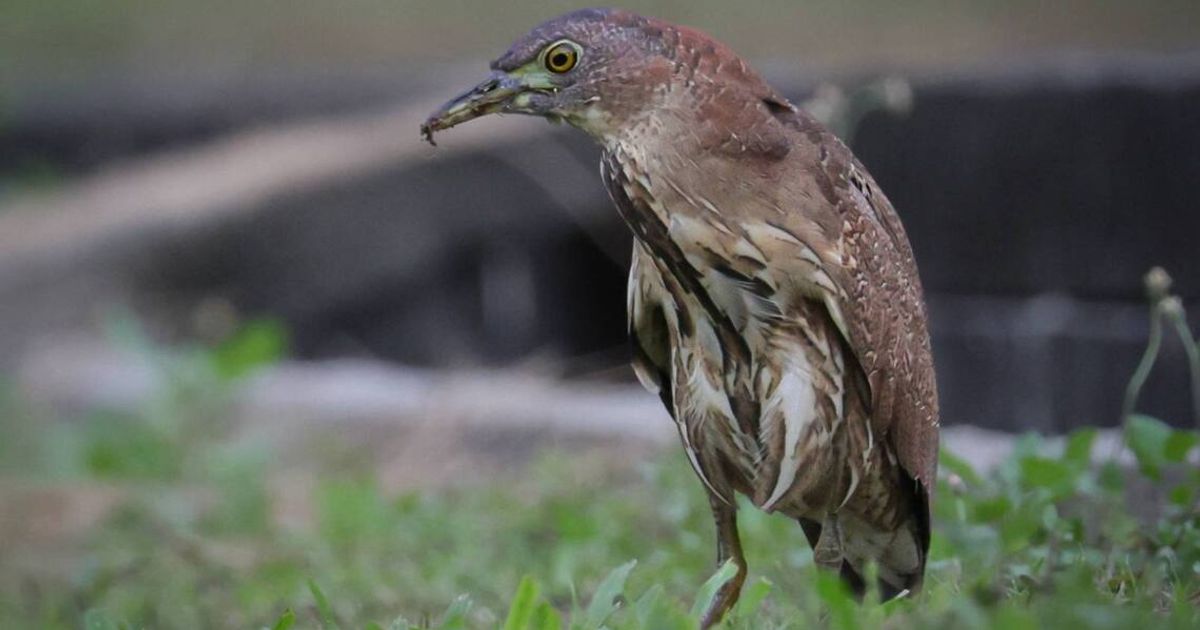
The elusive bird is a species globally threatened with extinction, whose wild population is estimated to number only several thousand individuals.
SINGAPORE – The local birding community is buzzing with excitement at the presence of a Japanese night heron (Gorsachius goisagi) in Pasir Panjang – the first record of the species not just in Singapore, but also in mainland South-east Asia.
The feathered traveller was first spotted on the morning of Nov 10 in Jalan Mat Jambol in Pasir Panjang by a Richard Clayton, said Yong Ding Li, the regional head of flyways and species conservation at BirdLife International.
Clayton uploaded a photograph of the bird on Facebook at 8am that day. After seeing the photo online, Yong rushed down to the site and managed to catch a glimpse of the bird at around 9.35am.
The elusive bird is a species globally threatened with extinction, whose wild population is estimated to number only several thousand individuals.
It breeds primarily on Japan’s main islands and South Korea’s Jeju Island.
But during the non-breeding autumn and winter months, the bird can undertake journeys of several thousand kilometres south towards the Philippines and Borneo, where it spends the winter months.
The latest sighting in Singapore also marks the first time it has been spotted on the continental portion of South-east Asia, which spans Myanmar, Thailand, Laos, Vietnam and Cambodia, said Yong.
He suggested that severe weather events in East Asia likely played a role in bringing the bird to Singapore.
For instance, a typhoon that struck South China recently could have blown the migrating bird off its usual path.
“Because they fly several thousands of kilometres to the Philippines and Borneo, it is easy for them to be blown off course, especially if there are major typhoons in the region,” Yong said.
Members of the public and photographers gather along Jalan Mat Jambol to photograph a Japanese night heron on Nov 11.
Local birdwatchers had initially suspected that the bird photographed by Clayton could be a Malayan night heron – a regular seasonal migrant expected in Singapore around this time of the year.
However, closer inspection of the photographs revealed key anatomical differences between the birds, Yong said. Having previously observed the Japanese night heron twice in Hong Kong, Yong noted that its plumage lacked the distinct white streaks, prominent barrings and dark crest typical of a Malayan night heron of a comparable age group.
“When I saw the photo at 8am, I thought the bird looked odd for a Malayan night heron,” Yong said.
Photographers taking photo of a Japanese night heron in Jalan Mat Jambol, on Nov 11.
To confirm its identity, he said he consulted bird experts across Malaysia, Hong Kong and Japan.
Local bird enthusiasts have also headed down to the site to observe the rare visitor.
Kelvin Ng, a local photographer, said he visited Jalan Mat Jambol at 8.45am on Nov 11 to photograph the bird, adding that the heron started to appear only around 9.20am.
Classified as a globally threatened species, the Japanese night heron’s total world population remains critically small due to ongoing habitat loss across its breeding areas and wintering grounds as a result of deforestation and commercial logging.
Unlike species that are accustomed to human environments, the species relies heavily on dense, damp and undisturbed forest habitats for nesting and protection, said Yong.
He noted that its stay in Singapore may be short-lived if it cannot locate suitable woodland cover to rest and feed before resuming its migration.
