Global tech policymakers agree to embrace AI in science
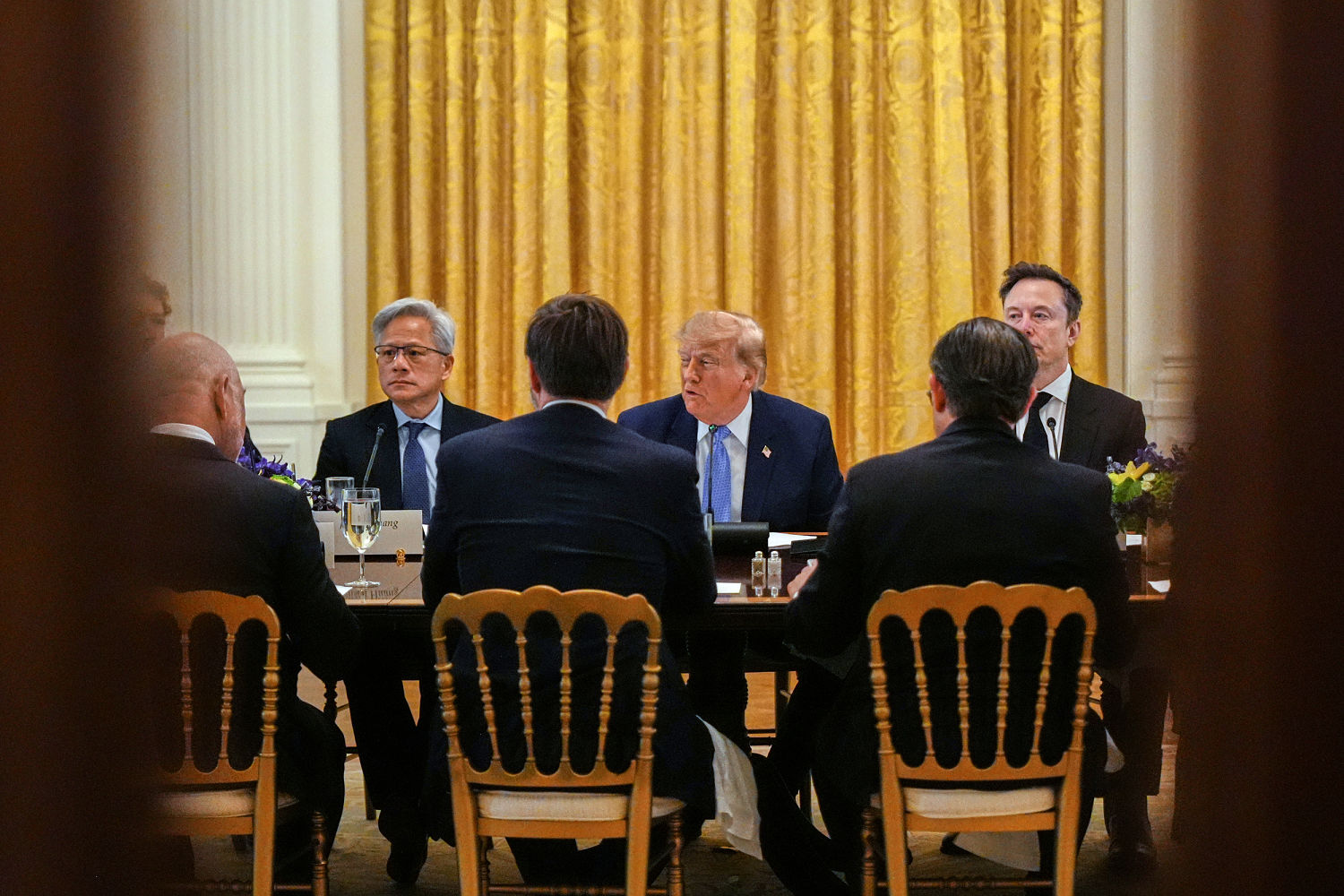
President Donald Trump speaks in the East Room of the White House on Sept. 29 during a lunch meeting with top executives of AI firms, as NVIDIA CEO Jensen Huang, left, and Elon Musk listen.Jacquelyn Martin / APShareAdd NBC News to GoogleOct. 3, 2026, 9:00 AM EDTBy Jared PerloThe United States on Sunday will release a joint statement with 15 other countries describing a shared vision for a “golden age of science” that embraces the potential of artificial intelligence.
The announcement is expected in Kyoto, Japan, at this year’s Science and Technology in Society Forum, an annual gathering of experts and policymakers that began in 2004.
The statement, titled the “Kyoto Vision for a Golden Age of Science,” begins by recognizing science and technology’s benefits to society then goes on to encourage research that integrates artificial intelligence. (The statement calls it “super intelligence,” given President Donald Trump’s recent executive order renaming the technology.)
“Super Intelligence and new ways of organizing research are opening entirely new frontiers of discovery,” reads the statement, which was seen by NBC News. “We recognize the opportunity to take advantage of these changes.”
Michael Kratsios, head of the White House’s Office of Science and Technology Policy, spearheaded the vision statement, which also says the participating countries welcome the “growing field of metascience,” a term that describes the study of the scientific process itself.
Tech ministers from Japan, Korea, the United Kingdom and the United Arab Emirates were among the representatives from other countries that endorsed the statement.
In remarks Kratsios plans to deliver at the forum, shared in advance with NBC News, he will outline a vision for an era of scientific progress in which laboratories run by robots and AI systems can design scientific experiments, iterate and analyze results at superhuman speeds.
“Super intelligence applied to science will be an incredible force for democratization of research and breakthrough developments,” he plans to say.
Leading AI companies Anthropic and OpenAI have recently launched initiatives to connect biomedical laboratories to powerful AI systems, while other companies have attempted to automate laboratories for years.
“The landscape has changed everywhere, the ground is moving beneath our feet, and we must all reinvigorate our research enterprise and lay new foundations for knowledge, innovation and prosperity,” Kratsios is expected to say in his remarks.
The vision statement also says that public trust is the bedrock of scientific innovation and progress and that there’s value in “a deliberate portfolio of funding mechanisms” for science.
The Trump administration has repeatedly attempted to make drastic cuts to federal funding for scientific research. Its proposed budget for the 2027 fiscal year would, for example, cut funding for the National Science Foundation by about half.
Gretchen Goldman, CEO of the Union of Concerned Scientists, said the administration had undermined many scientific research efforts. “They’ve shattered the trust of the American people in the way they’ve treated the U.S. science and technology enterprise,” she said, pointing in particular to cuts to the National Institutes of Health.
“It’s hard to take seriously any promises of increased trust and transparency when you look at the actions they’ve taken,” Goldman said.
The statement comes as part of a wider push by Kratsios to reform how the U.S. incentivizes scientific innovation. In July, he submitted a report to Trump recommending changes to the ways the federal government funds research. He plans to host a summit about it in Washington, D.C., on Thursday with scientific and business leaders.
FOR SUBSCRIBERSHow Trump’s strikes against Houthis foreshadowed struggles in Iran warFOR SUBSCRIBERSWalmart’s quest for market share expands with a new, bohemian fashion brandFOR SUBSCRIBERS‘It’s not enough to not rape somebody’: How parents are talking to kids about Cornell allegationsFOR SUBSCRIBERSLove is a casualty of war: How Russia’s invasion is killing Ukraine’s birthrateFOR SUBSCRIBERSHigh-profile special prosecutor takes over Cornell investigationFOR SUBSCRIBERSMore than 10,000 ICE officers to receive additional training to reduce violent encountersFOR SUBSCRIBERSKremlin critic and chess champion Garry Kasparov said FBI warned his life was in dangerFOR SUBSCRIBERSTom Cruise takes on a new mission: Selling ‘Digger’FOR SUBSCRIBERS‘I am Jane Doe’: Cornell case spurs women to share their experiences of sexual assault on campusFOR SUBSCRIBERSA sluggish Congress punts a long list of tasks until after the electionFOR SUBSCRIBERS‘Some of the medication has worn off’: Witness recalls failed Tennessee execution of Christa PikeFOR SUBSCRIBERS‘Couldn’t let all of them die’: Hero Indian pilot attacked midair speaks for first time FOR SUBSCRIBERSHow Trump’s homelessness crackdown became a sweeping retreat from disability rightsFOR SUBSCRIBERSCornell rape allegation pushes embattled New York prosecutor into national spotlightFOR SUBSCRIBERSJudge guts noncitizen voting law used in Trump administration’s election pushFor SubscribersFOR SUBSCRIBERSHow Trump’s strikes against Houthis foreshadowed struggles in Iran warFOR SUBSCRIBERSWalmart’s quest for market share expands with a new, bohemian fashion brandFOR SUBSCRIBERS‘It’s not enough to not rape somebody’: How parents are talking to kids about Cornell allegationsFOR SUBSCRIBERSLove is a casualty of war: How Russia’s invasion is killing Ukraine’s birthrateFOR SUBSCRIBERSHigh-profile special prosecutor takes over Cornell investigationFOR SUBSCRIBERSMore than 10,000 ICE officers to receive additional training to reduce violent encountersFOR SUBSCRIBERSKremlin critic and chess champion Garry Kasparov said FBI warned his life was in dangerFOR SUBSCRIBERSTom Cruise takes on a new mission: Selling ‘Digger’FOR SUBSCRIBERS‘I am Jane Doe’: Cornell case spurs women to share their experiences of sexual assault on campusFOR SUBSCRIBERSA sluggish Congress punts a long list of tasks until after the electionFOR SUBSCRIBERS‘Some of the medication has worn off’: Witness recalls failed Tennessee execution of Christa PikeFOR SUBSCRIBERS‘Couldn’t let all of them die’: Hero Indian pilot attacked midair speaks for first time FOR SUBSCRIBERSHow Trump’s homelessness crackdown became a sweeping retreat from disability rightsFOR SUBSCRIBERSCornell rape allegation pushes embattled New York prosecutor into national spotlightFOR SUBSCRIBERSJudge guts noncitizen voting law used in Trump administration’s election pushKratsios is also leading the Genesis Mission, a national effort Trump launched last year to “unleash a new age of AI‑accelerated innovation and discovery.”
The forthcoming vision statement puts a particular emphasis on metascience, an area of study that has received wider government attention in recent years.
Its prominence in the statement signals increased international adoption, according to Jenn Gustetic, director of metascience and research and development policy at the nonpartisan think tank Institute for Progress.
“Metascience efforts have built momentum in the U.K. and the U.S. and it’s encouraging to see other nations embrace this mindset of experimentation and evidence building,” Gustetic said.
In September, the National Science Foundation announced that it would establish an Office of Metascience (OMS), charged with evaluating new approaches to funding and identifying which award mechanisms lead to the best scientific outcomes.
“Through the OMS, NSF will become a learning, self-improving institution that tries new approaches, measures their effects, admits candidly when they do not work, and scales them when they succeed,” the agency’s acting director Brian Stone wrote in a letter.
The Science and Technology in Society Forum is intended as a venue for leaders to discuss how to maximize the benefits of science and address ethical and safety issues.
During the three-day gathering, scientists and policymakers from around the world are expected to discuss how AI is impacting education, how experts can foster trust in scientific research, recent breakthroughs in personalized medicine and more.
The vision statement is set to be released just days after Trump gathered the country’s leading tech executives at the White House to forge consensus on how to regulate and minimize risks from AI. The meeting culminated in the ‘White House Accord on Super Intelligence,” which laid out a four-part voluntary approach for companies to independently oversee their own safety protocols.
Kratsios participated in the AI meeting.
“If you take the risks and benefits of superintelligence seriously, the most important thing you can do is to develop your country’s ability to understand and use it,” he said at a United Nations Security Council meeting on AI last month.
Jared PerloJared Perlo is a technology reporter focused on AI for NBC News Digital.