Germany's judges seek to prevent AfD justice abuse
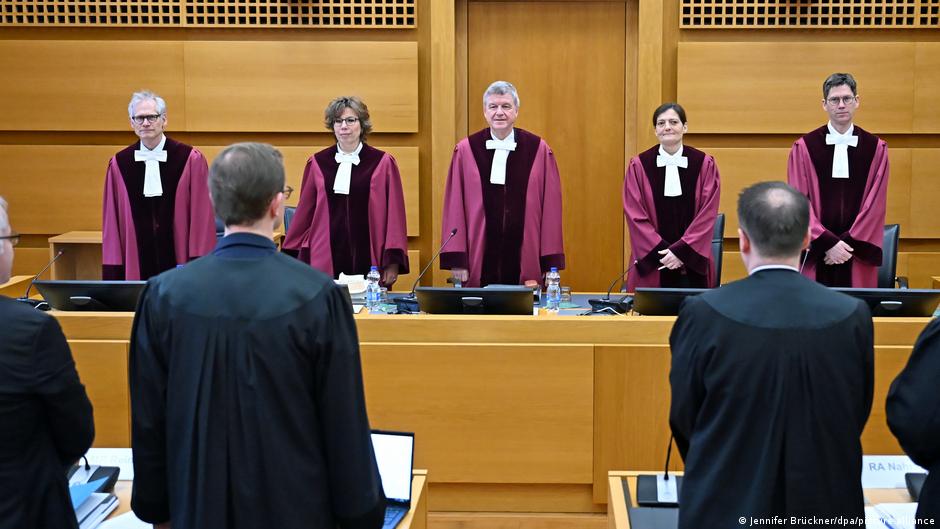
German judges want to make sure state governments cannot abuse prosecution powers to influence criminal casesImage: Jennifer Brückner/dpa/picture allianceAdvertisementThe official association of German judges, the Deutscher Richterbund (DRB), has called on the federal government to tighten up the law to stop state governments from abusing prosecution powers to potentially influence criminal cases.
The prospect of the far-right Alternative for Germany (AfD) taking over the government in Saxony-Anhalt, which appears highly likely after the party's resounding election win in early September, has raised fears that "extremists in government" could steer "criminal investigations in one direction or another through directives," according to the DRB.
The AfD, sections of which are considered a threat to the German constitutional democratic order by domestic intelligence agencies, is set to take control of a government for the first time ever in Saxony-Anhalt. This has sparked concern in the judicial system that the party could, for instance, push prosecutors away from pursuing cases against right-wing extremists.
"The top priority now is to prevent the misuse of public prosecutors' offices in Germany for partisan political purposes," DRB executive director Sven Rebehn said in a statement emailed to DW. "Currently, the law allows state justice ministries to interfere even in individual criminal proceedings. While there is a political tradition of self-restraint when issuing directives to prosecutors, this tradition can be abandoned at any time and offers no effective protection."
In Germany, unlike in many other countries, state prosecutors, along with the police, are part of the executive branch of government. This puts them under the authority of the state or federal Interior Ministries, and subject to parliamentary oversight. This dependence is seen by many constitutional lawyers as a democratic principle, as it means that prosecutors' actions can be checked by a democratically elected body. But others see it as a problem, as it opens the possibility of political influence.
German Interior Ministries, both at the federal level and in the 16 states, have the power to issue directives to prosecutors in individual cases. For instance, if some evidence has been supplied by an intelligence agency, the Interior Ministry can issue a directive to the prosecutor to keep that fact out of a court case, as disclosing it could compromise the work of the agency.
The German domestic intelligence agency, the Verfassungsschutz, which reports to the Interior Ministry, has long been a focus of the AfD's ire, as they consider it politicized. The agency is charged with keeping tabs on extremist tendencies in the country. By the same token, German Justice Ministries can make a ruling over how prosecutors interpret a certain law, or how investigations are to be pursued.
One such controversial directive was made in 2015, when the then federal Justice Minister Heiko Maas told the federal prosecutor to withdraw a report that found that state secrets had been compromised in a particular case. Maas denied that this had been the directive, and federal prosecutor Harald Range was dismissed in the ensuing power struggle.
As things stand, there is still no way to check the ministry's directives, which some see as a problem. Berlin's state prosecutor, Margarete Koppers, also has strong opinions on this point, and sees the danger as acute: "The rule of law is at risk when its rules are politically abused," a spokesperson for Koppers told DW by email. "A look at European countries that have, at various times, been under authoritarian-populist leadership — and where the structures of the rule of law were subsequently eroded — shows that this is not an unrealistic scenario." When the far-right Law and Justice (PiS) party took over in Poland, it triggered a constitutional crisis by trying to appoint judges to the constitutional court. The government of Viktor Orban in Hungary also tried to intervene in the judicial system.
Both the DRB and Koppers believe removing the ministries' right to take directives is long overdue, but others in the judicial community are not so sure.
"I can understand the fear that a sword like this in the hands of the wrong people makes the executive branch a danger," said Gül Pinar, a criminal lawyer based in Hamburg who in 2020 offered expert testimony in the Bundestag on the issue.
But Pinar agrees that reform is necessary, but mainly because ministries' directives are not documented. "The people who are affected by the criminal procedures don't know that certain actions taken by the prosecutors stem from a directive, from the government, or the federal prosecutors, or the Interior Ministry," she told DW.
But if the directives were documented, Pinar argued, it would be possible for lawyers to examine whether they were legally sound, or whether they overstepped their authority. "We have to insert new mechanisms to check what is happening," she said.
"But the solution is not to make the state prosecutors independent," she underlined. Hardly anyone in the judiciary, Pinar said, doubts that the right to issue instructions stems from the principle of democracy. But she added that there were many voices, particularly amongst judges and public prosecutors, who advocate for an independent public prosecution service.
For its part, the current federal government has not shown any inclination to change the law. In a statement to the Legal Tribune Online, the Federal Justice Ministry said that the current laws provided plenty of safeguards: Ministries are prohibited from issuing "unlawful" directives, and prosecutors from following them.
In fact, the ministry said, keeping prosecutors as part of the executive branch was important, because it meant that they were more accountable and subject to parliamentary oversight.
The relatively unique position of Germany's state prosecutors has come up at the European level before: In 2019, the European Court of Justice warned that European arrest warrants could be compromised by political influence because German state prosecutors were not independent enough — while European arrest warrants are supposed to be issued by state prosecutors, in Germany, only judges are allowed issue them.
According to Pinar, allowing state prosecutors to issue arrest warrants is "not compatible with our legal system." In fact, she thinks the German system safeguards more civil freedoms: "In Germany, withdrawing someone's freedom is always under the authority of the judge," she said. "I think it would better if other countries adapted their systems to ours, so that the executive branch can decide on the freedom, but was under a judge's authority."