Gaza: NGO reports dire camp conditions, says Israel is moving 'Yellow Line'
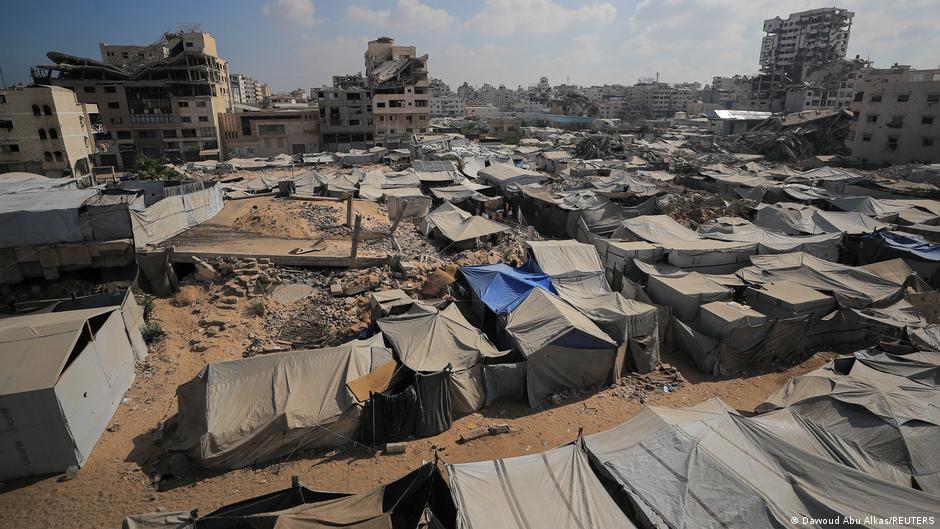
With much of Gaza either severely damaged or behind Israel's 'Yellow Line,' more than 80% of residents are estimated to be living in makeshift displacement campsImage: Dawoud Abu Alkas/REUTERSAdvertisementA new report on conditions in the Gaza Strip says that the roughly 1.8 million Palestinians in Gaza, or 86% of the population, living in displacement sites often face inhumane living conditions.
The Danish Refugee Council (DRC) published its findings on Thursday, almost three years after the October 7 terror attacks against Israel that triggered the war in Gaza, and a year after the phased October 10 ceasefire plan that was supposed to usher in the war's end.
"The October 2025 ceasefire in Gaza was supposed to end civilians' suffering. Nearly a year on, it exists largely in name only. Displacement in Gaza has not ended; it has changed shape," the report says.
The findings are based on group discussions with 195 people living in internal displacement camps across five governorates in Gaza.
Entitled "Confined by Design: The Human Cost of Protracted Displacement in Gaza," the report accuses Israel of "a policy of protracted displacement" since the ceasefire deal was reached.
One means of ensuring this, the DRC says, is the so-called "Yellow Line," which demarcates the area of eastern Gaza near the border that is controlled by the Israeli military and is, according to the report, creeping toward the coast.
"In addition to protracted displacement for hundreds of thousands of people, the defining feature of the so-called ceasefire is the Yellow Line which continues expanding westward and swallowing up more land, effectively squeezing families into 30% of Gaza's territory," said the NGO's country director for the occupied Palestinian territories, Alan Moseley.
Other groups, including the UN, have also reported the westward movement of the Yellow Line, as has the Israeli government, although some details differ.
Last month, Israeli Prime Minister Benjamin Netanyahu put the share of Gaza's territory inside the Yellow Line at 60% rather than 70%, but he also said the plan was to expand the area.
The DRC report also said aid organizations "describe being unable to operate within several kilometers of the line, either due to access constraints or security concerns."
It said that this led to crucial aid and supplies failing to reach displacement camps nearer the boundary.
The DRC and the Agricultural Development Association (PARC) highlighted a series of major shortcomings in the often informal tent shelters and makeshift camps that have sprung up amid Gaza's rubble, where more than eight in 10 residents are believed to be living.
The Danish Refugee Council also laid particular emphasis on lacking site management mechanisms at displacement camps.
It said only 36% of sites currently had a designated site manager, typically a national NGO, coordinating services and managing conditions.
Sites with such partners "have a structured community channel through which a gap, such as a collapsing cesspit, a missing water delivery, or an unsafe walkway, can be identified, escalated, and resolved," the report said.
Israel has not yet commented on the newly released report.
The DRC and PARC issued a number of appeals and recommendations, some to "all parties to the conflict," most to "the Government of Israel, as the occupying power of Gaza" and others to "the international community" and "donors and humanitarian actors."
The groups called on Israel to "halt the further expansion of the Yellow Line" and to "disclose its current and future route transparently."
They also urged Israel to cease the construction of permanent military infrastructure in the area and to provide "credible assurance that current troop positions are not intended to be permanent."
They appealed for fewer restrictions on aid access, particularly so-called "dual-use" restrictions affecting medical supplies, water, sanitation and hygiene items, pest control, rubble removal and fuel.
The report also warned that political and donor interest in the situation had declined markedly in the year since the ceasefire, even though conditions had not improved proportionately.
If you rely on our team for trusted reporting, please take a moment to select us as your Preferred Source on Google, so you'll always see our verified news first.